(This biography was excerpted from Lev Ginsburg's Volume 3 of "The Art of the Violoncello" pp. 561–564, translated by Yuriy Leonovich).
The Concerto Elegiaco for Cello and Orchestra (Op. 11, B minor) by Andrejs Jurjāns, composed in 1889, is one of the very few cello concertos written by composers from our country during the period in question. As previously noted, this work is likely the first example of the concerto genre in Latvian music.
In this piece, the composer’s love for his native Latvian folklore is evident, along with the classical traditions of the Russian school, which he absorbed during his studies with N. A. Rimsky-Korsakov at the St. Petersburg Conservatory, from which he graduated in composition in 1881.
In 1882, Jurjāns settled in Kharkiv, where he taught for many years at the RMO Music School. He dedicated his concerto to A. E. Glehn, a student of Karl Davydov. The concerto, published by Jurgenson in 1912 with this dedication, was first performed in Kharkiv by Glehn in 1889, the year it was written. Glehn had also been working at the Kharkiv school since 1884.
Contemporary Latvian musicologist O. Grāvītis ranks Jurjāns's Elegiac Concerto among the composer’s finest works, noting its foundation in “folk-song intonations, motifs, and sometimes entire folk melodies.”
The title, Concerto elegiaco, reflects the poetic and emotional tone of the work, which demonstrates a deep understanding of the cello’s expressive potential.
In the exposition and recapitulation of the first movement, the tonalities (E minor - A minor, and E minor - E major) adhere to the classical style. The uniqueness of the form lies in the development of each theme (especially the first) following its initial presentation.
After a majestic and concise introduction, an expressive cello recitative leads into the main body of the first movement:
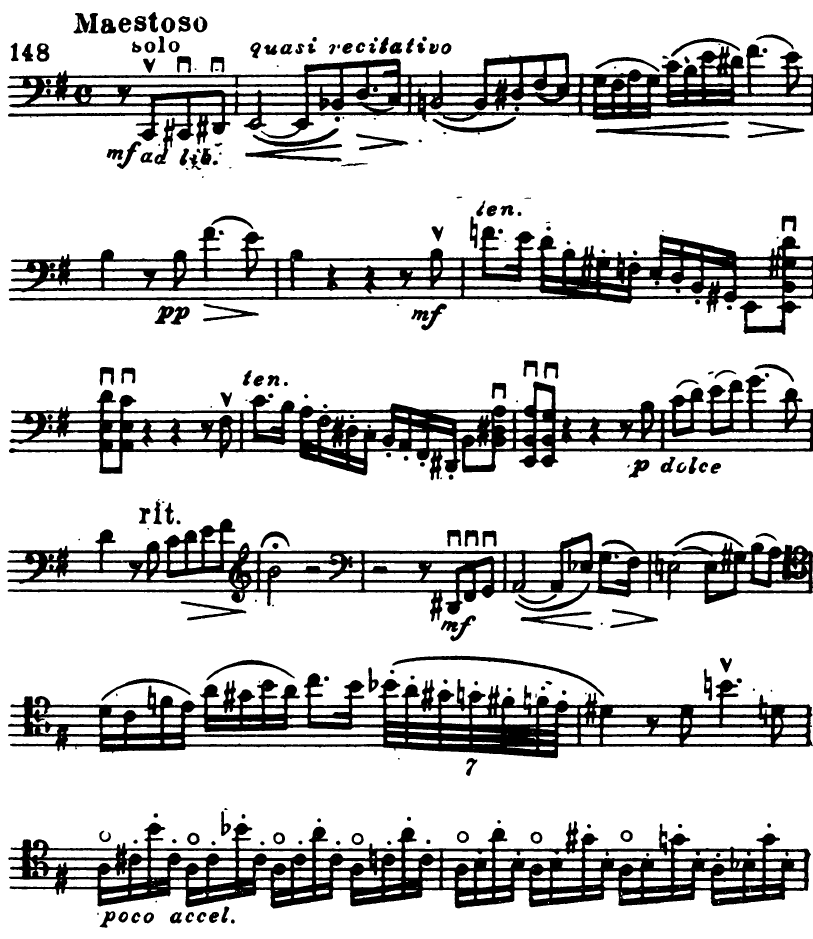
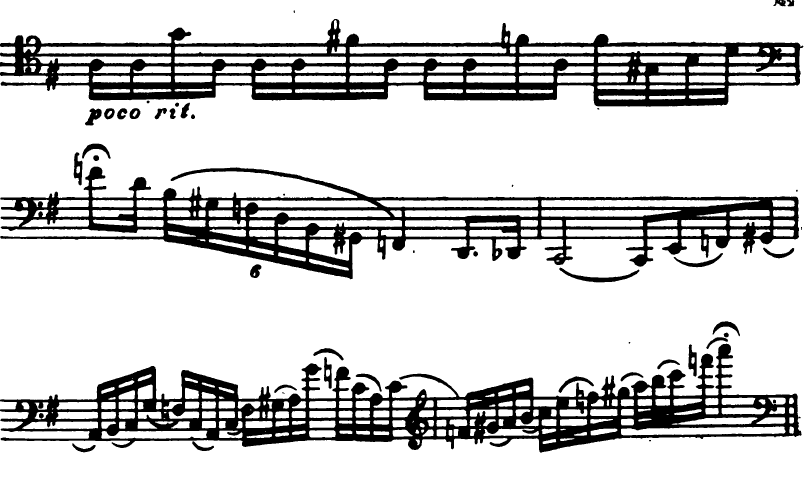
Both themes are melodic and contrast primarily in mode and mood:
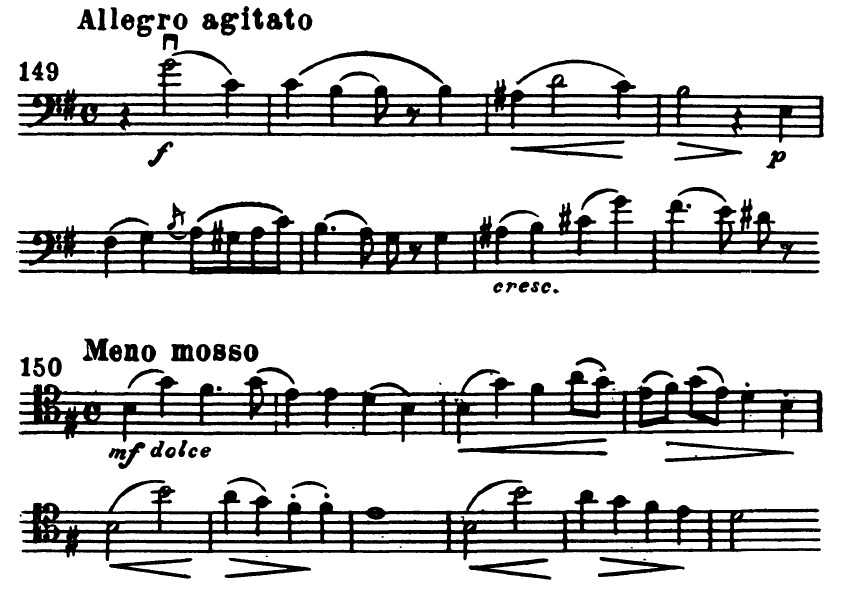
The lyrical and calmer secondary theme has a distinctive tonal character that underscores its folkloric roots; it is based on the Latvian folk song "Kā tu raudi, kas tev kait" (“Why are you crying, what’s wrong with you?”). This passage also includes another cello recitative interspersed with the secondary theme:
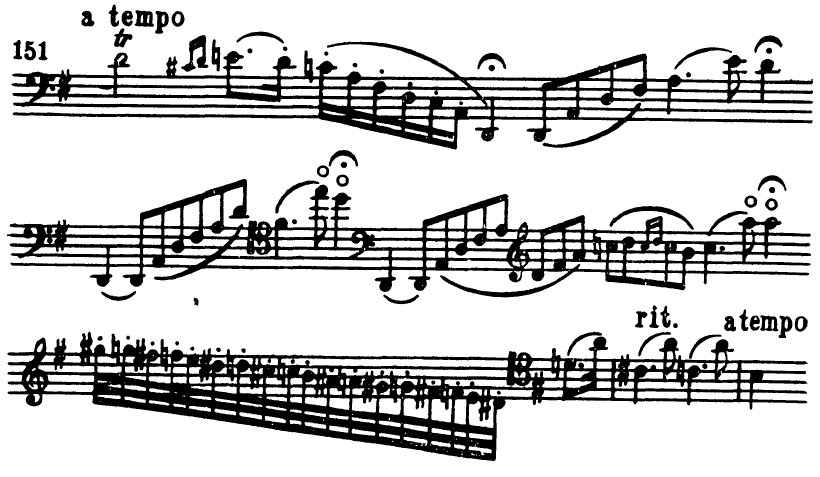
The middle section of the concerto—an Andante in F major with a flowing waltz rhythm—follows the first movement seamlessly, without a pause:

The recapitulation, as in classical concertos of earlier times, includes a fermata for the soloist’s cadenza. This cadenza is not provided in the published edition, suggesting that the performer was expected to compose it (rather than improvise it).
The recitatives and developmental sections make interesting use of the cello’s virtuoso techniques, such as chords, arpeggios, staccato passages, bariolage in three-string runs, and double stops.
The concerto’s qualities—its melodic expressiveness, originality of form, and diverse, well-applied technical demands for the solo instrument—make it a valuable work for modern pedagogical and even performance practice.