Lev Ginzburg, History of the Art of the Violoncello, vol. 3 (Moscow: Muzyka, 1965), pp. 398–432.
Translator’s note: Original printed pagination and page-specific footnote numbering are retained. Established original-language forms of personal names have been used where identifiable; otherwise, names are transliterated from the Russian. Historical dates, repertoire descriptions, and Ginzburg’s Soviet-era terminology have been preserved. The second side of the unnumbered plate following p. 416 depicts A. Ya. Shtrimer and is reproduced at its original location.
[p. 398]
Semyon Matveyevich Kozolupov also belongs among those outstanding musicians of the older generation in whose art the continuity between Soviet musical performance and pedagogy and Russian classical musical culture found vivid expression.
Like such remarkable musicians as A. A. Brandukov, F. M. Blumenfeld, L. V. Nikolayev, K. N. Igumnov, L. M. Tseitlin, A. F. Goedicke, M. B. Polyakin, A. I. Yampolsky, A. B. Goldenweiser, H. G. Neuhaus, S. E. Feinberg, K. G. Mostras, and other musical figures of this generation, Semyon Matveyevich Kozolupov received his musical education in the pre-revolutionary period and absorbed the finest realist traditions of the Russian classical school of musical performance. He succeeded in creatively carrying these traditions forward in his artistic and pedagogical activity and transmitting them to the Soviet performing school.
S. M. Kozolupov's artistic and pedagogical gifts unfolded fully under the conditions of Soviet life, when his creative outlook was substantially enriched by the progressive ideological and artistic principles of Soviet art.
More than fifty years of work by this foremost cellist, performer and pedagogue, left a profound mark on the development of the musical performing culture of our country. The desire and ability to transmit his rich practical experience to the younger generations of Soviet musicians accounted for the exceptional fruitfulness of S. M. Kozolupov's pedagogical activity. With this activity of his,
[p. 399]
which took place within the walls of the Moscow Conservatory for nearly forty years, the formation and flourishing of the Soviet cello school, whose achievements are widely known throughout the world, are organically linked.
The future musician spent his early childhood in the Cossack village of Krasnokholmskaya in the Orenburg province, where he was born into the family of a Cossack peasant on April 10, 1884. The living conditions of this large family (Semyon Matveyevich was the fifth of six brothers) were far from easy, and in 1894, shortly after the death of his mother, the boy, who was already showing musical gifts at that time, was sent by his father to the city of Orenburg and enrolled in the military band maintained at the headquarters of the Orenburg Cossack Host.
The Cossack symphony orchestra comprised about forty musicians. The orchestra was headed by the violinist G. F. Eysterreikh, who had graduated from the Moscow Conservatory in 1893 in the class of Jan Hřímalý.
Immediately upon joining the band, Semyon Kozolupov began to learn to play the cornet à pistons, followed by the violin. For three years he studied with G. F. Eysterreikh and had already achieved considerable success when an accident—a dislocation of the wrist of his left hand—compelled the young musician to exchange the violin for the cello.
At that time an amateur cellist, Colonel Vladimir Matveyevich Koch, lived in Orenburg and undertook to teach him the cello. Soon S. M. Kozolupov was playing in the Cossack orchestra not only the cornet but also the cello. When, in 1901, the orchestra was invited to Kislovodsk for the summer season, the young cellist was already listed there as a soloist.
In 1904, A. V. Verzhbilovich, who was giving concerts throughout Russia, came to Orenburg. The finest of K. Yu. Davydov's pupils, he was at that time in the full flowering of his talent. His playing, distinguished by its exceptional expressive power, vivid emotional quality, and heartfelt warmth, literally captivated the young Kozolupov. As the only professional cellist in the city, he was introduced to Verzhbilovich and played for him. Verzhbilovich immediately recognized the Cossack musician's gifts and expressed a wish to take him into his class at the St. Petersburg Conservatory.
Naturally, such an offer excited the talented cellist, who was eager to study and perfect his playing; he was ready to follow the outstanding artist to St. Petersburg immediately. However, he was prevented from doing so by his
[p. 400]
obligations connected with service in the military band; moreover, he lacked the necessary means for the journey and for living in the capital.
Assistance was provided by Orenburg music lovers, particularly the engineer S. G. Galakhov, who helped Kozolupov obtain permission to leave from the chief of staff of the Orenburg Cossack Host and undertook to send the young musician money for his studies and living expenses.
And so, in August 1904, Semyon Kozolupov was already in St. Petersburg. A disappointment awaited him there: A. V. Verzhbilovich, to whom he had brought a letter from S. G. Galakhov, was away on a concert tour. Nevertheless, the entrance examination took place. He was heard by Professors L. S. Auer, I. R. Nalbandian, and I. I. Seifert. The program brought by the Orenburg musician, who was almost entirely self-taught, is curious: he offered the committee Kummer's Ten Melodic Études (which, like the pieces, he played from memory), Davydov's Romance sans paroles, and Popper's Gavotte. But even this more than modest program (he played the fifth and eighth études and both pieces) enabled the experienced examiners to convince themselves of the cellist's undoubted talent. He was admitted to Verzhbilovich's class, although for about two months—until the latter's return from his tour—he studied with Seifert.
It should be noted that the young cellist's studies during this year were to a large extent independent, since soon after the events of January 1905, at the insistence of the revolutionary-minded portion of the student body, conservatory classes were interrupted. A. V. Verzhbilovich, as we have seen, sided with the progressive portion of the faculty and students. In June 1905, as a sign of solidarity with N. A. Rimsky-Korsakov, A. K. Glazunov, and A. K. Lyadov, who had previously been dismissed from the conservatory, he announced his departure from the conservatory.¹
At the end of his first year at the conservatory, when S. M. Kozolupov was already enrolled in I. I. Seifert's class, he was advanced to the highest course by decision of the examining committee chaired by L. S. Auer. A laconic notation by the chairman accompanies this decision: “Very capable and diligent.”²
I. I. Seifert enjoyed a reputation as a good pedagogue, who had assimilated the fundamental principles of the Davydov school and knew how to impart them to his pupils. The reason for Kozolupov's transfer to Seifert's class was probably, to some extent, the irregularity of the pedagogical activity of
[p. 401]
Verzhbilovich, who at that time gave many concerts and not infrequently missed conservatory lessons.¹
One must recall that Kozolupov (who had already entered his twenty-second year), continuing to be liable for military service, obtained only with difficulty the annual permission of the Orenburg Cossack authorities to continue his studies in St. Petersburg. Given the pressing need to complete his higher education in a short time and make the fullest use of conservatory lessons, the transfer to the class of Seifert—a pedagogue whose lessons were always systematic and regular—was sufficiently justified. This did not deprive Kozolupov of the opportunity to hear Verzhbilovich's artistic playing frequently at concerts or to visit his class.
According to the recollections of one of the pupils of the St. Petersburg Conservatory, A. A. Borisyak (Verzhbilovich's class), “in the cello department of the conservatory of that time, things proceeded sluggishly during those years. One might put it this way: whoever wanted and knew how to work, worked; whoever knew how to extract what was possible, extracted it. S. M. Kozolupov knew how to work in the fullest sense of the word and succeeded in deriving a great deal... He entered the class of the seventy-two-year-old Professor Seifert. The old man was energetic, could make demands, but could no longer demonstrate anything. Kozolupov's hands were made for the cello, and a sound instinct gradually suggested to him that splendid physical school which he possesses and which he himself, in a coherently systematized form, has already transmitted to more than a hundred pupils.”²
The progress of the young cellist was very considerable. In two years he studied a great number of works, including several concertos by Romberg, Servais's virtuosic Fantaisie sur une valse de Schubert, Davydov's Third and Fourth Concertos and pieces, Saint-Saëns's Concerto, and other works of the classical cello repertoire.
The extent to which S. M. Kozolupov's studies at the conservatory proceeded actively may be judged from his frequent appearances at student evenings. Thus, during the 1906–07 academic year, in addition to his difficult graduation program, he appeared five times at the “musical evenings of the students.” On October 20, 1906, he played Saint-Saëns's Concerto; on November 13, he participated in a performance of a quartet by Schumann; on December 12, he took part in the performance of a quartet by Beethoven and Chopin's Sonata for Cello and Piano, and on January 23, 1907, a trio by Mendelssohn and a quartet by Schubert; on January 26, he participated in a performance of Beethoven's Sonata in A major; on March 17,
[p. 402]
of the same year, at an evening devoted to the twenty-fifth anniversary of A. K. Glazunov's compositional career, he played his Mélodie and participated in the performance of the Novelettes for quartet.
The young cellist's serious aspirations are attested by his lively interest not only in the solo but also in the chamber music repertoire.
According to S. M. Kozolupov's own recollections, his attendance at the quartet class of the outstanding violinist, pedagogue, and chamber musician L. S. Auer gave him a great deal as a musician. Here, under the authoritative guidance of this musician, he was able to study a whole series of classical works of chamber literature. His partners were pupils of Auer, subsequently well-known violinists—E. Zimbalist, M. Piastro, Kathleen Parlow, A. Berlin, and others. In addition, he attended the chamber ensemble class of F. Blumenfeld and Ladislav Aloiz.
The artistic riches of the chamber music classics opened new musical horizons before the young performer, and he became so fascinated by them that, after graduating from the conservatory, he continued for some time to attend Auer's chamber music class.
It should be noted that only a year after arriving in St. Petersburg, Kozolupov ceased to avail himself of S. G. Galakhov's financial support. Making use of his Orenburg orchestral experience, he was compelled, in order to earn his living and pay for his studies, to play occasionally in various St. Petersburg orchestras (from the well-known symphony orchestra of Count A. D. Sheremetev to small restaurant orchestras), while continuing to practice the cello intensively. A certain assistance to him was the scholarship that was granted him during the last two years of his conservatory studies.
The rapid maturation of the talented musician and the formation of his mastery were promoted by his gifts, by the guidance of the conservatory faculty, and by the professional experience he acquired early. But of particular significance for the development of Kozolupov's musical gifts—he possessed a sound intuition, inquisitiveness, and a sense of purpose—was the artistic atmosphere of musical St. Petersburg, where Rimsky-Korsakov, Glazunov, and Lyadov then lived and worked.
At that time, on the St. Petersburg concert platform, the young artist had the opportunity to hear such excellent performers as Verzhbilovich, Essipoff, Auer, Blumenfeld, Chaliapin, Dolina, Yershov, Tartakov, Sobinov, Siloti, and many other Russian musicians; outstanding foreign artists also gave concerts in St. Petersburg at that time: Casals, Ysaÿe, Thibaud, Patti, and others.
[p. 403]
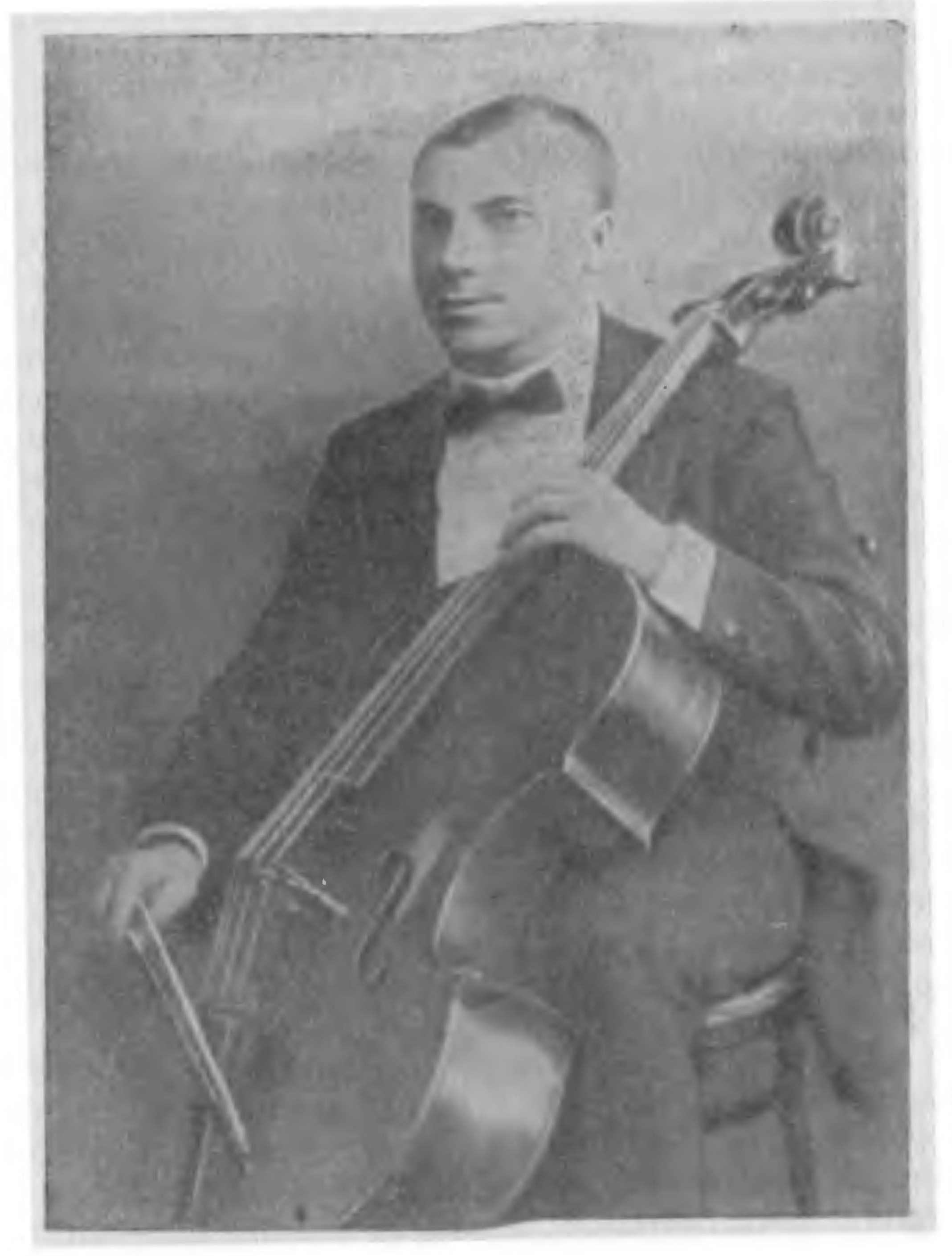
S. M. Kozolupov.
In the spring of 1907, S. M. Kozolupov successfully graduated from the St. Petersburg Conservatory, having studied there for only three years. At the spring examination, he performed Davydov's Third Concerto and, at the suggestion of the examiners, a Nocturne by Chopin (C-sharp minor), which he was required to prepare independently within half an hour. The performance of both pieces was awarded marks of five. The surviving document bears an inscription made by I. I. Seifert: “Very talented and diligent.” L. S. Auer wrote there: “Brilliant outward virtuosic qualities.”¹ A. K. Glazunov supplied the concluding phrase: “Admitted to the public examination.”²
[p. 404]
The public examination took place on April 27. Here S. M. Kozolupov performed Davydov's Third Concerto, the first movement of Romberg's Ninth Concerto, and a number of pieces.
The examining committee, whose members included L. S. Auer, I. R. Nalbandian, E. E. Krüger, and others, highly esteemed S. M. Kozolupov's achievements: he was awarded the large silver medal, and subsequently his name was inscribed on the marble honor board of the St. Petersburg Conservatory.
As one of the finest graduates, S. M. Kozolupov participated in the public ceremony of the forty-second graduating class of the St. Petersburg Conservatory, held on May 9, 1907; accompanied by orchestra, he performed Saint-Saëns's Concerto. The press particularly singled out the talented cellist, alongside the violinist E. A. Zimbalist, who performed the first movement of Tchaikovsky's Concerto.¹
Shortly after graduating from the conservatory, S. M. Kozolupov received an invitation to join the court orchestra without competition and was to assume his duties in September 1908. Circumstances, however, developed differently. After several months of work in St. Petersburg orchestras (mention may also be made of a trip to Helsingfors with an opera company), S. M. Kozolupov accepted the invitation of the conductor A. I. Orlov to take the position of soloist in the symphony orchestra in Rostov-on-Don for the summer season of 1908 (the concertmaster of the orchestra was the excellent violinist E. E. Krüger).
But already in the spring of that year, Kozolupov, who aspired to a solo concert career, undertook a tour of the cities of Central Asia (the Turkestan region). He appeared in Tashkent, Samarkand, Ashgabat, and Bukhara. The young artist was received warmly and enthusiastically in these distant cities of the country. His virtuosic mastery left a profound impression, and such works performed by him as the concertos of Davydov and Saint-Saëns, as well as many pieces, probably sounded there for the first time in his performance. In the local press, Kozolupov was called “one of those rare artists... who have studied the cello to perfection,” and his performance “beautiful and well considered.”
The summer season in Rostov also proceeded very successfully for the young musician. In addition to the regular conductor, A. I. Orlov, he had occasion there to become acquainted with M. M. Ippolitov-Ivanov, who had come to give concerts and who at that time was the director of the Moscow Conservatory.
On June 21, Kozolupov masterfully performed Davydov's Fourth Concerto with the orchestra conducted by Ippolitov-Ivanov. At the
[p. 405]
insistence of the public, the artist played two encores, performing Cui's Cantabile and a waltz by Chopin.
At this time, Semyon Matveyevich experienced serious doubts about the choice of his future path; service in the court orchestra did not attract him in the least, although it could provide him with financial security. Kozolupov's decision to decline work in the court orchestra was encouraged to a great extent by the friendly advice of Ippolitov-Ivanov, who supported him in this decision, declaring that upon the young cellist's entry into the court orchestra his further development would cease and that he would be unable to continue his concert career.
In the autumn of that same year, having formally declined work in the court orchestra in St. Petersburg,¹ S. M. Kozolupov came to Moscow to take part in the competition announced by the Bolshoi Theater. The candidate offered the authoritative committee, headed by V. I. Suk, a whole series of major cello works from which to choose, including the concertos of Davydov (Third and Fourth), Haydn (D major), Saint-Saëns, Servais's Fantaisie sur une valse de Schubert, and Tchaikovsky's Variations on a Rococo Theme.
Having brilliantly performed Davydov's Third Concerto and Tchaikovsky's Variations, S. M. Kozolupov was accepted for the position of second soloist (the first soloist was R. I. Ehrlich, a professor at the Philharmonic Music School), which he occupied for four years. In addition to ballet solos, he repeatedly had occasion to play operatic cello solos as well.
Work in the excellent orchestra of the Bolshoi Theater constituted an additional school for Kozolupov. The principal conductor in those years was the superb musician V. I. Suk.² On the theater's stage were performed Ruslan and Lyudmila, The Queen of Spades, The Golden Cockerel, The Snow Maiden, The Legend of the Invisible City of Kitezh and the Maiden Fevroniya, Carmen, Der Ring des Nibelungen, Lohengrin, Swan Lake, Raymonda, and others.
In addition, it should be borne in mind that the members of the Bolshoi Theater orchestra, Kozolupov among them (as principal cellist), participated in symphonic meetings of the Russian Musical Society and the Philharmonic Society. At these concerts, under the direction of such conductors as Nikisch, Rachmaninov, Mengelberg, Mottl, and others, the finest works of Russian and foreign classical composers, as well as of contemporary composers, were performed.
[p. 406]
S. M. Kozolupov appeared more than once at the symphonic concerts of the Russian Musical Society as a soloist. He was also a soloist at S. N. Vasilenko's “Historical Concerts.” Thus, on February 14, 1910, the talented cellist performed Tchaikovsky's Variations on a Rococo Theme with orchestra (under the direction of S. N. Vasilenko) with great success.¹
During his years in Moscow, S. M. Kozolupov constantly participated in various chamber ensembles. Together with A. Ya. Mogilevsky (who was later replaced by B. O. Sibor), M. I. Tsirelshtein, and V. R. Bakaleinikov (who was subsequently replaced by A. G. Blum), he was a member of the quartet of the Russian Musical Society. He also participated in trios, sonata ensembles, and other ensembles with such partners as S. I. Taneyev, K. N. Igumnov, A. B. Goldenweiser, V. I. Scriabina, B. O. Sibor, and others.
In addition to his numerous quartet appearances, mention should be made of S. M. Kozolupov's participation in a sonata ensemble with K. N. Igumnov (on November 12, 1909, they performed Rubinstein's Sonata in D major), as well as in trios with V. I. Scriabina (a trio by Haydn), with S. I. Taneyev (Taneyev's Trio), and others.
In May 1911, Semyon Matveyevich participated in the first performance of Taneyev's Piano Quintet (Op. 30), which took place at the composer's home. The piano part was played by A. B. Goldenweiser (Sergei Ivanovich himself could not play, as his hands had become painful the day before), and the first violin part by A. Ya. Mogilevsky. Among the listeners were G. L. Catoire, A. F. Goedicke, G. A. Alchevsky, O. O. von Riesemann, and other Moscow musicians.²
At times (chiefly during the summer period), the artist traveled to other cities to give concerts. In 1910, in Saratov, he performed a sonata by Mendelssohn, a suite by Sokolov, and other works. In the summer of that same year he appeared in a symphonic concert in Rostov with Servais's virtuosic fantasy on the theme of a waltz by Schubert (E. E. Plotnikov conducted). “The young artist, who had attracted attention the season before last through his remarkable technique, has apparently done much work in artistic respects,” wrote the local newspaper. “His bow has acquired a singing quality, his tone has become broader, and one senses inspiration in his interpretation. The gifted artist enjoyed great and quite deserved success
[p. 407]
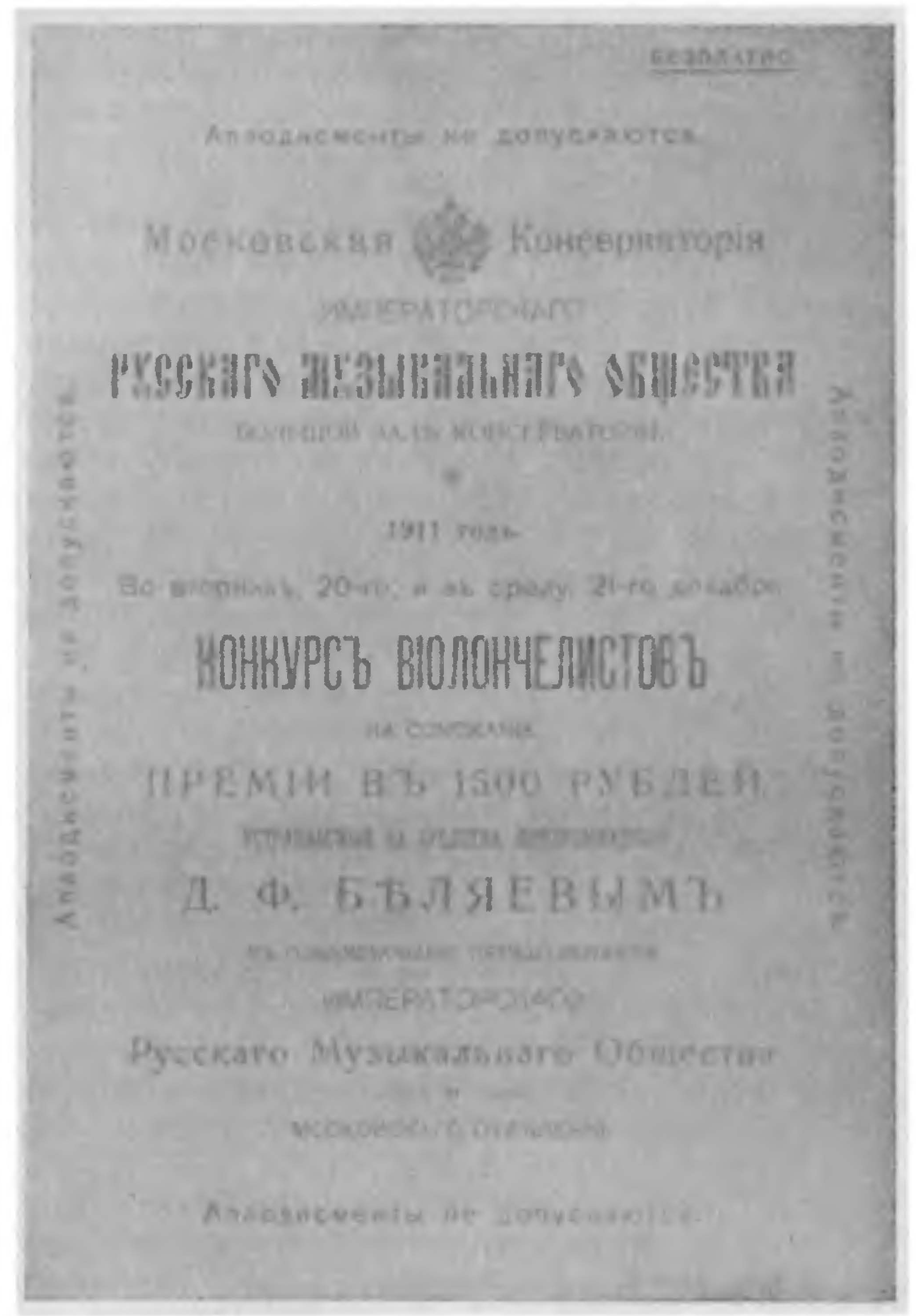
Title page of the program of the cello competition (1911).
and was obliged to play many encores.”¹ During these years S. M. Kozolupov also gave concerts in Tula, Orel, Tambov, Orenburg, and other cities of the country.
As early as 1908, S. M. Kozolupov began his pedagogical activity at the music school opened in Moscow by Léon Conus.²
A significant event in the creative biography
[p. 408]
of S. M. Kozolupov was the cello competition held in Moscow in December 1911, organized to commemorate the fiftieth anniversary of the Moscow branch of the Russian Musical Society with funds provided by D. F. Belyayev.
Those who had graduated from the Moscow or St. Petersburg Conservatory were eligible to participate in the competition, held on December 20 and 21 in the Great Hall of the Moscow Conservatory. The competition program required the performance of one of Bach's solo suites, a concerto, and two pieces—one of a cantabile and the other of a virtuosic character.
Of the sixteen cellists who had registered to participate in the competition, twelve appeared: Abram Banovich, Raimund von Bööcke, M. E. Bukinik, E. Ya. Belousov, V. P. Gutor, S. M. Kozolupov, A. S. Luboshutz, I. I. Press, L. V. Rostropovich, A. R. Rubinstein, Z. I. Stepinsky, and P. P. Fedorov. Many of them were already engaged in concert activity at that time and enjoyed wide renown.
In this serious and consequential competition, S. M. Kozolupov performed Bach's Second Suite, Davydov's Third Concerto, Fauré's Élégie, and Klengel's Capriccio.¹
The jury, headed by M. M. Ippolitov-Ivanov (its members also included L. Abbiate, Vasily Villoing, Jan Hřímalý, Julius Klengel, V. V. Pukhalsky, I. I. Slatin, Stanisław Eksner, and R. I. Ehrlich), decided to award the first prize (1,500 rubles) to S. M. Kozolupov (the second prize was divided between two graduates of the Moscow Conservatory, E. Ya. Belousov and I. I. Press).
The press noted the high qualities of S. M. Kozolupov's performance that enabled him to take first place. Thus, for example, the newspaper Russkoe Slovo reported that the gifted artist “magnificently performed Davydov's Third Concerto, Fauré's Élégie, Op. 24, Klengel's Capriccio, Op. 3, and completely won over the jury by his astonishing rendering of Bach's Suite No. 2 in D minor, written for solo cello without accompaniment.”² The correspondent of Russkaya Muzykalnaya Gazeta, G. P. Prokofiev, wrote that Kozolupov “has an excellent feeling for the style of each composition,” and noted his characteristic “flexibility of sound,” its “responsiveness to the will of the performer,” and the “warmth of his phrasing.”³
The prize he received enabled the young artist to acquire an exceedingly valuable instrument by Pietro
[p. 409]
Guarneri; this superb cello was Semyon Matveyevich's faithful friend throughout his artistic life.
The extensive concert activity that Kozolupov developed in the following years was of considerable educational significance, since he constantly strove to include in his programs the finest classical works of the cello and chamber music repertoire. The artist belonged among those outstanding Russian performing musicians who, by championing classical music at that time, did much to preserve the great realist traditions and successfully resisted the onslaught of modernist trends in music.
Semyon Matveyevich spent the summer seasons of 1912 and 1913 as a soloist in Pavlovsk (near St. Petersburg). The symphonic concerts at the Pavlovsk railway station (which had begun as early as 1838) enjoyed enormous popularity. There was an excellent orchestra here, conducted by celebrated conductors, whose programs included the finest works of Russian and foreign composers.
In each season, Kozolupov made five appearances, performing the concertos of Davydov, Saint-Saëns, and Dvořák, Tchaikovsky's Variations on a Rococo Theme, and other pieces.
The cellist made his debut on July 27, 1912, brilliantly performing Davydov's Third Concerto with orchestra. “This still young artist possesses brilliant qualities,” wrote the reviewer of Sovremennoe Slovo, “a superb tone, noble, soft, and singing, recalling in its tenderness and beauty the celebrated tone of Verzhbilovich, considerable technique, and impeccable precision and purity of execution...”¹
S. M. Kozolupov had occasion to perform in Pavlovsk when the remarkable Czech conductor Oskar Nedbal, well known to Russian listeners as the violist of the celebrated Czech Quartet, which had frequently given concerts in Russia, was appearing there. In June 1913, S. M. Kozolupov and O. Nedbal performed the concertos of Dvořák (June 11) and Saint-Saëns (June 14). The St. Petersburg press emphasized Kozolupov's perfect technique and beautiful, full tone.
The artist's virtuoso brilliance and singing tone are also noted in the reviews of his performance of Tchaikovsky's Variations on a Rococo Theme. In one of these reviews we read: “The superb cellist S. M. Kozolupov, with his singing bow and masterly rendering of Tchaikovsky's Rococo Variations, literally enchanted the listeners.”² It is interesting that at this same
[p. 410]
concert, held on August 3 (A. P. Aslanov conducted), the young S. S. Prokofiev, who was still studying at the conservatory at the time, appeared in a performance of his own First Concerto (from the manuscript).
The well-known St. Petersburg critic V. G. Karatygin wrote at the time: “Of the soloists who took part at Pavlovsk, besides Mr. Prokofiev, I shall mention the excellent cellist Mr. Kozolupov, who took part in many symphonic evenings and performed Tchaikovsky's Rococo Variations, the first movement of Davydov's Third Concerto, and so forth.”¹
“Such a soft, tender tone, carrying into the distance, and such a striking pianissimo we have not heard since Verzhbilovich,” states another review. “Alongside perfect technique, there is much artistic taste and expressiveness in his performance.”²
In all these symphonic concerts, Kozolupov's appearances took place with great success, and he repeatedly played encores, performing pieces by Tchaikovsky, Cui, Popper, and others.
When the third Russian conservatory opened in Saratov in the autumn of 1912, S. M. Kozolupov was invited to join its faculty, alongside such celebrated musicians as Józef Śliwiński, Georges Conus, M. L. Presman, A. F. Sklyarevsky, M. E. Medvedev, L. M. Rudolf, I. V. Lipaev, Willy Brandt, and others. S. M. Kozolupov's activity in Saratov, which proved exceedingly multifaceted, contributed in great measure to the development of musical life in that city.
For four years he directed the cello and chamber music classes of the conservatory and frequently appeared as a soloist and in various ensembles. Together with Jaroslav Hájek, V. V. Zaitz, and G. K. Yershov, he formed a quartet that performed classical chamber works. He appeared repeatedly in sonata ensembles with local pianists and gave solo concerts.³
In Saratov, a university city, “the city of Chernyshevsky,” there existed certain musical traditions, and the artist found there a sensitive, receptive, and prepared audience, which soon came sincerely to love the talented cellist.
Beginning already with the debut concert he gave in Saratov in November 1912, Semyon Matveyevich established himself as a serious musician, an artist who set himself
[p. 411]
complex and consequential tasks in the cultivation of the public's musical taste, without making the slightest concession to the “provinces.”
The Saratov correspondent of Russkaya Muzykalnaya Gazeta, I. V. Lipaev, wrote of S. M. Kozolupov after his first appearance (which took place on November 10, 1912) as an “artist of broad and rigorous musical horizons”; he noted the fullness of the cellist's tone, masterful command of bow strokes, “fluency extraordinary in its purity and clarity,” and the “ability to introduce one into the atmosphere of the composition he is performing.”¹
At this concert, the artist appeared with Bach's Suite in D minor for solo cello, Strauss's Sonata, and a number of small pieces, among them the Chopin–Glazunov Étude, Schumann's Evening Song, Klengel's Capriccio, and others.
The reviewer of the local newspaper singled out in particular the performance of Strauss's Sonata for Cello and Piano, in which both performers (the soloist's partner was I. A. Rozenberg, professor at the Saratov Conservatory) “proved to be artists worthy of one another both in their profound understanding of the work performed and in their superb technique.”²
An outstanding concert virtuoso, S. M. Kozolupov, as we have seen, did not confine himself to solo virtuoso music. Throughout his artistic career, he constantly appeared in sonata ensembles as well. During his stay in Saratov, for example, he gave a sonata evening with the pianist A. F. Sklyarevsky; the program included sonatas by Beethoven (Op. 69), Boëllmann, and Rachmaninov.
The review of this chamber concert stated that Beethoven's Sonata had been performed “with superb finish of detail, subtle taste, and precise realization of the composer's intentions.” Particularly highly esteemed was the performance of Rachmaninov's remarkable Sonata. The artists, according to the reviewer, reproduced its beauties “with great love and profound feeling. The harmony between the composition and the performance was complete.”³ Another review also noted that, in comparison with Beethoven's Sonata, in whose performance a certain academicism could be felt, Rachmaninov's Sonata was rendered more vividly and with greater inspiration.
In October 1915, S. M. Kozolupov, alongside solo works, performed Saint-Saëns's Sonata (Op. 29) with Józef Śliwiński.
In the artist's solo programs, attention is drawn to the concertos of Haydn (D major) and Svendsen, the sonatas of
[p. 412]
Boccherini, Birckenstock, and Eccles, and pieces by Davydov, Rimsky-Korsakov, Glazunov, Cui, Arensky, Rebikov, and others. S. M. Kozolupov constantly strove to expand his repertoire. He frequently acquainted listeners with new compositions, preferring works of the classical repertoire, and in particular works by Russian composers.
Kozolupov also involved his pupils in his concerts. For example, at one of the concerts held at the beginning of 1916, the artist performed Bach's celebrated Air in unison with eighteen of his pupils; at the same concert he played Popper's Requiem for three cellos with his pupils.
“Our public listened to the evening recital... of S. M. Kozolupov, professor at the local conservatory, with a feeling of profound aesthetic satisfaction,” wrote I. V. Lipaev of this concert. “The artist surpassed the most serious expectations.” The reviewer goes on to emphasize particularly Kozolupov's masterful performance of classical music—Boccherini's Sonata and Haydn's Concerto—the style of which was rendered with exceptional fidelity.¹
S. M. Kozolupov appeared repeatedly in symphonic concerts in Saratov. In one of the concerts (when the Moscow conductor K. S. Saradzhev conducted), he performed Dvořák's Concerto. A contemporary wrote of the penetrating quality of his interpretation, his technical ease, and his excellent sonority.
Noble, powerful, and full tone, artistic phrasing full of simplicity and expressiveness, and impeccable technique are noted by the reviewer of another evening at which Kozolupov performed Saint-Saëns's Concerto (Georges Conus conducted).
Particular mention may be made of Semyon Matveyevich's participation in a symphonic concert devoted to the works of A. K. Glazunov, held in the spring of 1916. At this concert the composer conducted, and S. M. Kozolupov was the soloist, performing with orchestra his Chant du ménestrel and Sérénade espagnole.
During his work at the Saratov Conservatory, S. M. Kozolupov also gave concerts in other cities of the Volga region. At the end of 1914 he appeared with great success in Astrakhan in a concert whose entire program was devoted to Russian music and contained works by Davydov, Tchaikovsky (Variations on a Rococo Theme), Rimsky-Korsakov, Lyadov, and Rebikov. The press noted the expression and expressiveness of his interpretation, his high degree of mastery, and the artist's beautiful, manly tone.²
[p. 413]
S. M. Kozolupov did not forget his native city of Orenburg either. In particular, in August 1912 he appeared there at the traditional student evening. The local newspaper noted such merits of his playing as broad, expressive sound, technical mastery, and artistry.
While still a professor at the Saratov Conservatory, Kozolupov repeatedly gave concerts in Kiev, where he found a grateful audience and a cordial reception. The artist appeared with success at the summer symphonic concerts held there in the Merchants' Garden. On March 31, 1916, he gave a concert in Kiev, in the extensive program of which he included Bach's Second Suite, a sonata by Boccherini, Haydn's Concerto in D major, Tchaikovsky's Variations on a Rococo Theme, and a whole series of small pieces by Russian composers.
Let us quote an excerpt from the response to this concert published in the newspaper Kievlyanin. Recalling Kozolupov's summer appearances in Kiev (the artist had then performed Dvořák's Concerto and pieces by Servais, Bruch, and others), which made it possible to judge him “as a good musician with excellent technique and great erudition,” the reviewer (A. Kanevtsev) continues: “These qualities of the cellist, as well as his beautiful tone, the lightness and mobility of his wrist, became even more apparent in the favorable circumstances of his own recital. The qualities of the serious school through which Mr. Kozolupov has passed, and the significance of style, were eloquently demonstrated by the excellent performance of Haydn's Concerto (D major, No. 2), Tchaikovsky's Rococo Variations, two movements from Boccherini's Sonata in A major, and an entire suite by Bach (D minor, No. 2)... All the small, exceptionally interesting pieces included in the second half of the program were also performed beautifully and distinctly by the cellist: Lyadov's Prelude, Op. 11, No. 1, Rimsky-Korsakov's Sérénade, Rebikov's Song Without Words, Cui's Barcarolle, and Davydov's graceful little piece À la Fontaine... Mr. Kozolupov made a favorable impression with his beautiful, polished, thoughtful playing.”¹
Other Kiev newspapers also highly esteemed the performing qualities of the talented cellist. One of the reviews speaks of the expressiveness and grace of his interpretation of Haydn's Concerto and Tchaikovsky's Variations; in Bach's Suite in D minor, “the artist showed himself a serious and thoughtful interpreter possessing brilliant technique and a broad and powerful tone...”² Another review particularly notes the “broad and free sweep, beautiful tone, and extraordinary lightness of the right hand.”³
In that same year S. M. Kozolupov was invited to join the
[p. 414]
faculty of the Kiev Conservatory, which had opened not long before (in 1913). Such remarkable musicians as R. M. Glière, K. N. Mikhailov, M. G. Erdenko, V. V. Pukhalsky, G. N. Beklemishev, Friedrich von Mulert, and others had gathered here at that time.
The musical life of Kiev opened up broader possibilities for S. M. Kozolupov to apply his creative energies, and he gladly accepted this invitation.
On September 18, 1916, the artist gave his farewell concert in Saratov. “His farewell to the public,” wrote I. V. Lipaev, “was exceedingly cordial: he was noisily greeted, and the hall was literally overflowing. Sad as it is to say, our (i.e., Saratov. — L. G.) conservatory, with Mr. Kozolupov's departure, has lost both a magnificent pedagogue and a brilliant artist. On the evening of his final appearance, Mr. Kozolupov performed sonatas by Eccles, Boccherini, and Rachmaninov, Saint-Saëns's Concerto in A minor, and Tchaikovsky's Variations on a Rococo Theme. On this occasion, Mr. Kozolupov's performance was particularly magnificent and distinguished by its inspiration.”¹
At the Kiev Conservatory, I. M. Buravsky, N. E. Zedeler, R. E. Sapozhnikov, S. B. Feigin, and many other cellists studied with him.
In Kiev, too, S. M. Kozolupov combined his pedagogical activity with concerts—both chamber and solo. He immediately joined a quartet in which the violin parts were played by M. G. Erdenko and S. K. Kaspin, and the viola part by S. M. Pruslin (in 1917 he was replaced by D. I. Uzhumetsky).
The first appearance of this quartet took place on October 16, 1916, at a chamber music matinée devoted to Beethoven's works. The local press particularly noted that Kozolupov, “despite his great individual talent, also showed himself to be an excellent ensemble player, capable of subordinating his striking performing qualities to the interests of the entire ensemble.”²
Together with the pianists Professors V. V. Pukhalsky and G. N. Beklemishev, S. M. Kozolupov announced a series of sonata evenings in 1916. The very first of these (November 16), whose program consisted of three sonatas by Beethoven (Op. 5, Nos. 1 and 2, and Op. 69), aroused enormous interest among the inhabitants of Kiev. The reviewer of Kievlyanin (A. Kanevtsev), emphasizing the educational character of such evenings, wrote: “The idea of organizing such special sessions deserves every praise, since their programs include pieces that are extremely rarely performed on the concert platform and, at the same
[p. 415]
time, are of the most profound interest not only to confirmed admirers of chamber music style but also to the broad mass of average listeners, who owing to their lack of preparation are ordinarily distrustful of examples of serious music, but who, upon becoming more closely acquainted with them, gradually learn to discover great merits in serious music and thereby develop their aesthetic taste without being aware of it.”
The reviewer ranks the sonata evening of V. V. Pukhalsky and S. M. Kozolupov alongside the sonata evenings of A. N. Essipoff and L. S. Auer, or of A. Hekking-de-Nancy and V. I. Safonov; he writes of the artists' artistic inspiration and their excellent interpretation of Beethoven's sonatas. “Both performers,” continues A. Kanevtsev, “were equally imbued with their artistic task, merged into a single whole, and attained exemplary ensemble in respect of beauty of sonority and rhythmic unity; there is nothing to be said of the outward technical finish: in both parts of all the pieces performed it proved impeccable.”¹
In his review of the second sonata evening, which took place on November 28, the same reviewer again emphasized the educational significance of these evenings, whose initiator he calls S. M. Kozolupov. Noting the increased interest of the Kiev public in serious music, the reviewer wrote that “the success of the sonata evenings was also greatly facilitated by the participation in them of a new Kiev musical force—the superb cellist S. M. Kozolupov, who in a comparatively short time had won the great affection of the Kiev public...”²
The program of this concert included sonatas by Rubinstein (Op. 18), Rachmaninov, and Yurasovsky. A particular impression was produced by the performance of Rachmaninov's superb Sonata. S. M. Kozolupov's partner on this occasion was G. N. Beklemishev.
S. M. Kozolupov's third sonata evening took place on December 10 of the same year; together with G. N. Beklemishev, the artist performed sonatas by Boëllmann, Franck (a transcription of the violin sonata), and Saint-Saëns (Op. 32).
S. M. Kozolupov's first concert season in Kiev was also exceedingly rich in solo appearances. On October 27, 1916, he appeared as soloist at a symphonic concert of the local branch of the Russian Musical Society, performing Haydn's Concerto in D major (S. N. Vasilenko conducted). The Kiev newspapers wrote of the brilliant and masterful performance of the artist. One of the reviews noted the “classical
[p. 416]
nobility” of his interpretation, the “soft and caressing tone” of the cellist, and his virtuosic merits, which were particularly vividly manifested in the cadenza to the first movement of the concerto.¹ As an encore, Kozolupov performed Vasilenko's Nocturne (with orchestra), as well as pieces by Glazunov and Rebikov.
S. M. Kozolupov was a soloist more than once at symphonic concerts conducted by R. M. Glière; in particular, under his direction he performed Tchaikovsky's Variations on a Rococo Theme.
On November 6, S. M. Kozolupov gave a concert in Kiev with a very varied program, with great success. It included three classical sonatas—by Birckenstock, Eccles, and Boccherini—Boëllmann's Variations symphoniques, and Servais's Fantaisie sur une valse de Schubert. In addition to the program, the artist played several pieces by Russian composers (including Lyadov, Cui, and Rimsky-Korsakov), as well as works by Popper and Klengel.
The review of this concert said of Semyon Matveyevich: “He is an excellent, well-balanced technician, a serious musician correct in every respect, who knows how to draw from the cello with ease all its natural and artificial effects: good, soft tone, mobility of the wrist, transparency in rapid passages, impeccable purity of intonation in the highest positions, and gracefulness of bow strokes make Mr. Kozolupov's masterful, substantial playing exceedingly beautiful and attractive.”²
The February Revolution found Kozolupov on a concert tour of the southern cities of Russia (Kerch, Kharkov, and others). The Civil War, which broke out in the country after October 1917, proceeded with considerable acuteness in Ukraine; Kiev repeatedly changed hands. Naturally, musical life in the city was disrupted at that time. For this reason, as well as because of family circumstances, S. M. Kozolupov gave concerts repeatedly in other cities during those years: in Orenburg, Omsk, Samara, Saratov, and so forth.
Thus, in the spring of 1918 he gave a concert in Samara. This concert was organized by the People's Conservatory. The concert program included Bach's Third Suite, Haydn's Concerto in D major (No. 2), and a whole series of pieces by Corelli, Mozart, Beethoven, Boccherini, Bruch, Davydov, Rachmaninov, and Glière.
As early as October 1920, while in Orenburg, S. M. Kozolupov received an invitation to take the position of professor at the Petrograd Conservatory. Having decided nevertheless to return to Kiev, he was compelled, however, to remain for a time in Saratov,
[Unnumbered illustration plate following p. 416]
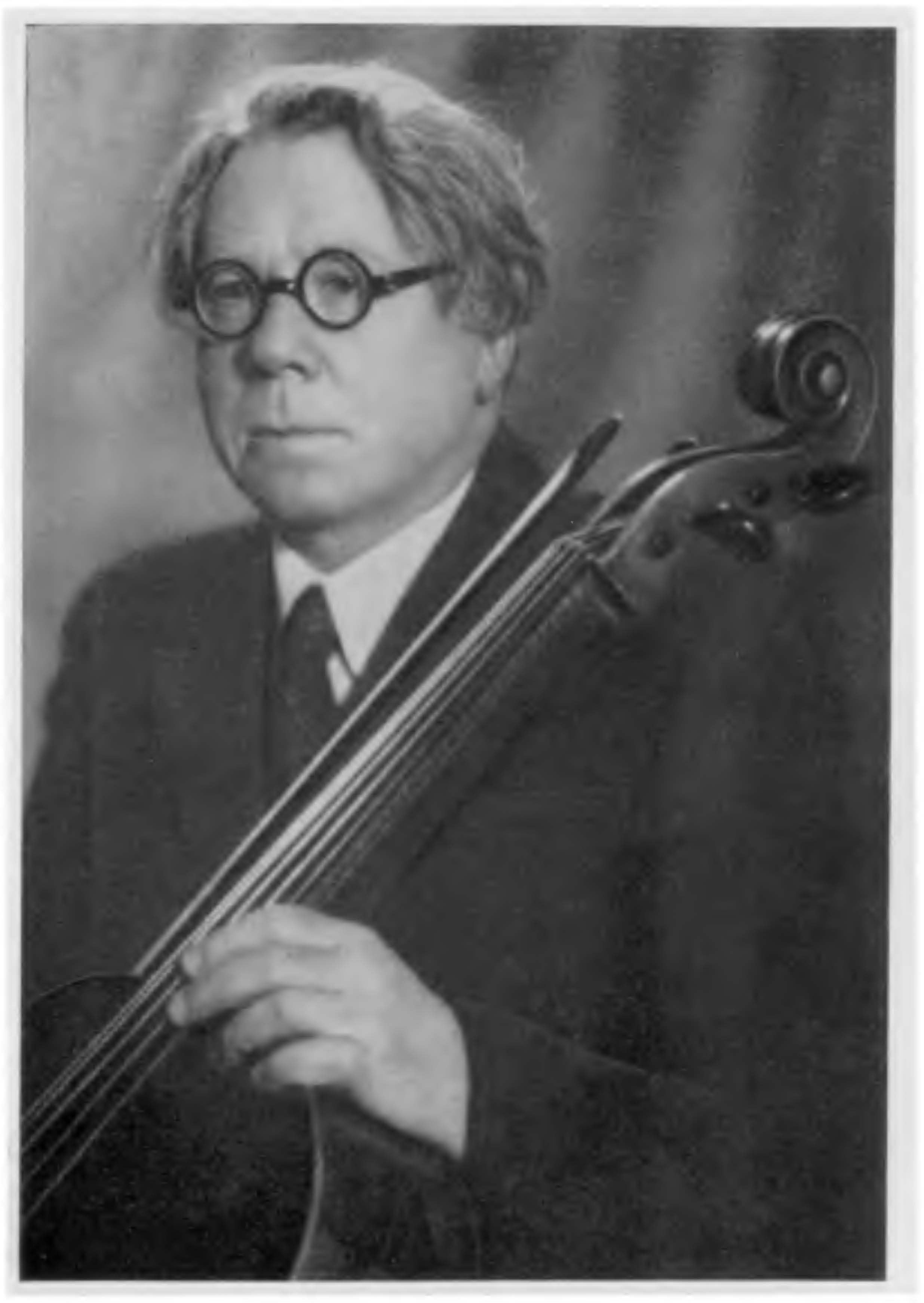
S. M. Kozolupov.
[Unnumbered illustration plate following p. 416, verso]
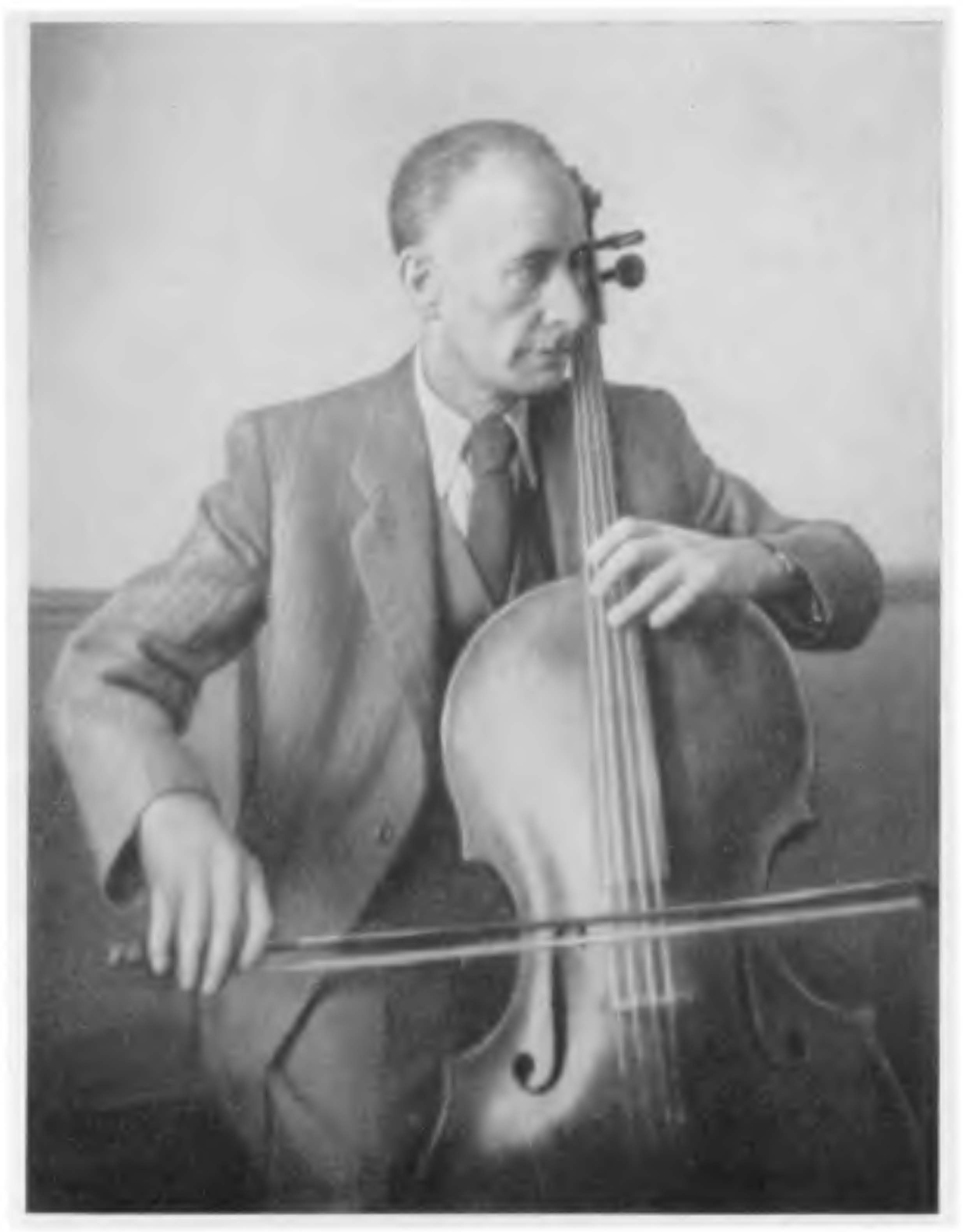
A. Ya. Shtrimer.
[p. 417]
since the railway route to Kiev had been cut off. In Saratov, Kozolupov resumed his pedagogical activity at the local conservatory and soon also occupied the post of director of that conservatory.
In 1922, Semyon Matveyevich received an invitation to join the faculty of the Moscow Conservatory, which at that time was headed by M. M. Ippolitov-Ivanov. Here he (simultaneously with A. A. Brandukov) replaced Professor A. E. von Glehn, who had left for the Baltic region in 1921.
When S. M. Kozolupov was already in Moscow, he received (on September 17, 1922) a telegram from the Petrograd Conservatory in which its rector, A. K. Glazunov, informed him that the Petrograd Conservatory had elected him as its professor. But by that time Kozolupov had firmly decided to settle in Moscow. From then on, his pedagogical activity, inseparably associated with the Moscow Conservatory, assumed a particularly broad scope.
The democratization of the country's cultural life, particularly the successfully developing new, progressive system of musical education, was not slow to affect the activity of the leading Soviet conservatory. At the beginning of the 1920s, the latter united within its walls foremost performing musicians, composers, and pedagogues of the older generation, who had decided to devote their energies and knowledge to the noble task of educating young Soviet musicians.
Creative association with his foremost colleagues at the conservatory had a most fruitful effect upon Kozolupov's artistic outlook and tastes, and his expanding pedagogical activity, in the words of the musician himself, gave him much as a performer.
“In my pedagogical activity I find enormous creative satisfaction, which over the years has replaced my former enthusiasm for the activity of a virtuoso performer,” wrote S. M. Kozolupov in 1947. “But I would like to note the circumstance that it was precisely in the course of my pedagogical activity that my development as a performer took place and my artistic maturity came.”
With the arrival at the Moscow Conservatory of such outstanding musicians as the violinists L. M. Tseitlin, A. I. Yampolsky, and K. G. Mostras, and the cellists A. A. Brandukov and S. M. Kozolupov, the center of string-playing musical and pedagogical culture, as has already been noted, shifted from St. Petersburg–Petrograd to Moscow.
Right up to the middle of the 1950s, S. M. Kozolupov continued his performing activity. From 1924 (after the death of R. I. Ehrlich) until 1931, he was soloist of the Bolshoi Theater orchestra, where he was entrusted with the performance of cello solos in such ballets as Swan Lake,
[p. 418]
The Sleeping Beauty, Raymonda, The Little Humpbacked Horse, The Magic Mirror, and others.
It should be noted that S. M. Kozolupov also felt an attraction to conducting. Already in his youth, he had substituted for the bandmaster in Orenburg. During his stay in Saratov, Semyon Matveyevich conducted a series of symphonic concerts. Subsequently, he appeared occasionally as a conductor in Moscow as well.¹
At the same time, Semyon Matveyevich frequently participated in symphonic, solo, and chamber concerts. In 1928 he appeared in a concert of Persimfans (the well-known symphony orchestra without a conductor) with Tchaikovsky's Variations on a Rococo Theme. Together with D. M. Tsyganov, S. M. Kozolupov played Brahms's Double Concerto (with the symphony orchestra of the State Philharmonic), and with B. O. Sibor and L. G. Lukomsky, Beethoven's Triple Concerto (V. I. Sadovnikov conducted).
With the orchestra of the State Philharmonic, in 1937 he gave the first performance of Hamburg's Concerto, dedicated to him (L. P. Steinberg conducted).
Kozolupov also repeatedly gave his own concerts in Moscow. As before, he continued to appear chiefly as an advocate of classical music for the cello—the suites of Bach, sonatas of Boccherini, Haydn, Birckenstock, and d'Hervelois, concertos of Haydn, Boccherini, and Saint-Saëns, as well as works by the Russian composers Davydov, Tchaikovsky, Rimsky-Korsakov, Cui, Glazunov, Borodin, Arensky, Lyadov, Rachmaninov, Myaskovsky, and Glière.
The artist's performances during the Soviet period acquired greater finish, artistic maturity, and increased mastery. One cannot fail to note S. M. Kozolupov's constant interest in the creative work of Soviet composers. By this means, he stimulated to no small degree the development of young Soviet cello literature. Semyon Matveyevich included in his programs not only the sonatas of the outstanding Soviet masters Myaskovsky and Prokofiev, but also works by the middle and younger generations of Soviet composers. In S. M. Kozolupov's performance, Moscow listeners first became acquainted with Hamburg's Concerto, Rakov's Poem, Feltsman's Sonata, and pieces by Vl. Vlasov, Tsintsadze, Miroshnikov, and other composers.
[p. 419]
The cello works of Soviet composers always occupied an honored place not only in Kozolupov's concert activity, but also in his pedagogical practice.
Let us note here that the enormous attention devoted by Kozolupov as a pedagogue to the study of classical music was of particular significance at the time of the active work of RAPM [Russian Association of Proletarian Musicians], when the classical heritage was to a considerable extent ignored.
By cultivating his pupils' taste for the artistic riches of classical music and attaining technical perfection in its realization, Semyon Matveyevich furthered the development of young cellists in both musical and virtuosic respects.
Semyon Matveyevich frequently participated in various chamber concerts in Moscow. Many Moscow listeners remember his sonata ensembles with K. N. Igumnov, A. B. Goldenweiser, H. G. Neuhaus, and also with I. S. Kozolupova, who regularly accompanied her father in his solo concerts. Among the chamber works performed by him in the 1920s–1950s may be mentioned the sonatas of Beethoven, Brahms, Grieg, Saint-Saëns, Rubinstein, Rachmaninov, Myaskovsky, Prokofiev, Hindemith, and others. Semyon Matveyevich participated more than once in trios; in particular, he performed Tchaikovsky's Trio with K. N. Igumnov and L. M. Tseitlin.
Together with D. M. Tsyganov, on November 26, 1925, S. M. Kozolupov performed Ravel's Sonata for Violin and Cello for the first time in Moscow.
He appeared repeatedly with the Beethoven Quartet (the quintets of Schubert and Glazunov). In 1923, Semyon Matveyevich, replacing S. P. Shirinsky, the cellist of that ensemble who had fallen ill, participated together with K. N. Igumnov and S. V. Rozanov in the first performance in Moscow of Prokofiev's Overture on Hebrew Themes.¹
In 1928, S. M. Kozolupov twice participated in performances of Schubert's Quintet with two cellos, at concerts organized in connection with the hundredth anniversary of the death of the great composer (with the quartet of the Moscow State Conservatory, which subsequently received the name of the Beethoven Quartet, and with the quartet of advanced students of the Moscow State Conservatory, now the Komitas Quartet).
Although the press reviews of Kozolupov's appearances during this period are very few, they nevertheless allow us to supplement our conceptions of the concert artist's artistic personality.
[p. 420]
After his concert held in December 1922 (the program consisted of Bach's Second and Third Sonatas, the sonatas of Eccles, Birckenstock, and Boccherini, and other works), the reviewer wrote: “Among Russian cellists, Kozolupov occupies a prominent place as a major virtuoso and a thoughtful interpreter. The virtuosic side, perhaps, even attracts his attention most of all. But it does not follow from this that Kozolupov does not pay due tribute to artistic emotions. On the contrary, he has tried to give them considerable scope. By the nature of Kozolupov's talent, works of broad conception and complex technical designs suit him more and turn out better in his performance. Kozolupov's large tone and broad bow stroke constitute the chief characteristic of his interpretation. He loves the classics and renders their style beautifully, but the general tone of his performance always remains academic. Kozolupov permits himself no departures from what is 'permissible.' Nor does the realm of impetuous feeling attract him. Nevertheless, Kozolupov's performance is not devoid of warmth and softness.”¹
Another reviewer of this concert, noting that Kozolupov is an artist possessing an excellent school, great technique, and good taste, comes to the following conclusion: “The general impression is that in Kozolupov, Moscow is acquiring a major cellistic talent.”²
Here is an excerpt from a review of Semyon Matveyevich's concert in 1925: “With an impeccably compiled and, we would add, impeccably performed program, the cellist S. M. Kozolupov, professor at the Moscow Conservatory, appeared in his recital in the Small Hall of the conservatory. J. S. Bach's Suite in D minor for Solo Cello, Haydn's First Concerto, Boccherini's Sixth Sonata, Boëllmann's Variations, pieces by Debussy, Fauré, and F. Schmitt, and in conclusion, an interesting novelty: Ravel's Sonata for Solo Violin and Cello (violin—D. M. Tsyganov)—all this provided the artist with a broad and rewarding field in which to display all sides of his talent: his rigorous, thoughtful musicality, rich tone, enormous finger and wrist technique, and at the same time an exceedingly simple manner of playing, alien to all affectation.
“With particular penetration, as a great master, the artist performed Bach's Suite—the touchstone of true musicality; he then shone in the lace-like passages of Haydn's Concerto, and lightly and playfully rendered Debussy's graceful Arabesque.”³
In the program of the concert under review, it is not difficult to discern Kozolupov's characteristic striving to expand his repertoire. Having devoted the first half to Bach, Haydn, and
[p. 421]
Boccherini, he filled the second half with works by Debussy, Ravel, and other French composers rarely performed at the time. Semyon Matveyevich was the first performer in Moscow of Hindemith's Sonata (Op. 11, No. 3), which he played alongside the sonatas of Handel, Beethoven, and Brahms in a sonata evening given by him with I. Kozolupova in October 1927.
Together with V. I. Kachalov, A. V. Nezhdanova, E. K. Katulskaya, N. S. Golovanov, and M. G. Erdenko, S. M. Kozolupov appeared in the first Soviet radio concert, organized on September 8, 1924, in the Bolshoi Theater for the participants of the Thirteenth Congress of the Communist Party of the Soviet Union.
At the beginning of 1927, the artist took part in the series “History of the Instrumental Concerto,” which was conducted by the House of Scientists in the Great Hall of the conservatory; he participated in the performance of Beethoven's Triple Concerto.
On March 24, 1927, in one of the concerts devoted to the sixtieth anniversary of the founding of the Moscow Conservatory, S. M. Kozolupov took part alongside other foremost professors—A. B. Goldenweiser, K. N. Igumnov, L. M. Tseitlin, A. N. Alexandrov, E. A. Bekman-Shcherbina, and others—playing Fauré's Élégie and Debussy's Arabesque.
His fiftieth birthday found Semyon Matveyevich in the full flowering of his creative powers; his tireless creative work and fruitful pedagogical activity received warm recognition on the part of the Soviet musical community. Among the numerous congratulations sent to the celebrant, particular attention is drawn to the telegram from People's Artist of the Republic L. V. Sobinov, with whom S. M. Kozolupov had repeatedly given concerts. Very shortly before his death, the outstanding singer and artist wrote in this telegram: “I congratulate dear Semyon Matveyevich on the fiftieth anniversary of his working life, also on the jubilee of a superb virtuoso and remarkable pedagogue, who has produced numerous ranks of splendid pupils, maintaining the widespread fame of their teacher. Leonid Sobinov.”
Soon, in recognition of his creative achievements, Semyon Matveyevich was awarded the title of Honored Art Worker of the RSFSR.
About this time, S. M. Kozolupov appeared in a concert in Leningrad; his daughter and pupil Galina Kozolupova also took part in this concert. In 1938, a creative evening of S. M. Kozolupov was held at the Central House of the Red Army, in which his wife—the pianist Nadezhda Nikolayevna Kozolupova—and his daughters—the pianist Irina, the cellist Galina, and the violinist Marina—
[p. 422]
the Kozolupovs—participated. This concert-report was devoted to the twentieth anniversary of the Red Army. “Professor S. M. Kozolupov's playing astonishes by its exceptional virtuosity. Many of our outstanding artists might envy the ease with which Semyon Matveyevich played Klengel's Capriccio,” we read in a review published in the newspaper Sovetskoe Iskusstvo.¹
In November of the same year Kozolupov, together with his daughters, gave two concerts in Saratov. In the review in the local newspaper, it was noted in particular that Semyon Matveyevich was “one of the finest cellists in the Soviet Union, who has mastered the technique of cello playing to perfection, a rigorous and subtle artist. The classical heritage is particularly close to him. With the composure of a mature master he renders Bach, Haydn, Schumann... Through his crystal-clear interpretation, Kozolupov teaches an understanding of the finest works of musical culture, of their ideas and styles.”²
At the beginning of 1941, Semyon Matveyevich Kozolupov, as head of the cello department (he headed the department from the time of its organization in 1936 until 1954), who had created a superb school of Soviet cellists, was awarded the academic degree of Doctor of Art Studies.
Two months before the beginning of the war, S. M. Kozolupov appeared successfully with a varied concert program, which included classical works by Bach, Boccherini, and Haydn, pieces by Rachmaninov, Fauré, and Ibert, Klengel's virtuosic Capriccio, and also compositions by Soviet composers: a sonata by the then still very young O. Feltsman, which the artist played with the composer (I. Kozolupova accompanied at the concert), and Vl. Vlasov's Old French Song.
It should be noted that Semyon Matveyevich did not cease his creative activity during the period of the Great Patriotic War either. Together with all Muscovites and all Soviet people, even in the most difficult moments he firmly believed that the enemy would not enter Moscow. He appeared frequently on the radio, and when, long before the end of the war, at the end of 1942, the decision was made to resume the conservatory's activity in Moscow (its main body, as is known, had been evacuated in the autumn of 1941), S. M. Kozolupov was appointed dean of the orchestral faculty. Semyon Matveyevich deserves considerable credit for the restoration of this faculty; he devoted much work and time to assembling the professors, teachers, and students and to restoring normal academic life. He remained in the post of dean for six years.
[p. 423]
When, in 1944 (April 25)—the year of his sixtieth birthday—S. M. Kozolupov gave a concert in the Great Hall of the conservatory, three generations of cellists took part in it—not only pupils of the esteemed artist but also pupils of his pupils. At the concert, in particular, there appeared the children's cello ensemble of the Central House of Art Workers, which had arisen from the large cello class (about 100 students) of the music school of the Rostokino district of Moscow, over which Kozolupov's department had exercised patronage before the war. The ensemble, which performed works by Tchaikovsky, Dzerzhinsky, and Aslamazyan, was warmly received by the listeners. “The children play in good ensemble, clearly, and above all with that fullness and beauty of sound which is characteristic of S. Kozolupov and his school,” Professor K. A. Kuznetsov wrote of this appearance.¹
At the same concert, Semyon Matveyevich performed a Handel sonata with Galina Kozolupova, a Passacaglia by the same composer with Marina Kozolupova, and the third movement of Rachmaninov's Sonata with Irina Kozolupova.
The celebrant appeared at the concert as a true master; in addition to the ensemble works, he excellently performed solo works by d'Hervelois, Loeillet, Tartini, Fauré, Boëllmann, and Rakov. The review quoted above stated: “Absorbed in pedagogical work, S. Kozolupov unfortunately rarely appears as a soloist. His playing captivates through noble simplicity and naturalness, a sense of proportion, and remarkable qualities of sound—powerful and at the same time soft. Not without reason are S. Kozolupov's pupils proud of their teacher's 'bow.'”
At the conclusion of the concert an ensemble of sixty pupils of S. M. Kozolupov, under his direction, performed Davydov's Hymn. The inclusion of this composition in the anniversary concert program once again emphasized those ties of kinship that the Soviet cello school, in the person of its leading representative, Professor S. M. Kozolupov, had preserved with the glorious Davydov school.
Semyon Matveyevich recalls this concert as one of the most significant events in his creative life: “On the day of my sixtieth birthday, an extraordinary concert took place at the conservatory: sixty of my beloved pupils sat at the music stands with their cellos. And when I raised the conductor's baton, my heart beat so with joy that it seemed the hall could hear it. Were I to live a thousand years, I would not forget that concert, unique and unrepeatable.”²
[p. 424]
At about this time, Semyon Matveyevich recorded two pieces on a disc—Rebikov's Song Without Words and Arensky's Chanson triste.¹ This, unfortunately, the artist's only gramophone recording, captured the manly, full sonority and noble simplicity of phrasing characteristic of his style.
For outstanding achievements in the field of musical art and in connection with his sixtieth birthday, S. M. Kozolupov was awarded the Order of the Red Banner of Labour. In 1946 he was awarded the title of People's Artist of the RSFSR.
During these years, Kozolupov continued, as before, to carry on extensive pedagogical and public musical activity. He headed the cello department and was dean of the orchestral faculty of the Moscow Conservatory. Semyon Matveyevich consulted at children's music schools, taught at the Gnessin Music School (and before that at the Central Music School attached to the conservatory). At the same time, he was a member of the Expert Commission of the Higher Attestation Commission (VAK), consulted at the musical instrument factory, and served on the juries of competitions for performing musicians. In particular, S. M. Kozolupov was among the members of the juries of international competitions at the festivals of democratic youth in Prague (1947) and Budapest (1949), and also of the International Hanuš Wihan Cello Competition in Prague (1950).
At these international competitions, the Soviet cello school immediately attracted attention; its outstanding achievements found recognition in the awarding of first prizes to M. Rostropovich and F. Luzanov (both pupils of S. M. Kozolupov) in 1947, and to M. Rostropovich and D. Shafran in 1949 and 1950.
Despite being exceptionally occupied with pedagogical and public musical work, Semyon Matveyevich did not cease his performing activity at this time either.
Among his solo concerts, the concert held on November 22, 1948, in the Small Hall of the conservatory deserves particular mention, when he masterfully performed works by Bach, Beethoven, Boccherini, Schumann, Fauré, Klengel, Rachmaninov, and Tsintsadze.
Kozolupov's concerts continued into the 1950s. At this time, too, the venerable Soviet cellist was in excellent performing form. On December 27, 1950, he appeared with an extensive program including works of various epochs and styles—from a suite by Bach to Myaskovsky's Second Sonata. The artist once again demonstrated exceptional
[p. 425]
mastery, brilliant virtuosity, and ease of execution.
S. M. Kozolupov's appearance on March 30, 1952, at an evening of two generations at the House of Journalists aroused considerable interest.
He appeared with an extensive and substantial program at his concert on January 3, 1953. He played works by Beethoven—the First Sonata and variations on a theme from Mozart's The Magic Flute—and sonatas by Brahms (E minor) and Prokofiev (the piano part was played by Irina Kozolupova). Artistry and a sense of form, rich sonority, and excellent bowing technique—all this was vividly manifested in this appearance as well.
The seventieth anniversary of the birth and the fiftieth anniversary of the musical-pedagogical and performing activity of S. M. Kozolupov were solemnly celebrated. Several months before the anniversary, he was awarded the Order of Lenin.
On April 26, 1954, an evening took place in the Great Hall of the conservatory, opened by introductory remarks from I. I. Lyubimov. The celebrant performed works by d'Hervelois, Mendelssohn, Boëllmann, Fauré, Klengel, and Rachmaninov with mastery and assurance rare at his age. The old musician's numerous pupils, filling the entire stage of the Great Hall, performed Schubert's Air and Davydov's Hymn. The tribute to the celebrant became a vivid demonstration of the Soviet musical community's recognition of the outstanding merits of the seventy-year-old artist and pedagogue.
This was, in essence, the last public appearance of the venerable cellist. Both his age and his state of health led Semyon Matveyevich to decide to cease his performing activity. It is true that until the very end he not infrequently sat down at the instrument to demonstrate to his pupils one phrase or another, one technique or another. And this living demonstration by a great master, combined with vivid verbal explanations, was extraordinarily convincing and useful for the pupils who strove to absorb everything that the many years of artistic and pedagogical experience of their beloved professor could give them.
Until the end of his life, the old musician did not cease to devote himself to the task so close and dear to him, that of educating young Soviet cellists. Among the prizewinners of performing competitions in the last years of Semyon Matveyevich's life, his pupils Valentin Feigin and Natalia Shakhovskaya stood out; the latter continued her postgraduate studies with Professor M. L. Rostropovich.¹
[p. 426]
Semyon Matveyevich greeted his seventy-fifth birthday full of energy and the desire to continue his noble work directed toward the formation of young musicians. Warmly thanking his colleagues and pupils who had congratulated him, the old master said that he would be happy if his health allowed him to continue his beloved work.
However, two years later, on April 18, 1961, after a brief illness, Semyon Matveyevich Kozolupov died. On April 20, a civil memorial service took place in the Great Hall of the conservatory, during which numerous pupils and friends of the deceased spoke.
As has already been said, the development of the Soviet cello school is closely connected with the activity of S. M. Kozolupov—a brilliant performer and outstanding pedagogue. This activity, which unfolded over several decades within the walls of the Moscow State Conservatory, was distinguished by exceptional creative productivity, allowing us to regard the school (direction) of S. M. Kozolupov as one of the leading ones in Soviet musical performing culture.
Speaking of the origins of Semyon Matveyevich's school, one should point out two principal sources that nourished its formation and development. These are the Davydov cello school, on the one hand, and Soviet musical culture, on the other.
It is entirely natural that the progressive Davydov traditions proved especially strong and enduring at the St. Petersburg Conservatory, where S. M. Kozolupov creatively absorbed them. Of significance here was not only his attendance in the classes of Davydov's remarkable pupil A. V. Verzhbilovich and of I. I. Seifert, Davydov's contemporary who had assimilated his school. The study of Davydov's cello concertos contributed to the formation of Kozolupov's performing mastery; he attended the chamber music class of Davydov's quartet partner, L. S. Auer, associated closely with Davydov's pupils; and indeed at that time
[p. 427]
the entire atmosphere of the string classes of the St. Petersburg Conservatory was permeated by Davydov's artistic ideals and traditions.
But speaking of Kozolupov's school, it would be erroneous to see in it only the realization of Davydov's ideals and traditions. This would mean failing to see that new quality which was introduced into it by Soviet life, by the conditions of development of Soviet musical culture with its ideological and artistic content.
In Kozolupov's school the continuity between the Soviet cello school and the Davydov school is organically affirmed. Just as the contemporary Moscow violin school, having absorbed all the finest elements contained in the St. Petersburg school, continued and creatively developed its achievements in artistic, technical, and methodological respects, so the school of Kozolupov, as the successor to the Davydov school, developed along the path of further progress, determined by the progressive method and ideological and artistic principles characteristic of Soviet musical art as a whole.
It goes without saying that S. M. Kozolupov's personal qualities and talent as an outstanding performing artist, gifted pedagogue, and progressive methodologist were of great significance for the development of the school. In his numerous pupils, without in any way constraining their creative individuality, he instilled the finest traits characteristic of his own performing style.
In Semyon Matveyevich's performing mastery, the glorious traditions of the old Russian cello school and the progressive interpretative ideals of the Soviet performing style manifested themselves with great clarity. It was characterized by the combination of an interpretation of the utmost clarity of form, simple and at the same time full-blooded, with technical perfection, with a definite subordination of technical means to musical tasks. Mannerism, sentimentality, saccharinity, and salon style were absolutely alien to Kozolupov's performing style. His virtuoso technique manifested itself in the expressive ease and freedom of his bow, in masterfully developed bow strokes, in extraordinary finger dexterity and bold fingering devices. A powerful and rich sound always distinguished the playing of this artist.
It should be noted that the culture of broad, full, and at the same time expressive sonority, so characteristic of Russian musical performance as a whole, was always given special attention by S. M. Kozolupov's school. The technical level of the representatives of Semyon Matveyevich's school is likewise exceptionally high; his system
[p. 428]
and method of work contributed extraordinarily to a free and virtuosic mastery of the instrument.
Of the utmost significance is also the circumstance that in Semyon Matveyevich's school the performing aspect, pedagogy, and methodology manifest themselves in their unity, consolidated by the many years of performing and pedagogical experience of the head of the school.
It was precisely in rich practical experience, in constant, living contact with the surrounding reality and its ideological and artistic manifestations, that S. M. Kozolupov's school took shape. Its evolution was characterized, in general, by the overcoming of a certain predominance of the virtuosic aspect of performance at the early stage of the existence of this school and by the ever greater subordination of technical mastery to the tasks of realizing musical content, by the striving to attain unity between the artistic essence of the composition performed and the performing means employed.
The development of the Kozolupov school took place in close connection with the development of Soviet musical culture as a whole. Perhaps the most general trait, characteristic in respect of performance, pedagogy, and methodology alike, is the sense of contemporaneity inherent in the school.
In his performing and pedagogical activity, as we have seen, S. M. Kozolupov constantly displayed a profound interest in Soviet cello literature, did much to stimulate its progress, and was the first performer and editor of a number of works by Soviet composers. A lively interest in Soviet music was also absorbed by the finest representatives of his school, particularly S. N. Knushevitsky and M. L. Rostropovich, to whom many works by outstanding Soviet composers are dedicated.
It is superfluous to speak of the positive influence Soviet cello literature exerts on the development of the Soviet cello school, on its ideological and artistic orientation in accordance with the tasks of the present day. At the same time, one cannot but link the achievements in the field of Soviet cello composition—especially the flourishing of the genre of the cello concerto and the revival of the concertante element in cello music—with the simultaneous flourishing of Soviet cello performance.
Of the considerable number of Soviet cello concertos, the concertos of Myaskovsky, Prokofiev, Glière, Khachaturian, and Shostakovich deserve particular attention—concertos combining the significance of their musical content and symphonic development with vivid expressive means corresponding to them. Undoubtedly, these concertos could not fail to exert an influence on the performing style
[p. 429]
of Soviet cellists. But it is equally beyond doubt that the appearance of these concertos became possible only under the conditions of the achievements of Soviet cello performance, achievements connected to a considerable degree with the school of the Moscow Conservatory, with the school of S. M. Kozolupov.
In the course of the performing and pedagogical activity of S. M. Kozolupov and the representatives of his school, interpretative conceptions of many Soviet works are born, and obsolete, stereotyped interpretations of the finest works of the classical cello repertoire are reconsidered from the standpoint of the Soviet performing style.
Optimism, the vivid life-affirming principle so characteristic of the ideals of Kozolupov's school, is closely connected with the truthfulness and objectivity of the interpretation of musical content, while virtuosity and genuine mastery of the instrument ensure freedom of expression of one or another artistic aspiration.
In his methodological views, Kozolupov was alien to any sort of inertia or routine. He not only took a lively interest in the newest trends in contemporary methodology, but was himself an innovator in many fields. His bold yet always rational fingering devices, virtuosic bow strokes, his system of position changes, and so forth testify to this.¹
A sense of our own times manifested itself also in the pedagogical activity of Semyon Matveyevich, who, being a highly experienced practicing musician, devoted enormous attention to preparing the student for his future independent practical activity.
From his pupils S. M. Kozolupov demanded a truthful, vivid, and artistic interpretation of the music performed, and the virtuosic mastery necessary for the perfect realization of its content. Kozolupov's pedagogical method was characterized by a distinctive, individual approach to the pupil, as well as by the demand that the pupil clearly comprehend the artistic or technical task before him. The lively method of conducting the lesson, the constant reinforcement of verbal instructions by demonstration on the instrument, vivid, comprehensible language, and the clarity with which the recommended devices were demonstrated—all this supplements our conception of Kozolupov's pedagogical principles.
[p. 430]
And in all this one particularly wishes to emphasize the exceptional organizational discipline characteristic of him as a pedagogue. For more than thirty years, the author of these lines had the opportunity to observe the work in S. M. Kozolupov's class. Work was carried on with students of varying talent, advancement, inclinations, and so forth. But with all of them he strove to achieve that high degree of organization both of the mind and of the playing apparatus, that victory of order and regularity over chaos and slackness, which are necessary to the genuine artist-musician and are so characteristic of the finest representatives of his school.
Semyon Matveyevich persistently cultivated in his pupils a love of their profession, a love of work and of working on themselves. Exacting toward himself, he demanded from his pupils, too, unremitting self-control and a high degree of self-criticism.
Devoting considerable attention to bringing out the individual characteristics of the young performer and awakening his creative initiative, S. M. Kozolupov strove to develop his capacity for independent work.
One cannot fail to note the extraordinary productivity of S. M. Kozolupov's pedagogical activity. The number of his pupils is very great. Among them are outstanding performers—prizewinners of all-Union and international competitions—as well as professors and associate professors of conservatories, teachers at music colleges and schools, members of chamber ensembles and orchestras of the country, and representatives of scholarly thought in the field of cello art. Many of them are inscribed on the honor board of the Moscow Conservatory.
Among S. M. Kozolupov's pupils are those who continued his school at the Moscow Conservatory—S. Aslamazyan, S. Knushevitsky, G. Kozolupova, M. Rostropovich—as well as L. Adamov, A. Aivazyan, V. Bazilevsky, I. Buravsky, G. Vasilyev, A. Vlasov, I. Kozolupov, F. Luzanov, D. Lyubkin, B. Reentovich, R. Sapozhnikov, V. Simon, P. Slavinsky, Ya. Slobodkin, A. Stasevich, V. Feigin, S. Feigin, S. Chidzhavadze, I. Shveitser, and many other cellists. Under S. M. Kozolupov's guidance in the postgraduate program of the Moscow Conservatory, the Czechoslovak cellist Saša Večtomov, who had previously studied with Ladislav Zelenka, perfected his mastery.¹
The names of Semyon Matveyevich's pupils are widely known beyond the borders of our country as well. The outstanding successes of S. M. Kozolupov's pupils at international competitions, as well as their concert tours (particularly those of M. L. Rostropovich) in various countries, contributed to the prestige of the Soviet cello school. In recent years, a considerable number of foreign cellists
[p. 431]
have sought to continue their education at the Moscow Conservatory.
Kozolupov's progressive methodological views and his in many respects innovative methodological principles manifested themselves not only in the pedagogical process, but also in his editions of Bach's suites, Davydov's concertos, sonatas by Corelli, Boccherini,¹ Haydn, Birckenstock, Schubert,² and in collections of an instructional and pedagogical character.³
The performing edition of Bach's Suites for Solo Cello made by S. M. Kozolupov (Moscow, 1948) is the first Soviet edition of these works. It did not concern itself with the musical text, but had a purely practical orientation: making use of his enormous performing and pedagogical experience, Semyon Matveyevich proposed in this edition his own bowings and fingerings, which, in his opinion, corresponded in the best possible way to the style and musical content of the suites.
The performing devices used by Kozolupov (bowings and fingerings) contribute to a considerable degree to bringing out the voice leading in the implied polyphony, as well as to the clarity and relief of the phrasing. In addition, they are in many respects based on technical clarity and convenience. The introduction of alternative bowing, fingering, and metronome indications should be recognized as a positive feature that makes provision for the individuality of the performer. The logic and a certain systematic character of his interpretation, repeatedly tested in performing and pedagogical respects, enabled Kozolupov to create an edition that brought considerable practical benefit and systematized the study of Bach's suites in educational institutions of the capitals and the provinces.
At the same time, Semyon Matveyevich was not entirely satisfied with this edition, saw certain shortcomings in it, and regarded it only as the first practical version of his work on the suites. Unfortunately, he did not have time to realize his plans for a new, more thorough edition of these remarkable creations of Bach.
[p. 432]
S. M. Kozolupov, together with the author of this book, prepared the first edition in Russian of Davydov's cello School; certain principles of Kozolupov's school were also reflected in the notes and supplements to this edition (1947).¹
S. M. Kozolupov's department published two collections of études for cello, reissued on numerous occasions,² and compiled curricula for the cello classes of conservatories, music colleges, and schools.
Within the framework of S. M. Kozolupov's department, courses in the history and methodology of cello art took shape, intended to contribute to the all-round education of young Soviet cellists.
Here one could name a considerable number of other published works belonging to Kozolupov's pupils—methodological manuals, pedagogical collections, editions, and transcriptions—in which his influence can be discerned to one degree or another.
The basic demands that we have a right to make of the Soviet musical-pedagogical school consist in its inseparable connection with life, in the union of the tasks of communist education and the professional training of youth; the school must unite practical activity with theoretical activity, must be productive, and, relying broadly on criticism and self-criticism, must advance unswervingly along the path of further progress. It must be recognized that all this is characteristic of S. M. Kozolupov's school to a great extent.
Speaking of the broad prospects for the development of Soviet cello culture and of the generations of young musicians educated by the Soviet school, Semyon Matveyevich added, with an understandable feeling of pride and satisfaction: “It is pleasant to realize that in this undertaking there is a share of my labor, to realize that my pupils worthily serve Soviet art.”
Original Footnotes
p. 400
¹ Verzhbilovich returned to the conservatory only six months later.
² “Chairman's Lists,” 1904/05. GIALO. Records of the St. Petersburg Conservatory, fond 361.
p. 401
¹ In the “Chairman's Lists,” on the pages allotted to Verzhbilovich's class, the inscription “No examination took place” occurs repeatedly.
² A. Borisyak, My Musical Impressions. Manuscript, 1952.
p. 403
¹ Concerning the performance of Chopin's Nocturne, L. S. Auer wrote: “The melody was performed very nobly, somewhat monotonously. The tempo dragged.” He also gave the performer a mark of five.
² “Chairman's Lists,” 1906/07.
p. 404
¹ See Muzyka i Penie, 1907, no. 7.
p. 405
¹ The cellist Ladislav Aloiz was invited to become its principal cellist.
² Vyacheslav Ivanovich (Váša) Suk (1861–1933), a musician of Czech origin who moved to Russia in 1880, began his conducting activity at the Bolshoi Theater in 1906.
p. 406
¹ See Moskovskie Vedomosti, 1910, no. 37, and also Golos Moskvy, February 16, 1910.
² See A. B. Goldenweiser, “From My Recollections,” in S. I. Taneyev: Materials and Documents, vol. 1, Correspondence and Recollections. Moscow, 1952, p. 308. In 1912, the Quintet was performed publicly in Moscow by the composer and the Czech Quartet.
p. 407
¹ Priazovskii Krai, 1910, no. 162.
² Lev Eduardovich Conus (1871–1944), pianist and pedagogue (brother of G. E. and Yu. E. Conus), a pupil of P. A. Pabst and A. S. Arensky.
p. 408
¹ S. M. Kozolupov was accompanied by D. N. Weiss.
² Russkoe Slovo, 1911, no. 294.
³ Russkaya Muzykalnaya Gazeta, 1912, no. 2, col. 56.
p. 409
¹ Sovremennoe Slovo, 1912, no. 1637.
² Birzhevye Vedomosti. Evening edition, 1912, no. 13075.
p. 410
¹ Russkaya Khudozhestvennaya Letopis', 1912, no. 12, p. 167.
² Vechernee Vremya, 1912, no. 208.
³ In his solo programs, S. M. Kozolupov was accompanied by N. N. Fedotova-Kozolupova, L. M. Rudolf, Aurelian Grigoryevich Rubbakh, and others.
p. 411
¹ Russkaya Muzykalnaya Gazeta, 1913, no. 6, cols. 172–173.
² Volga, 1912, no. 246.
³ Saratovskii Vestnik, 1914, no. 16.
p. 412
¹ See Russkaya Muzykalnaya Gazeta, 1916, no. 14, col. 331.
² Aurelian Grigoryevich Rubbakh accompanied him at this concert.
p. 413
¹ Kievlyanin, 1916, no. 94.
² Vechernyaya Gazeta, 1916, no. 1024.
³ Kievskaya Mysl', 1916, no. 94.
p. 414
¹ Russkaya Muzykalnaya Gazeta, 1916, no. 49, col. 955.
² See Kievskaya Mysl', 1916, no. 290.
p. 415
¹ Kievlyanin, 1916, no. 321. The correspondent of Kievskaya Mysl' (1916, no. 322) also wrote of the artistic finish and exceptional ensemble of the participants in this evening.
² Kievlyanin, 1916, no. 333.
p. 416
¹ See Kievskaya Mysl', 1916, no. 305.
² Kievlyanin, 1916, no. 311. S. V. Tarnovsky accompanied S. M. Kozolupov at this concert.
p. 418
¹ S. M. Kozolupov conducted the orchestra accompanying appearances by Marina and Galina Kozolupova (violin concertos by Mozart and Brahms, cello concertos by Boccherini and Dohnányi) in Moscow and Saratov.
p. 419
¹ The performance took place on October 24, 1923, at one of the “Musical Exhibitions” organized by “Mezhdunarodnaya Kniga.”
p. 420
¹ Zrelishcha, 1923, no. 19.
² Teatr i Muzyka, 1923, nos. 1/2.
³ Iskusstvo Trudyashchimsya, 1925, no. 54.
p. 422
¹ Sovetskoe Iskusstvo, 1938, no. 11.
² Kommunist, 1938, no. 276.
p. 423
¹ Prof. K. Kuznetsov, “Musical Fragments,” Literatura i Iskusstvo, 1944, no. 18.
² Ogonyok, 1947, no. 32, p. 15.
p. 424
¹ Aprelevka factory, no. 16481/2.
p. 425
¹ V. Feigin and N. Shakhovskaya received first prizes at the Sixth World Festival of Youth and Students (Moscow, 1957). V. Feigin, in addition, was awarded third prize at the International Pablo Casals Competition (Paris, 1957) and third prize at the All-Union Competition of Performing Musicians (Moscow, 1961). N. Shakhovskaya received first prize at the All-Union Competition of Performing Musicians (Moscow, 1961) and second prize at the International Dvořák Competition (Prague, 1961). In addition, both musicians subsequently became prizewinners at the Second International Tchaikovsky Competition: N. Shakhovskaya was awarded first prize, V. Feigin second prize.
p. 429
¹ Semyon Matveyevich also deserves credit for perfecting fingering on the double bass, which he enriched with cellistic devices. Not only cellists but also the double bassists A. I. Astakhov, V. K. Zinovich, V. P. Khomenko, and others graduated from the Moscow Conservatory in S. M. Kozolupov's class.
p. 430
¹ The author of the present book also graduated from the Moscow Conservatory and its postgraduate program in S. M. Kozolupov's class.
p. 431
¹ This refers to the first Soviet edition of six sonatas by Boccherini, prepared together with the author of this book (first edition, 1948).
² Mention should be made here also of S. M. Kozolupov's arrangement for cello and piano of the “Chorus and Dances of the Polovtsian Maidens” from Borodin's opera Prince Igor (Moscow, 1956); the arrangement entered the repertoire of many cellists.
³ Among the latter let us name the series Pedagogical Repertoire of the Cellist, compiled by A. A. Borisyak and Aleksandr Dzegelenok, published under the general editorship of S. M. Kozolupov (Moscow, 1937–1938), and N. Baklanova's Melodic Exercises in Connecting Positions (Moscow, 1955), likewise published under his editorship.
p. 432
¹ A number of S. M. Kozolupov's methodological observations are cited in the author's essay On Working on a Musical Composition (Moscow, 1953; second edition, Moscow, 1960).
² S. Kozolupov, G. Kozolupova, S. Shirinsky, and L. Ginzburg participated in the compilation and editing of one of them, and S. Kozolupov and L. Ginzburg of the other.