Lev Ginzburg, History of the Art of the Violoncello, vol. 3 (1965), pp. 122–174.
Translator’s note: The original printed pagination and page-specific footnote numbering are retained. The cellist’s Polish name is Aleksander Wierzbiłłowicz. Established original-language forms of names have been used where identifiable; uncertain identifications and spellings have been retained in transliteration. Original-language dedications are reproduced as quoted in the source.
[p. 122]
Among the greatest Russian performing musicians, a prominent place belongs to Alexander Valerianovich Verzhbilovich, an outstanding cellist and the finest representative of the Davydov school. An inspired artist, Verzhbilovich enjoyed the ardent affection of broad circles of listeners, who were invariably touched and moved by his deeply emotional, heartfelt, truthful, and sincere playing.
A. V. Verzhbilovich was born on December 27, 1849, into the family of Valerian Varfolomeevich Verzhbilovich, a teacher of geography and a St. Petersburg amateur musician who played the cello well.¹ His father became the young musician's first teacher.
Already at the age of fourteen, Alexander Verzhbilovich was renowned as a good cellist. He performed at various musical evenings, particularly at St. Anne's School in St. Petersburg, where he was studying at the time. Apparently, during the final years of his attendance at this school, Verzhbilovich
[p. 123]
received instruction from a professional musician, possibly K. Yu. Davydov himself.¹
It was on the latter's advice that Verzhbilovich, at the age of sixteen or seventeen (even before completing his general education at St. Anne's School, from which he graduated in 1869), entered the St. Petersburg Conservatory. A petition discovered by us in the State Historical Archive of the Leningrad Region, submitted by A. Verzhbolovich,² a student of the St. Petersburg Conservatory, in which he requests permission from the director of the conservatory, A. G. Rubinstein, to travel to Kharkov for the holidays, is dated May 15, 1867.³ It confirms that Verzhbilovich was already studying at the conservatory in that year. This disproves the assertion that has prevailed until now⁴ that he entered the conservatory only in 1869 and studied there for just two years, whereas in fact he attended the conservatory for more than four years.
Alexander Verzhbilovich apparently entered the conservatory already a fairly advanced cellist. His studies in K. Yu. Davydov's cello class, as well as in L. S. Auer's quartet class and Theodor Leschetizky's chamber music class, contributed to the further extraordinarily rapid development of his musical and professional-technical abilities. During his years at the conservatory, the artistic gifts of the young musician took shape and became distinctly apparent. He soon attracted the attention of St. Petersburg listeners through his talent and striking creative individuality.
As early as January 1869, Verzhbilovich, as one of Davydov's most gifted pupils, was selected to participate in a musical evening held at the St. Petersburg Conservatory. The conservatory orchestra, conducted by Carl Sicke, a student of the St. Petersburg Conservatory, performed at this evening, as did instrumentalists trained at the St. Petersburg and Moscow conservatories, including the pianist A. Zograf (a pupil of N. Rubinstein) and the violinist Tovbich (a pupil of Ferdinand Laub). At this concert, Verzhbilovich played Servais's virtuosic Fantaisie sur deux romances de Lafont.
[p. 124]
At the end of the following academic year, Verzhbilovich distinguished himself at the spring examinations and once again caused people to speak of him as one of Davydov's finest and most promising pupils. A correspondent of the journal Syn Otechestva, who attended these examinations, noting the high standard of Davydov's cello class, ranked Alexander Verzhbilovich among those pupils of Davydov who were already displaying independence and outstanding artistic gifts.¹
Even before this, in March 1870, Verzhbilovich had participated in a concert given by his teacher: we find him among the performers of Davydov's Hymn for ten cellos.
The report of the St. Petersburg Conservatory for the 1870/71 academic year records only one appearance by the talented cellist with solo works: these were Davydov's pieces Farewell and À la Fontaine, which he performed at a public musical evening on November 3, 1870. On the other hand, he appeared repeatedly at student musical evenings in various chamber ensembles, testifying to his interest in this rich domain of music. During the same academic year, Verzhbilovich participated in performances of Mozart's Quartet in D minor, Mendelssohn's Trio in D minor, Schubert's Trio in E-flat major, Schumann's Piano Quartet in E major [sic], and Mendelssohn's Variations for Piano and Cello.
While still a student at the conservatory, Verzhbilovich also performed successfully outside its walls as a soloist and ensemble player. From the memoirs of the violinist A. Unkovskaya relating to this period, we learn that the young musician's playing already made an irresistible impression. In these memoirs, Verzhbilovich, “a tall young man with an interesting face, a fiery gaze, and thick, long black hair,” appears as “Davydov's finest pupil.”² Describing one of the St. Petersburg musical evenings, the author of the memoirs vividly conveys the impressions preserved in her memory and evoked by the cellist's deeply expressive playing:
“After the quartet, Verzhbilovich played a solo on a Stradivarius cello, and in their delight people became motionless, while inanimate things came to life... The gleaming parquet floor in the hall vibrated with the delicate, artistic tremor of the cello's reverberations, and the candle flames, sparkling and glittering in the trembling crystal pendants of the chandeliers and candelabra, burned joyfully within them in thousands of iridescent rays... My chair itself seemed to come alive, and in my rapture I seemed to float upon it through space, above a sea of sounds, in a realm of light where something new was being revealed in the enchanted world of beauty.”³
[p. 125]
Somewhat at variance with these and other accounts of the young cellist's playing is the response of the reviewer for the literary supplement to Nuvellist. In his report on the public conservatory examinations of 1871, having noted Verzhbilovich's “enormous progress” and “highly commendable dexterity,” he added that the cellist nevertheless “does not give the impression of a skilled and thoroughly educated musician.”¹ It is quite possible that this reproach was inspired by those circles within the conservatory that could not forgive the talented artist his apparently negligent attitude toward theoretical studies. In the year of his graduation from the conservatory, Verzhbilovich was enrolled in the music theory class taught by Professor A. I. Rubets. By the time he completed his conservatory studies, however, he had still not passed his examination in theory. In all probability, it was this circumstance that prevented him from being awarded the gold medal that he deserved on the strength of his performing talent and mastery.
Naturally, given A. V. Verzhbilovich's exceptional musical gifts, there could be no question of his inability to meet the requirements of the music theory class; this is completely refuted by the surviving compositions written by the young musician himself.²
Following the examinations held in May 1871, at which Verzhbilovich performed Schumann's exceedingly difficult and, at that time, still little-known concerto, the Council of Professors of the St. Petersburg Conservatory resolved:
“To recognize the student Alexander Verzhbilovich, of Professor Davydov's class (cello playing), as having completed the course in his principal subject, with the right to receive a certificate and, in consideration of his exceptional talent, a large silver medal, upon passing the examination in elementary theory.”³
After graduating from the conservatory, A. V. Verzhbilovich appeared only sporadically at St. Petersburg concerts for several years, many of which were organized for charitable purposes. In 1872 he made his first successful appearance
[p. 126]
in Warsaw.¹ In March 1874, a reviewer noted a “great step forward” in the young artist's playing in comparison with the preceding year and emphasized the artistry and finish of his performance of Davydov's pieces Farewell and À la Fontaine.²
In the same month, a correspondent of another newspaper wrote of the talented cellist:
“Mr. Verzhbilovich, who graduated from the conservatory only recently and was one of Davydov's finest pupils, is now decidedly an artist. Quite apart from the power of his tone and his remarkable and splendid technique, the young cellist phrases tastefully and with great correctness. His portamento might serve as a model to certain first-rate singers, particularly those of the Italian school...”³
Apparently, the cellist's first independent concert also dates from this year. He gave it on April 11 in the hall of St. Anne's School. An announcement published in the newspaper Golos stated that the St. Petersburg public had already duly appreciated the artist's “talent and good technique.” “Recently,” the newspaper wrote, “Mr. Verzhbilovich's name has served as one of the surest attractions on concert posters.”⁴ This was attributable above all to such qualities of his playing as expressiveness and artistry.
The review of this concert stated:
“Davydov's talented pupil, Mr. Verzhbilovich, recently gave a concert in the hall of St. Anne's School. Possessing excellently developed technique, a powerful tone, and intelligent phrasing, this young cellist undoubtedly occupies a prominent place as a solo cellist, after Davydov and other first-rate celebrities. At his concert he performed the Andante and Allegro from Goltermann's concerto with considerable understanding, two pieces by Davydov (Solitude and À la Fontaine. — L. G.), and Servais's exceedingly difficult fantasy Lestocq. Passages requiring broad cantabile and great lyricism were rendered quite successfully by Verzhbilovich; rapid passages in variation form did not always sound impeccably clean...”⁵
It should be noted here that the reproaches concerning insufficient accuracy or clarity of technique, which occur from time to time in reviews of Verzhbilovich's performances, by no means indicate a lack of virtuosic gifts in this musician. Indeed, alongside such comments, it is not difficult to
[p. 127]
find many favorable assessments of the artist's virtuosic mastery, particularly during the flowering of his performing career. And although, as we shall see, the greatest strength of Verzhbilovich's performing art lay in the exceptional poetry and emotional quality of his phrasing and in his heartfelt and expressive “singing” on the instrument, he also possessed masterful virtuosic technique. This is demonstrated, in particular, by his excellent performances (especially in the 1880s and 1890s) of such works requiring a high degree of virtuosity as the concertos of Davydov and Rubinstein, the fantasies of Servais, and Schumann's concerto.
Endowed with a rich artistic intuition, a natural gift for expressive cantilena, and the ability to convey feelings sincerely in the language of his instrument, he attracted the attention and affection of listeners through these means alone, warming their hearts and captivating them with his inspiration. At the same time, one cannot pass over the fact that there were periods in Verzhbilovich's life when he virtually ceased working on his technique, which, naturally, affected his playing. This applies chiefly to several years following his graduation from the conservatory, when the young artist had not yet found himself or found an outlet for his aspirations, and also to the final years of his life, when illness undermined his health, capacity for work, and willpower.
Having just graduated from the conservatory, the talented cellist, who by then had experienced no shortage of praise and the most flattering reviews, essentially saw no opportunity to put his art to use or to determine the direction of his musical activity. The demand for concert cellists in St. Petersburg at that time was limited; it was largely met by the appearances of the celebrated Davydov and certain visiting artists. Davydov himself was the soloist in the orchestra of the Italian Opera and a member of the Russian Musical Society's quartet. Verzhbilovich was still too young to undertake pedagogical activity and apparently felt no particular inclination toward it.
He had to confine himself to occasional concert appearances, which, naturally, could neither provide a livelihood for the artist nor satisfy his artistic aspirations. Performances of small pieces offered him no particular incentive for regular practice, so essential to any performer.
Following a performance at a charitable concert (for the benefit of students) on February 1, 1875, at which Verzhbilovich played Davydov's Solitude and a waltz by Chopin, a St. Petersburg critic wrote:
“Recently his playing has deteriorated considerably. The reasons for this are unknown to us, but probably include a lack of the daily exercises
[p. 128]
necessary for maintaining technique. Mr. Verzhbilovich is K. Yu. Davydov's finest pupil, perhaps the most talented of the young cellists known to us, and it is therefore a great pity that he has begun to treat his art so negligently.”¹
Two months later, following Verzhbilovich's concert in the hall of the Court Singing Chapel, one could read in the same newspaper, which again called the cellist “Davydov's finest and most talented pupil”:
“The power of his tone in performance is remarkable, and there is much feeling in his playing. By continuing to perfect himself and without being carried away by the false glitter of the difficulty of the music performed, we hope that Mr. Verzhbilovich will soon cease to be Mr. Davydov's pupil and become a colleague worthy of him.”²
During this period, too, Davydov continued to take an interest in his pupil's fortunes. He assisted in organizing his concerts and tried to make him practice and work toward the further perfection of his mastery. Probably on the recommendation of Davydov, who had performed successfully in Paris at the beginning of 1875, Verzhbilovich also visited the French capital in October of that year and played there “in an intimate circle of local artists.”³ Perhaps he already met Saint-Saëns at that time, who shortly afterward gave concerts in St. Petersburg.
In the following year, appearing at a St. Petersburg concert given by the pianist Peschel, Verzhbilovich performed with her the sonata of Saint-Saëns, which the composer had played with Davydov during the preceding season, as well as Davydov's Romance and Chopin's Waltz in C-sharp minor. The review noted the richness and expressiveness of the cellist's tone⁴ and emphasized that the talented artist was “making noticeable progress.”⁵
Verzhbilovich's artistic taste encouraged him to turn to music of greater substance than the works of Goltermann and Servais. In this respect, his teacher K. Yu. Davydov, who had done much to elevate the cello repertoire, served as his model.
These years constituted, to some extent, a turning point in the artist's development. Under the beneficial influence of K. Yu. Davydov and other musicians who were well disposed toward him, he resumed regular practice, worked to perfect his mastery, and studied several new works.
[p. 129]
In February 1877, Alexander Valerianovich participated successfully in a concert given by the pianist Anna Dobzhanskaya-Novitskaya,¹ and in March in a concert given by the violinist N. V. Galkin and the pianist Daniil Ivanovich Bem (a trio by Rubinstein and a piano quartet by Brahms).²
In April of the same year, Verzhbilovich's annual concert took place in the hall of the Court Singing Chapel. He performed Mendelssohn's Variations, Servais's concerto, pieces by Davydov (Romance and À la Fontaine), and Lindner's Tarantella, all with great success. In addition, together with four cellists and a double bassist, Verzhbilovich played K. Schuberth's sextet on themes from Meyerbeer's opera Les Huguenots.
Unanimous recognition of the artist's progress is found in the judgments of the reviewers of this concert, published in Muzykalnyi Listok, Muzykalnyi Svet, Vechernyaya Gazeta, and other periodicals. “Verzhbilovich's concert,” wrote one of the critics, “once again showed us the enormous talent of this young cellist and the tremendous progress he has made recently, and allowed us to enjoy his superb tone, his unaffected expressiveness, and the deeply felt quality of his performance.”³
“I have had occasion several times to write about Mr. Verzhbilovich and the merits of his playing,” we read in Vechernyaya Gazeta, “but it is with particular pleasure that I note that Mr. Verzhbilovich has made enormous progress in the perfection of his technique as well... Staccato, rapid bow strokes (bowings. — L. G.), leaps from the bass-clef register into the tenor register, and chromatic scales—all these he accomplished with remarkable perfection.”⁴
When, by 1877, Davydov felt that he was no longer able to combine his work at the conservatory (from 1876 he was also its director) with the duties of principal cellist at the Italian Opera, he recommended Verzhbilovich as his successor. As a result of a serious competitive examination (E. F. Nápravník was among the members of the examining committee), in which such cellists as Emil Herbeck, A. Vorobyev, and others participated, Verzhbilovich emerged victorious. The surviving minutes (the assessment by the conductors) of the competitive examination held on September 30, 1877, state that “despite
[p. 130]
the fact that Mr. Herbeck demonstrated superiority in the accompaniment of recitatives,¹ preference was unquestionably given to Mr. Verzhbilovich for the position of principal solo cellist of the Italian Opera.”²
Apparently, even before officially joining the orchestra of the Italian Opera in 1877, during his conservatory and post-conservatory years, Verzhbilovich, having no regular income, was compelled to play in theater orchestras. This is indicated, in particular, by an article published at the time by the St. Petersburg musician N. F. Solovyov, in which he reproached the conservatory for “leaving its finest pupils to provide for their existence by work that was often ruinous to their talent and diverted them from their chosen path.” The author of the article mentions V. Pushilov, N. Galkin, and A. Verzhbilovich as “virtuosos by nature who earn their living by playing in theater orchestras,” and expresses the fear “that endless rehearsals and unbearable languishing will ultimately destroy their outstanding abilities.”³
Although the author of this article was to a certain extent justified in referring to the difficulty of combining serious instrumental practice with the exhausting work in theater orchestras of that time, or with the occasional supplementary employment of young virtuosos in various orchestras and small ensembles that were often insufficiently qualified, one should not underestimate the positive significance that the activities of an opera orchestra soloist under the direction of so remarkable a musician as E. F. Nápravník were to have for Verzhbilovich in subsequent years. The rich operatic repertoire, which included the finest Italian operas at the Italian Opera and the operas of Glinka, Dargomyzhsky, Tchaikovsky, Musorgsky, and Rimsky-Korsakov at the Mariinsky Theater, could not fail to exert a most beneficial influence on the development of A. V. Verzhbilovich's artistic tastes and performing art. It was likewise in the opera theater that this musician began a fruitful artistic association, which continued thereafter, with outstanding vocalists and instrumentalists who worthily represented Russian realist performing culture.
At the same time, the participation of so outstanding and musical a performer as Verzhbilovich was of great value to the
[p. 131]
opera orchestra. One of his contemporaries subsequently recalled that “when Verzhbilovich was for a time a member of the Mariinsky Theater orchestra, its cellists seemed to be transformed. The combined cello sound was so powerful, so singing, and so beautiful that the listeners were simply enchanted: such was the significance of Mr. Verzhbilovich's bow among his excellent colleagues, such was the power of his leadership.”¹
Shortly after his marriage, which took place in 1880, Alexander Valerianovich went abroad with his wife. In a petition addressed to the directorate, he requested a year's leave “for the perfection of my playing of the instrument I have chosen”; his principal purpose, however, was probably to give concerts. Following a successful appearance in Paris (together with A. G. Rubinstein) in February 1882 (see below), he returned to St. Petersburg, where, following the abolition of the Italian Opera, he transferred to the orchestra of the Russian Opera (the Mariinsky Theater).
He was also granted leave in 1884 for a concert tour of Russia and abroad (with the harpist Albert Zabel).
Naturally, it was difficult, and at times impossible, to combine orchestral duties with solo concert activity, as well as with the pedagogical work that Verzhbilovich had begun in 1882 at the St. Petersburg Conservatory. Already in 1884 he complained of nervous exhaustion and intended to leave the orchestra. Anxious to retain this cellist among its orchestral musicians, the directorate sought to accommodate him. The report of the inspector of music, E. K. Albrecht, who called Verzhbilovich “the most talented artist in the orchestra,” states, among other things:
“Verzhbilovich is a renowned, outstanding talent, and to lose him altogether would be a great loss to the orchestra.”
In a memorandum addressed to the minister, the director of the Imperial Theaters, I. A. Vsevolozhsky, proposed that, having granted Verzhbilovich's request for dismissal submitted in 1885, he should nevertheless retain him on the establishment of the orchestras of the Imperial Theaters, so that this “artist who is at present the finest in his specialty,” and who “could serve as an ornament to our orchestra,” might, when necessary, play solos in individual performances. The minister, however, declined to support Vsevolozhsky's proposal, and on February 9, 1885, Verzhbilovich was discharged.²
[p. 132]
Considerably later, at the end of 1894 (December 26), A. V. Verzhbilovich again had occasion, under unusual circumstances, to perform the cello part from a Russian opera. Visiting N. A. Rimsky-Korsakov at his apartment that evening, he became one of the participants in a private performance of the opera The Snow Maiden. As V. V. Yastrebtsev recalls:
“Verzhbilovich, beginning with the duet, played along on the cello wherever he could, from which not only the duet between Kupava and the Tsar itself, but also Tsar Berendey's Cavatina and Lel's Third Song gained considerably.”¹
Berendey's Cavatina, introduced and accompanied by the solo cello (as was the entire part of this character), was sung by M. D. Vasilyev; the roles of the Snow Maiden, Lel, Kupava, and Mizgir were sung by E. K. Mravina, M. I. Dolina, A. K. Ruge, and L. G. Yakovlev, respectively.
M. F. Gnesin also told us of the indelible impression left by Berendey's Cavatina as performed by I. V. Yershov and A. V. Verzhbilovich, particularly emphasizing the exceptional expressiveness of the cello introduction and the unity of sound between Verzhbilovich's cello “voice” and Yershov's singing voice, which adapted itself to it with great sensitivity.
Alexander Valerianovich apparently made occasional appearances in the theater even after his resignation. K. A. Erdeli describes as unforgettable the impression she received in her youth when, while still a student, she heard the well-known trio in the second act of Swan Lake at the Mariinsky Theater, performed by A. G. Zabel, L. S. Auer, and A. V. Verzhbilovich. The cello solo remained particularly vivid in her memory—“sounds quite impossible to describe... powerful, yet at the same time full of some inexpressible charm...”
Recalling in later years the period when Verzhbilovich was a soloist in the opera orchestras, one of the people who frequented the St. Petersburg theaters at that time wrote:
“How well everyone in those orchestras remembers his bow, what an enchanting impression it made, how readily all the other cellos took up his playing, how inspiredly he led them. After him there was no cello like that in the orchestra.”²
Upon joining the Italian Opera orchestra as a soloist, A. V. Verzhbilovich did not abandon his concert activity. He continued to perfect his mastery, benefiting from Davydov's guidance. The high esteem in which Davydov held his pupil's art may be judged, in particular, from the fact already mentioned that in 1878 he entrusted him with the first performance of his newly written Fourth Cello Concerto. It should be noted that this performance,
[p. 133]
which took place on December 1, 1878, at the sixth symphonic meeting of the Russian Musical Society under the direction of E. F. Nápravník, constituted the young artist's first appearance in the Hall of the Nobility Assembly—at a concert of such importance and with so responsible a task.
“Despite Mr. Verzhbilovich's remarkable talent and his already considerable reputation,” wrote one of the reviewers, “we regard as a great honor the task that fell to him—to acquaint the public with the new work of our celebrated cellist... Mr. Verzhbilovich proved entirely worthy of this confidence. He rendered many passages of the concerto with his customary warmth, sincerity, and the beauty of his full, singing tone. Perhaps a certain understandable timidity on the part of a debutant prevented him from rendering all the concerto's passages with absolute perfection (especially in the final movement), but here, too, we find an excuse: K. Yu. Davydov's concerto is extraordinarily difficult, and only the composer himself could render all the subtleties of its details with complete perfection.”
The reviewer goes on to add:
“Since we last heard Mr. Verzhbilovich, he has made enormous progress technically; at the present time he undoubtedly occupies one of the most prominent places as an excellent performer.”¹
In his review of the same concert, G. A. Laroche refers to Verzhbilovich as a major talent who until very recently had been too little known to the public.
“The performer of Mr. Davydov's concerto,” continues the author of the review, “and at the same time a pupil of the composer, Mr. Verzhbilovich displayed the qualities not merely of a promising talent but of a superb virtuoso: a majestic and pleasing tone, brilliant technique, nobility and elegance of singing, an abundance of life and youthfulness in every phrase without excluding a sense of proportion—these are the qualities that make Mr. Verzhbilovich one of the most gratifying phenomena of the present season. If our Italian Opera had to suffer so irreparable a loss as K. Yu. Davydov, it is consoling, at least, to know that he has as his successor so outstanding an artist as Mr. Verzhbilovich. Let us wish, for our own sake and that of the Musical Society, that Mr. Verzhbilovich will again take part in the concert series of the coming season.”²
Throughout the 1880s and 1890s, Verzhbilovich appeared repeatedly as a soloist at symphonic meetings of the St. Petersburg and Moscow branches of the Russian Musical Society.
Although pieces in the virtuoso style, such as the fantasies of
[p. 134]
Servais—brilliant and effective, but of little substance—appear relatively frequently in his repertoire at first, from the middle of the 1880s they begin to give way to more significant musical works. In this respect, he followed his own taste, Davydov's example, and the advice of Russian critics, who directed his artistic endeavors toward music of greater substance.
Verzhbilovich's cultivation of Servais's virtuosic fantasies reflected a tribute to the era in which such outstanding virtuosos as the Spanish violinist Pablo Sarasate (with whom, incidentally, he gave concerts on numerous occasions) shone on the concert platform. At the same time, the still-surviving traditions of the limited cello repertoire of that period made themselves felt—traditions that corresponded neither to the artistic demands nor to the performing style of the talented artist.
The time when Servais's virtuosic fantasies, brilliantly performed by their composer, astonished listeners had already passed irrevocably. The progressive aesthetics of Verzhbilovich's own time demanded not outward effects or virtuosity for its own sake, but substance and expressiveness both in the music itself and in its performance.
After Verzhbilovich played Servais's Fantaisie caractéristique at one of the symphonic concerts of the Russian Musical Society in January 1888 (conducted by L. S. Auer), a reviewer for Muzykalnyi Listok wrote:
“This is an utterly insignificant piece, overflowing with cello acrobatics. I confess that its appearance at symphonic concerts and its performance by so serious an artist as Mr. Verzhbilovich are inexplicable, particularly since in the execution of all the purposeless difficulties of this piece our cellist displayed less than impeccable technique.”¹
The reviewer goes on to observe that the piece by Davydov, beautifully performed by Verzhbilovich, made an incomparably better impression.
Other reviewers expressed themselves along similar lines. César Cui, in particular, wrote of this appearance by Verzhbilovich:
“As an encore he performed one of Davydov's pieces much better, and with this elegant trifle he afforded considerably greater pleasure than with Servais's lengthy Fantasy. But our gentlemen virtuosos do not wish to understand this and prefer to astonish the public with the dexterity of their hands and bow rather than attract it through the musicality of the work performed and the expressiveness invested in the performance.”
Cui added ironically:
“I shall not be surprised if the Americans outstrip us along this path and produce a cellist who will perform this fantasy on a loosely stretched tightrope and without a balancing pole.
[p. 135]
His success will be colossal and, in this instance, entirely deserved.”¹
Verzhbilovich, like Davydov, made his contribution to the development and elevation of the cello repertoire. He included in his programs concertos by Davydov, Rubinstein, and Schumann; sonatas by Beethoven, Boccherini, Chopin, Grieg, Strauss, and Rubinstein; and pieces by Bach, Mendelssohn, Svendsen, Glinka, Davydov, Tchaikovsky, Glazunov, Cui, Arensky, and other contemporary composers.
From the middle of the 1880s to the beginning of the twentieth century, Verzhbilovich displayed the greatest interest in expanding his repertoire. This was encouraged by the writings of prominent Russian critics, who repeatedly urged the talented artist to enrich his repertoire and did not allow him to become settled in a limited circle of popular cello pieces beloved both by the performer himself and by the public. G. A. Laroche concluded his review of one of the concerts at the Pavlovsk railway station in 1895 with the following words:
“In conclusion, a few warm words for A. V. Verzhbilovich, whose tender and powerful bow is destined, as no other's, to sustain us at the level of the highest culture and the most extensive knowledge, and who, unfortunately, is beginning to settle into a repertoire that, although noble, is far too one-sided.”²
The artist's interest in the works of Russian composers is particularly noteworthy. He repeatedly performed the concertos and pieces of Davydov. Verzhbilovich performed the latter's First Concerto (the second and third movements) with great success, for example, in December 1886 at a St. Petersburg symphonic meeting of the Russian Musical Society conducted by A. G. Rubinstein. In his review of the concert, V. V. Bessel wrote of Verzhbilovich's performance:
“Despite the wonderful, incomparable performance of this composition by Davydov that remains in our memory, he afforded us genuine pleasure through his talented performance. Verzhbilovich enjoyed great success and had to play Davydov's Romance 'in addition'; an enormous laurel wreath was presented to him.”³
Verzhbilovich performed Davydov's Fourth Concerto on more than one occasion. As already mentioned, he first played it with E. F. Nápravník, and subsequently performed it with F. M. Blumenfeld and other conductors.
Among the works most frequently performed by the artist were also Davydov's Farewell, Solitude, Romance, À la Fontaine, Waltz, and other pieces.
[p. 136]
Verzhbilovich's interest in the music of Russian composers is also demonstrated by his performances of works by A. Rubinstein. For example, Verzhbilovich performed this composer's Second Concerto, dedicated to Davydov, at the beginning of the 1880s with an orchestra conducted by the composer.¹ He repeatedly played the First Sonata by the same composer (with the pianists I. Borovka, E. Holliday, and others).
In a review of the performance of Rubinstein's aforementioned concerto, which is distinguished by the broad cantabile of its characteristically Russian themes, as well as by brilliant virtuosity,² the high quality of Verzhbilovich's interpretation was noted.
“With the extraordinary power, beauty, and fullness of his tone,” wrote the St. Petersburg critic K. P. Galler, “he combines elegance and heartfelt expression in his performance with considerable technique.”³
At a time when Russian cello literature was still comparatively limited, Verzhbilovich willingly included in his concert programs transcriptions (some of his own making) of pieces by Russian composers, among them Glinka's well-known romance Doubt, which he performed with the harpist Professor A. G. Zabel and the latter's finest pupil, D. A. Andreyev, Tchaikovsky's Chant sans paroles and Chanson triste, and other works.
Verzhbilovich's transcriptions of Tchaikovsky's Chant sans paroles (Op. 2, No. 3) and Chanson triste (Op. 40, No. 2) were one of the manifestations of his sincere love and respect for the great composer.⁴
The artist performed Chant sans paroles in St. Petersburg in 1890 at the sixth Russian Symphonic Concert, conducted by N. A. Rimsky-Korsakov.⁵ A. V. Verzhbilovich performed this piece (as well as Arensky's Petite Ballade) with piano accompaniment (S. M. Blumenfeld), and Glazunov's Élégie with orchestra.
“The program (it also included Cui's Suite, Alferaki's Dances, Glazunov's The Sea, and excerpts from Rimsky-Korsakov's Mlada. — L. G.) consisted entirely of works that had not previously been performed,” wrote the reviewer, “with the possible exception of Tchaikovsky's little piece, but even that
[p. 137]
in a transcription for cello. It must be said at once that this little piece also enjoyed the greatest success... An outburst of truly ardent applause and demands for a repetition accompanied precisely this simple little piece. Perhaps its musicality stood out to advantage beside Glazunov's pretentious The Sea; perhaps the talent of the virtuoso Mr. Verzhbilovich also contributed to the impression, but the fact remains: Mr. Tchaikovsky's unpretentious Chanson sans paroles with piano accompaniment triumphed over complex orchestral works, some of which, such as the excerpts from Mr. Korsakov's opera-ballet Mlada, were exceedingly interesting.”¹
Tchaikovsky's Chant sans paroles in Verzhbilovich's transcription apparently was not published. His published transcription of Chanson triste, which, unlike other transcriptions of this piece, is distinguished by its closeness to the original, firmly established itself in the concert and pedagogical repertoire of the cellist. A gramophone recording of Verzhbilovich's performance of Chanson triste has also survived.² In full accordance with the content of this piece by Tchaikovsky, the artist interprets it as a simple and heartfelt lyrical song; he subtly conveys the gentle artistic contrast between the middle episode and the outer sections. Verzhbilovich admirably realizes the demand for expressive “singing on the instrument” contained in the composer's indication: La melodia con molt' espressione. Both the quality of the sound and Verzhbilovich's characteristic use of rubato contribute to this.
A prominent place in Verzhbilovich's repertoire was occupied by such remarkable cello pieces by Russian composers as Cui's Cantabile,³ Rimsky-Korsakov's Sérénade, Arensky's Petite Ballade and Chanson triste, and Glazunov's Mélodie, Sérénade espagnole, Élégie, and Chant du ménestrel.
The artist willingly performed works by younger contemporary composers—A. Kuznetsov, Jāzeps Vītols, N. Sokolov, L. Kashperova, and others.
Verzhbilovich's expressive and heartfelt playing inspired many of his contemporary composers to write pieces for the cello. The Manuscript Department of the M. E. Saltykov-Shchedrin State Public Library preserves a whole series of cello pieces bearing dedications
[p. 138]
or presentation inscriptions to the remarkable artist. Particularly noteworthy is the inscription made in N. A. Rimsky-Korsakov's own hand on his Sérénade for cello:
“To the incomparable and inimitable artist Alexander Valerianovich Verzhbilovich, in remembrance from the composer. N. Rimsky-Korsakov. December 26, 1891.”
Warm inscriptions from the composer to Verzhbilovich are also found on A. K. Glazunov's cello pieces. “A son ami Monsieur Alexandre Wierzbilowiecz,” reads the dedication on Glazunov's two pieces for cello and orchestra, united under Op. 20: Mélodie and Sérénade espagnole.¹ To this same artist the composer dedicated his Chant du ménestrel (Op. 71), likewise written for cello and orchestra.²
On a copy of the Élégie in memory of F. Liszt (Op. 17), a piece composed by Glazunov for cello and piano, the composer inscribed in Polish:
“Kochanemu koledze Alexandrowi Wierzbiłowiczowi na pamiątkę od Alexandra Głazunova. 8-ego Stycznia 1890 roku. Petersburg.”
This inscription was made on the day of the first performance of the piece, January 8, 1890, at a symphonic concert of the Russian Musical Society conducted by N. S. Klenovsky.³ The performance of the Élégie on February 18 of the same year at the aforementioned sixth Russian Symphonic Concert conducted by N. A. Rimsky-Korsakov was apparently its second performance.
“To dear Sasha Verzhbilovich, in remembrance from the composer who loves him. March 17, 1891,” writes A. K. Glazunov on a copy of his Mélodie arabe.
Contemporaries recall on more than one occasion the close friendship and artistic relationship that existed between Alexander Verzhbilovich and Alexander Glazunov. N. A. Rimsky-Korsakov's pupil M. F. Gnesin, speaking of Glazunov's works, writes, among other things:
“I remember the first presentations of his remarkable cello pieces with piano and orchestra, first by Verzhbilovich, who played the Chant du ménestrel enchantingly, and later by the incomparable Casals.”⁴
“To dear Alexander Valerianovich Verzhbilovich, from his ardently devoted friend and admirer, Nik. Sokolov. May 7, 1893”—such is the inscription on the Élégie and Barcarolle,
[p. 139]
cello pieces by N. A. Sokolov, a pupil of Rimsky-Korsakov. A friendly inscription is addressed by this composer to the inspired performer on another of his cello pieces, the Romance (Op. 19). Among the works dedicated to Verzhbilovich may also be named the sonatas by L. Kashperova and N. Tereshchenko, the Waltz by K. Davydov, the Élégie, Waltz, Berceuse, and Allegro giocoso by E. Nápravník,¹ the Sketch by J. Vītols, At the Cradle by A. V. Kuznetsov, the Album Leaf by M. Dulov (“Dedicated to the cellist-artist A. V. Verzhbilovich”), the Song Without Words by Boris Levenson (“Dedicated to the highly esteemed Professor Verzhbilovich”), and other works dating from the end of the preceding century and the beginning of our own.
Also dedicated to A. V. Verzhbilovich is the composer's own transcription for cello and piano of César Cui's Orientale (Op. 50, No. 9).
Among foreign musicians who dedicated their pieces to Verzhbilovich, particular mention should be made of the prominent Czech cellist D. Popper, who gave concerts in Russia on numerous occasions. On the manuscript copy of his Sérénade, which belonged to Verzhbilovich and is preserved in the M. E. Saltykov-Shchedrin Public Library, there is an inscription by the composer:
“Meinem lieben guten Alexander zu herzlichen Erinnerung an seinen ihm ergebenen Freund. D. Popper. St. Petersburg, 6.1.83.”
In 1893, A. K. Glazunov orchestrated Popper's Sérénade orientale and Danse espagnole for Verzhbilovich. These pieces, as a contemporary wrote, “acquired a special sonority and an entirely new interest.”² D. van Goens dedicated his Tarantelle to Verzhbilovich.³
Many cello pieces were written for Verzhbilovich by musicians of Polish origin; among them are the Élégie and Capriccioso by F. Blumenfeld, the Romance and Polonaise mélancolique by Zygmunt Zaremba, the Romance by Henryk Skirmunt, the Ballade by M. Viskovskaya-Sablyanskaya, the Mazurka by Ludwika Groppler, the Artist's Song by M. Sukhorovsky, and others.
In this connection, one cannot fail to note the valuable contribution that A. V. Verzhbilovich made to the development of traditional and fruitful
[p. 140]
Russian-Polish musical relations. Throughout his artistic career, he maintained friendly and creative relationships with Polish musicians, not only with those who lived in St. Petersburg but also with those in Warsaw and other Polish cities that at that time formed part of Russia.
In Warsaw, in addition to his public performances, he repeatedly made music in private circles with S. Barcewicz, A. Michałowski, F. Blumenfeld, and other prominent musicians.
According to the recollections of Professor F. I. Belza,¹ Verzhbilovich participated on numerous occasions in music-making in their family, at the homes of Jan and Mieczysław Karłowicz, and in other musical households. Verzhbilovich also performed on more than one occasion with Ignacy Jan Paderewski, who played both the piano and the organ, when the two celebrated musicians performed transcriptions of organ works (principally Bach preludes) that they had made together.
In the pages of the Warsaw press, we repeatedly find praise of Verzhbilovich's mastery, and particularly the singing quality of his tone.² The well-known Polish critic and writer Wiktor Kiesewetter published a considerable number of enthusiastic accounts of Verzhbilovich's playing in the Polish and French press. In his book Mes souvenirs, published in Paris in 1917, he speaks of Verzhbilovich as the greatest cellist of his time.
It may be assumed that certain connections maintained by the “Soloist to His Imperial Majesty” (a title also held by A. Rubinstein, K. Davydov, Henryk Wieniawski, and L. Auer, and with which Verzhbilovich was “honored” at the end of the preceding century) with representatives of Polish culture were not always pleasing to the official tsarist authorities.
A. V. Verzhbilovich was one of the earliest and most inspired interpreters of Chopin's Cello Sonata and a genuine advocate of this remarkable work in Russia. The poetry and melodic expressiveness of the great Polish composer's music proved extraordinarily close to the artist's musical taste.
In 1887, A. V. Verzhbilovich performed Chopin's Sonata with the celebrated pianist Sophie Menter, at that time a professor at the St. Petersburg Conservatory. César Cui particularly noted the artistry of the interpretation by both musicians.³
On January 9, 1891, Verzhbilovich, participating in a concert organized by M. A. Balakirev for the benefit of the Free
[p. 141]
Music School, performed the Sonata with this remarkable musician.¹
Among Verzhbilovich's other performances of this work, our attention is drawn to his appearance at the concert held in St. Petersburg on November 6, 1899, in connection with the fiftieth anniversary of Chopin's death. At this concert, in addition to Chopin's Sonata, Verzhbilovich performed with the pianist L. N. Kashperova the composer's Nocturne in E-flat major in a transcription for cello and piano.
“Let us note Verzhbilovich's superb performance, as always, of the Nocturne in E-flat major, which he chose as an encore,” wrote a St. Petersburg reviewer. “He succeeded in imparting a wonderfully poetic character to the already beautiful Sonata in G minor... His cello fairly sang in the Scherzo and in the Largo, which is full of profound feeling.”²
The enthusiastic judgments, so authoritative for us, expressed concerning this performance by V. V. Stasov, who was present at the concert, confirm the profound understanding of Chopin's music possessed by the cellist-artist A. V. Verzhbilovich.
“Yesterday I attended a concert in honor of Chopin...” V. V. Stasov wrote to his brother D. V. Stasov. “I was delighted beyond measure, to goodness knows what extent, with my priceless Chopin and Verzhbilovich.”³
Some time later, describing in a letter to the same correspondent the speeches he had made at a dinner at M. P. Belyayev's home, V. V. Stasov returned once again to the vivid impression made upon him by Verzhbilovich's interpretation of Chopin's Sonata.
“Then,” he writes, “I made yet a third speech in honor of Verzhbilovich—and of his poetry, so enchanting to me, which had struck me so deeply and movingly in Chopin's Sonata a week and a half or so ago...”⁴
One cannot fail to note also the performances of the Sonata, exceptional both in the artistry of their interpretation and in their ensemble, by A. V. Verzhbilovich with A. I. Siloti in 1900 and with A. N. Essipoff at the third concert of the Essipoff–Auer–Verzhbilovich Trio in 1903.⁵ In 1908, the artist performed the Sonata with I. A. Vengerova at his own concert.
Verzhbilovich participated repeatedly in performances of Chopin's Trio—with F. Blumenfeld and S. Barcewicz, with A. Essipoff and L. Auer, and with other partners. He performed cello transcriptions of Chopin's pieces (an Étude and a Nocturne) subtly and with deep expression.
[p. 142]
An enthusiast for Chopin, Verzhbilovich transcribed one of his études (Op. 25, No. 7) for trio, in which the principal solo voice remained with the cello.¹ Chopin's influence may also be detected in Verzhbilovich's own piece Tempo di Valse and in another piece attributed to him, the Étude.
Verzhbilovich was sometimes reproached for the monotony of his repertoire;² these reproaches, however, were by no means always justified. There were periods in the artist's career (particularly during the final decade of his life) when his repertoire hardly changed, but it could never be called monotonous. Alongside the aforementioned compositions of Russian and Polish composers, he also included such masterpieces of foreign classical cello literature as the sonatas of Ariosti and Boccherini. A. V. Verzhbilovich was one of the earliest performers of these works in Russia. The introduction of such substantial musical compositions into the repertoire of concert cellists made it possible, to a considerable extent, to purge it of the salon and virtuoso pieces so abundant at that time. The melodically expressive music of these sonatas, rich in artistic contrasts and clear in form, distinguished by the masterful exploitation of the cello's cantabile and technical characteristics, found in A. V. Verzhbilovich an excellent interpreter, as was repeatedly noted in the press.
Thus, following a performance of Ariosti's Sonata by A. V. Verzhbilovich and A. I. Siloti in 1900, César Cui, noting the melodic and expressive qualities of the work of this seventeenth-century master, wrote particularly of Verzhbilovich's “warm, heartfelt playing,” which delighted listeners and made upon them a “profound and irresistible impression.”³
Verzhbilovich's performances of Boccherini's Sonata were received just as warmly (he performed it with A. K. Glazunov, A. I. Siloti, Erazm Dłuski, and other pianists⁴). And this is entirely natural, for the aspiration of Luigi Boccherini, one of the progressive musicians of the eighteenth century, to “speak to the human heart” through his music was so close to the aesthetic
[p. 143]
position and performing style of the Russian cellist.
Verzhbilovich, like his teacher K. Yu. Davydov, was also an unsurpassed interpreter of Bach's celebrated Air (from the orchestral Suite in D major), which he played successfully throughout his artistic life—in St. Petersburg, on concert tours throughout Russia, and abroad. The surviving gramophone recording allows us to judge the exceptional expressiveness of Verzhbilovich's performance of this piece, the beauty of his sound, and the broad breathing of his bow.
Reviews repeatedly noted the noble singing of his cello in this Air. N. D. Kashkin, in particular, spoke of the “decided sensation” produced by Verzhbilovich's performance of this piece in Moscow in 1890.¹ Its superb performance was also written about by César Cui² and by I. V. Lipaev, who noted the artist's “broad, soul-penetrating tone,” which delighted listeners when he performed Bach's Air as an encore following Schumann's Concerto.³
The performance of Schumann's Concerto with an orchestra conducted by V. I. Safonov (on January 17 in St. Petersburg and January 24, 1898, in Moscow) constituted an important stage in the development of Verzhbilovich's performing art and repertoire. This concerto, the performance of which presents an exceedingly difficult task for the cellist even today, did not yet enjoy sufficient popularity at that time and was not understood by everyone. But even those who had not fully recognized the artistic merits of Schumann's Concerto were captivated by the poetry and expressiveness of Verzhbilovich's interpretation.
“The incomparable cellist-artist, Mr. Verzhbilovich,” wrote I. V. Lipaev in the review quoted above, “performed Schumann's rarely heard Concerto in A minor, a monotonous work that becomes interesting only in the hands of a master such as Mr. Verzhbilovich.”⁴
A St. Petersburg review of Verzhbilovich's performance of Schumann's Concerto stated:
“Professor Verzhbilovich quite deservedly enjoys the unfailing affection of our public, which on this occasion, too, accorded him a thunderous ovation. By his choice and excellent performance of Schumann's Cello Concerto, a difficult and rather unrewarding work, but one of considerable musical substance, Mr. Verzhbilovich afforded the public profound pleasure. As encores, he played Bach's Air and a piece by Popper with his characteristic beauty and power of tone and nobility of phrasing.”⁵
[p. 144]
It should be noted that A. V. Verzhbilovich had also played Schumann's Concerto in the preceding year, at the opening of the summer season in Pavlovsk (May 18, 1897).
If we recall that Verzhbilovich also performed such pieces as Mendelssohn's Variations, Bruch's Kol Nidrei, Svendsen's Romance, Noskowski's Polonaise, Lindner's Tarantella, van Goens's Scherzo, and a number of Popper's cello pieces—including the Sérénade orientale and Danse espagnole, orchestrated by A. K. Glazunov especially for Alexander Valerianovich—his solo repertoire, for its time, will prove neither small nor monotonous.
Alexander Valerianovich performed the aforementioned Variations for Cello and Piano by Mendelssohn in St. Petersburg and Moscow in 1897 with the celebrated Polish pianist Josef Hofmann. Following a chamber concert in St. Petersburg in which Hofmann, Auer, and Verzhbilovich participated (in addition to Mendelssohn's Variations, the program included Beethoven's Trio in B-flat major and Grieg's Violin Sonata in F major), a reviewer wrote:
“Messrs. Auer and Verzhbilovich surpassed themselves this evening. Together with Hofmann, they revived in the memories of those present the classical age of chamber music in St. Petersburg. The performance of each number was accompanied by unanimous demands for repetitions.”¹
In the summer of the same year, a benefit concert for A. V. Verzhbilovich took place at the Pavlovsk railway station (this year marked the twenty-fifth anniversary of his artistic career, but with his characteristic modesty Alexander Valerianovich declined to celebrate the anniversary). At the concerts there he appeared repeatedly, enjoying enormous success.
In connection with the benefit concert, the journal Teatr i Iskusstvo published an extensive article containing the artist's first printed biography. Its author wrote of the “world of exalted, enchanting sounds with which this likable artist has continued for many years to delight our ears, ennoble our hearts, and afford us so much lofty pleasure with his bow, incomparable in beauty, power, and singing quality!”²
A. V. Verzhbilovich, who was not only a remarkable soloist but also an excellent chamber musician, substantially enriched his repertoire with chamber sonatas for the cello (and thereby set an example for many of his contemporaries). Most of the sonatas for cello and piano that he performed were, in their musical content, incomparably superior to the traditional and frequently obsolete pieces of the cello repertoire of his time.
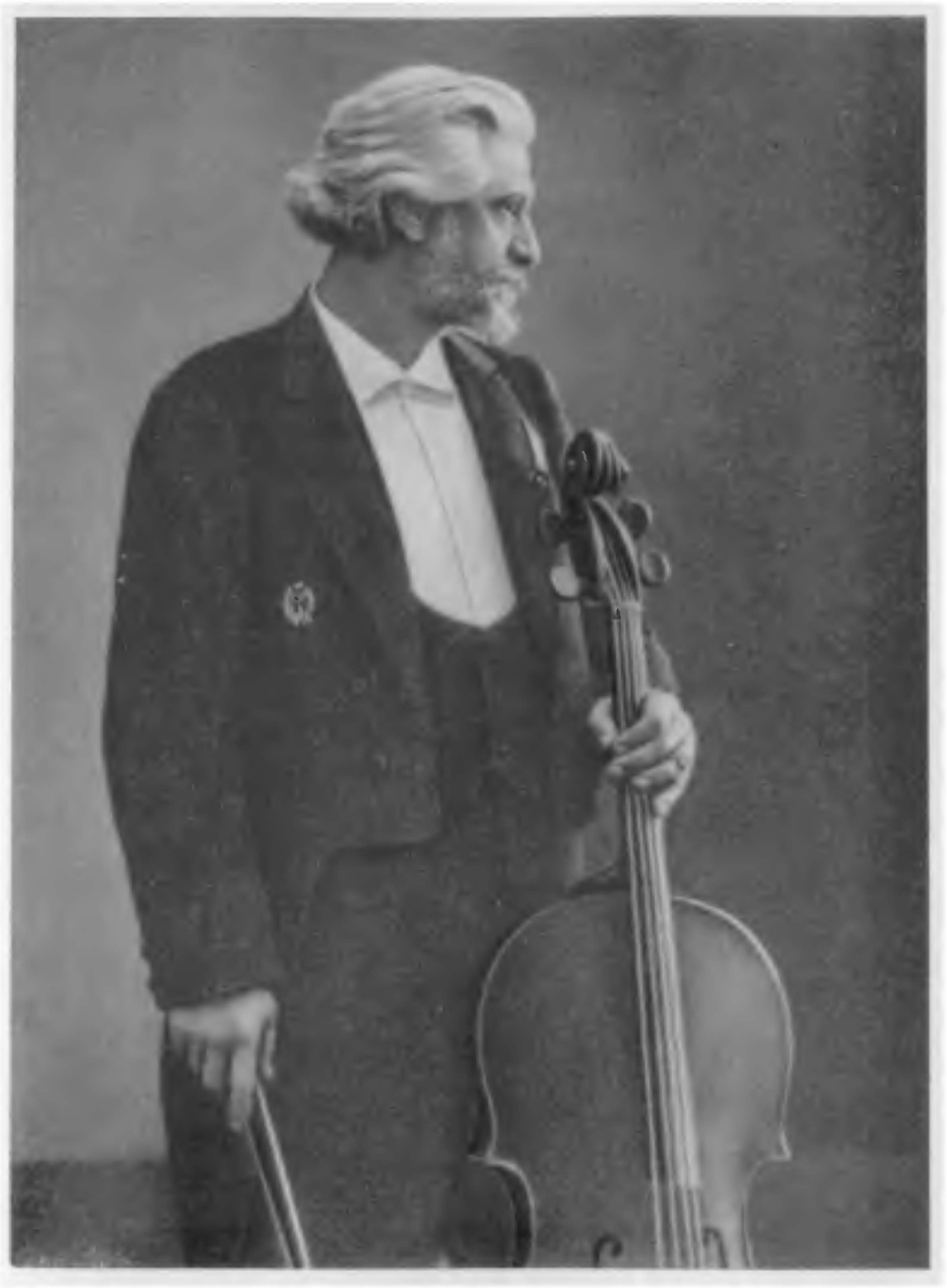
A. V. Verzhbilovich.
[p. 145]
Besides the aforementioned sonatas of Chopin and Rubinstein, A. V. Verzhbilovich performed sonatas by Beethoven, Mendelssohn, Grieg, Saint-Saëns, Strauss, and others. He was also already acquainted with Rachmaninov's remarkable Sonata and held it in high esteem.
Alexander Valerianovich's partners in sonata ensembles included such outstanding pianists as A. G. Rubinstein, V. I. Safonov, A. I. Siloti, P. A. Pabst, A. N. Essipoff, F. M. Blumenfeld, S. V. Rachmaninov, I. A. Borovka, D. D. Klimov, and others.
The high quality of Verzhbilovich's performances of Beethoven's sonatas was noted on more than one occasion in the press. When Alexander Valerianovich played Beethoven's Sonata in A major with the pianist Beniamino Cesi at one of the quartet meetings in 1887, the reviewer particularly praised “this first-rate cellist, who performed the cello part in Beethoven's Sonata with an enormous tone and artistic understanding.”¹
Following the performance of Beethoven's Sonata in G minor by A. V. Verzhbilovich and P. A. Pabst in Moscow in 1890, which enjoyed enormous success (they performed a movement from a sonata by Rubinstein as an encore), N. D. Kashkin wrote:
“Justice must be done to both artists—they fully deserved the unanimous and unceasing expressions of approval with which their delighted listeners rewarded them.”²
Another Moscow critic, S. N. Kruglikov, singles out in his review “the superb St. Petersburg cellist, Mr. Verzhbilovich, who enjoyed enormous success after performing Beethoven's Sonata together with Mr. Pabst. Indeed,” adds the reviewer, “the Sonata was played excellently by both artists.”³
In the 1880s, César Cui noted the musicality of Verzhbilovich's performance of Grieg's Sonata.⁴ N. D. Kashkin, reviewing a concert by A. I. Siloti and A. V. Verzhbilovich in 1900 (October 14), wrote of the well-deserved success of both artists and called their performance of R. Strauss's Sonata—the first in Moscow—“the most interesting item on the program.”
“Usually,” he observes, “such sonatas were and are written for piano with cello, whereas this one, on the contrary, is written for cello with piano.”⁵
Perhaps this conclusion was prompted by Verzhbilovich's more striking and impressive performance. To these same artists belongs the honor of the first performance of the Sonata in St. Petersburg, which took place ten days later.
In trios, A. V. Verzhbilovich frequently appeared with the pianists
[p. 146]
A. I. Siloti, S. I. Taneyev, A. S. Arensky, A. N. Essipoff, and F. M. Blumenfeld, with the violinists L. S. Auer and Jan Hřímalý, with S. Barcewicz, P. Sarasate, and many others.
On November 27, 1882, A. V. Verzhbilovich, in an ensemble with S. I. Taneyev and S. Barcewicz, participated in the first St. Petersburg performance of Tchaikovsky's Trio. Subsequently, he participated repeatedly in performances of this outstanding work. In particular, he played it with S. I. Taneyev and L. S. Auer at a quartet meeting of the Russian Musical Society devoted to the memory of P. I. Tchaikovsky (November 11, 1893), and with A. I. Siloti and L. S. Auer at a concert organized for the benefit of M. A. Vrubel (March 18, 1910).
Mention should be made of the St. Petersburg performance of Schubert's Trio in B-flat major in 1880 by an ensemble consisting of L. Brassin, P. Sarasate, and A. Verzhbilovich (at the same concert Verzhbilovich and Sarasate participated in a performance of Saint-Saëns's Sextet). In 1895, together with the composer and L. S. Auer, A. V. Verzhbilovich participated in a performance of Arensky's Trio. In the same year, with F. Blumenfeld, L. Auer, and F. Hildebrandt, he played a piano quartet by Brahms (according to the reviewer, the quartet was performed “with great taste and ensemble”).¹ In 1897, F. Blumenfeld, L. Auer, and A. Verzhbilovich gave the first performance of Nápravník's Second Trio.
At the beginning of our century, the trio consisting of professors of the St. Petersburg Conservatory A. N. Essipoff, L. S. Auer, and A. V. Verzhbilovich enjoyed great popularity. The artistic merits of this ensemble were repeatedly noted in the press,² although, according to the testimony of contemporaries, particularly M. F. Gnesin and A. V. Ossovsky, the difference between the performing styles of Auer and Verzhbilovich was especially perceptible in the trio. The refinement, emotional restraint, and relatively modest power of the former's tone contrasted with the enthusiasm and temperament of Verzhbilovich's playing, with its brilliant, rich, and heartfelt tone.
Beginning in 1880, Verzhbilovich was a member for twenty-five years of the quartet of the St. Petersburg branch of the Russian Musical Society (Auer played first violin in this ensemble), alternating with Davydov during the first years.
Playing in this excellent ensemble, whose repertoire included the finest works of the classical and contemporary repertoire, and which gave the first performances of many quartets by Russian composers, served as an excellent additional school for the young cellist.
“It is
[p. 147]
impossible even to imagine a better school for the further artistic development of this gifted cellist,” wrote César Cui, reporting Verzhbilovich's entry into the quartet.¹ It must be said that Verzhbilovich faced a far from easy task—to replace, in an already well-established ensemble, so sensitive and experienced a quartet player as Davydov. And the young musician coped magnificently with his new role. Following the quartet's first appearance with Verzhbilovich, the same César Cui wrote that the artist “acquitted himself with the greatest honor in the difficult, almost impossible task of replacing Mr. Davydov in the quartet.”²
Another St. Petersburg critic, K. P. Galler, also wrote of this performance:
“The first quartet meeting was of interest: Mr. Verzhbilovich took the place of K. Yu. Davydov. In Beethoven's Quartet (B-flat major, Op. 18) and Schumann's Quartet (F major, Op. 41), he performed the cello part with great talent and care, occasionally drawing attention to himself through the fullness of his tone and the unaffected elegance of his performance. I would observe, however,” added the reviewer, “that the individual qualities of the performers must recede into the background in a quartet for the sake of the artistic unity of the overall impression.”³
Apparently, it was not easy for Verzhbilovich to subordinate the striking individual qualities of his performing style to the style of the other members of the ensemble.
Having heard a performance of Tchaikovsky's Second Quartet in 1883, a contemporary ranks the quartet of the Russian Musical Society, playing in its usual formation—Auer, Pickel, Weickmann, and Verzhbilovich—alongside the finest quartets in the world and speaks of the exceptional understanding and exceptional elegance of performance characteristic of its members. The same reviewer, highly evaluating the aforementioned ensemble's performance of Schubert's Quartet in D minor, wrote:
“The Quartet was listened to with delight and aroused enthusiasm. The Adagio elicited thunderous applause; the public was electrified by it.”⁴ “Indeed, it is difficult to imagine a more perfect performance (Messrs. Auer and Verzhbilovich).”⁵
Nevertheless, in the press of that time one may also encounter observations such as the following, expressed by César Cui in 1898 after a performance of the same quartet in St. Petersburg by Sarasate, Auer, Korguev, and Verzhbilovich:
“In the variation in which the principal theme is entrusted to the cello, Mr. Verzhbilovich
[p. 148]
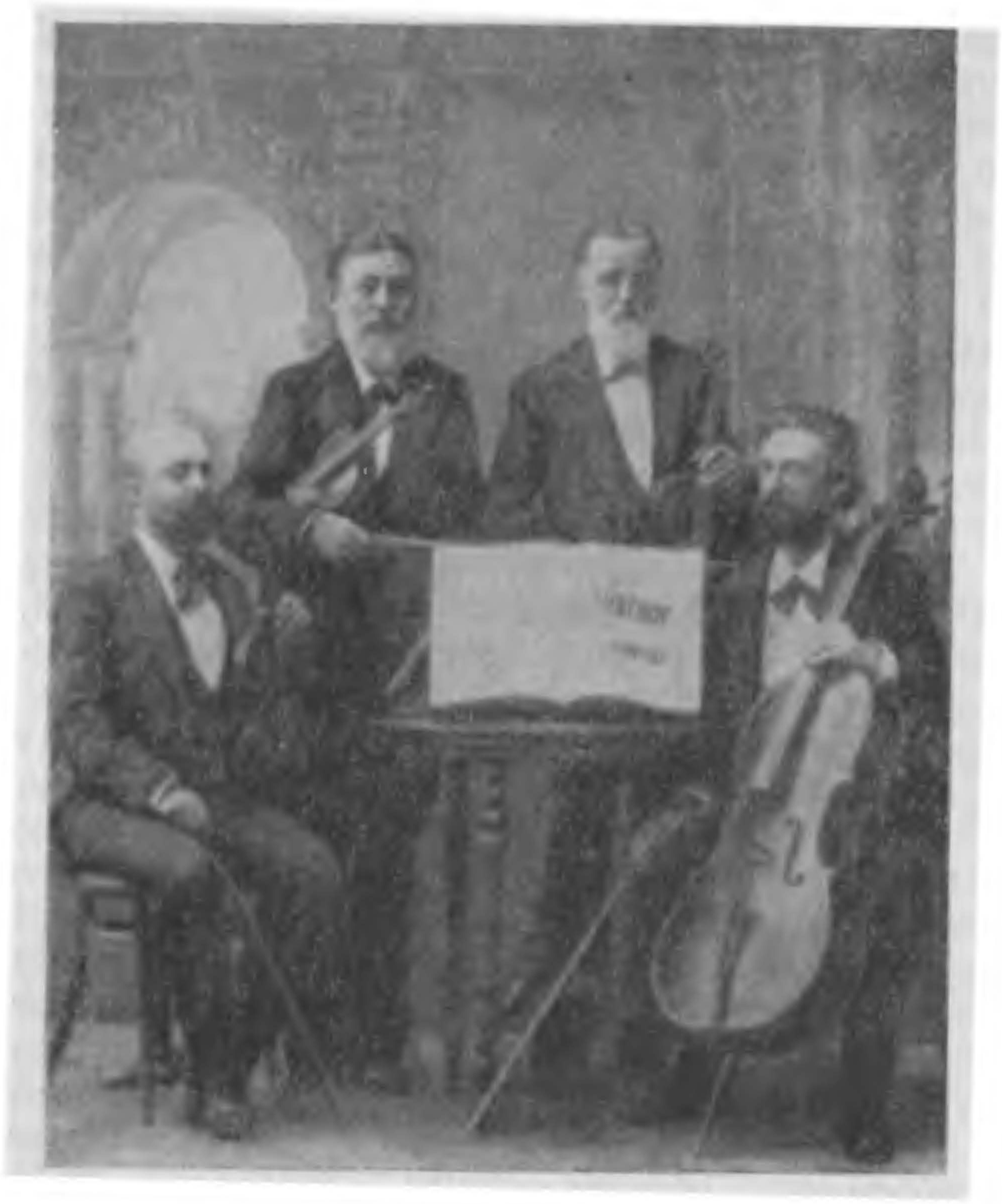
Quartet of the St. Petersburg branch of the Russian Musical Society (L. Auer, Johann Pickel, Hieronymus Weickmann, and A. Verzhbilovich).
abused the sonority and power of his tone; he completely drowned out and obliterated the charming patterns that Schubert entrusted to the first violin at this point.”¹ But if one imagines Verzhbilovich's powerful, manly tone and the beautiful, silvery, but dynamically less powerful tone of the Spanish virtuoso, one can understand the difficulty of the cellist's task, particularly in an episode in which the cello is the solo instrument.
From 1872, that is, from the first year of the existence of the St. Petersburg Chamber Music Society, A. V. Verzhbilovich also played for a number of years in the quartet of this Society,² of which he was an honorary member. As a member of
[p. 149]
the Society's quartet, Verzhbilovich participated in the first performances of Nápravník's Quartet (1883), Glazunov's Novelettes (1886) and Quatuor slave (1888), and a number of other chamber works.
In November 1890, A. V. Verzhbilovich, together with E. K. Albrecht, O. F. Hille, F. N. Hildebrandt, B. K. Heine, and A. V. Kuznetsov, participated in a performance of Tchaikovsky's newly written sextet Souvenir de Florence. The performance took place in St. Petersburg in P. I. Tchaikovsky's rooms at the Hotel Rossiya, in the presence of A. K. Glazunov, A. K. Lyadov, and several other prominent musicians. After this, the Sextet underwent some further revision and was then given its first public performance, likewise with Verzhbilovich's participation, on November 24, 1892, at a meeting of the Russian Musical Society, and the following day at a meeting of the St. Petersburg Chamber Music Society, to which the composer had dedicated the work. It is interesting that even before the first private performance of the Sextet, P. I. Tchaikovsky wrote in a letter to E. K. Albrecht:
“Where is Verzhbilovich? Without him I cannot imagine the performance of the first cello part.”¹
The concerts of the St. Petersburg Chamber Music Society saw the first performances of A. V. Kuznetsov's works for four cellos, in particular the Suite in C major, which was performed in October 1890 by A. V. Verzhbilovich, P. P. Fedorov, P. A. Ronginsky, and A. V. Kuznetsov.
Alexander Valerianovich also participated in the first performance of Glière's Sextet, which took place in January 1902 at a meeting of the St. Petersburg branch of the Russian Musical Society. The ensemble consisted of L. S. Auer, E. E. Krüger, S. P. Korguev, G. I. Warlich, A. V. Verzhbilovich, and V. F. Aloiz.
A. V. Verzhbilovich understood perfectly the educational importance of the Chamber Music Society and its role in popularizing contemporary Russian music. He particularly valued the creative, comradely, and democratic atmosphere of this Society, which he contrasted with the Imperial Russian Musical Society, where the “official” attitudes of the reactionary portion of the directorate and grand-ducal “patronage” manifested themselves in many ways. A. V. Verzhbilovich's attitude toward the aforementioned societies is vividly expressed in his letters to E. K. Albrecht. In one of them, expressing indignation at the conditions proposed to him for the continuation of his contract, and chiefly at the prohibition against playing in other concerts (in particular, at the concerts of the Chamber Music Society), the artist informs Albrecht of his reply to the directorate of the Russian Musical Society, in which he wrote:
“Under no circumstances and for no sum of money will I sell my Artistic Freedom, and I shall play,
[p. 150]
as long as my strength permits, in all the Societies with which I sympathize.”
In response to E. K. Albrecht's appeal to exercise restraint and prudence, Verzhbilovich thanks him for his friendly advice and adds: “...but I do not think I shall be capable of selling my freedom.”¹
And indeed, the artist continued to play at the concerts of various societies, particularly at many charitable concerts, appearing both as a soloist and as a member of all manner of chamber ensembles.
Let us note in passing that the financial conditions offered to A. V. Verzhbilovich by the Russian Musical Society corresponded neither to the outstanding merits of this artist nor to his manifold duties. In the spring of 1890, A. G. Rubinstein was compelled to speak specifically at a meeting of the directorate of the Russian Musical Society:
“Of the necessity of providing the senior teacher Verzhbilovich with a fixed salary for his instruction in the cello class, as well as remuneration for participation in quartet and symphonic meetings, in view of the fact that Verzhbilovich, being the only outstanding cellist we have in Russia of the solid school of the late K. Yu. Davydov, cannot easily be replaced by another person.”²
One cannot fail to note Verzhbilovich's regular participation in Belyayev's “Fridays,” where, in the presence of Rimsky-Korsakov, Borodin, Glazunov, and other leading Russian musicians, many of their chamber compositions were performed for the first time.
In addition, during his concert tours of various Russian cities, Verzhbilovich repeatedly appeared as a member of local quartets. An excellent quartet player, Verzhbilovich rapidly adapted himself to a new ensemble and became an integral part of it. Thus, following A. V. Verzhbilovich's appearance with Moscow quartet players (Jan Hřímalý, D. S. Krein, and V. Z. Salin) in 1890, N. D. Kashkin wrote:
“The last item on the program, P. I. Tchaikovsky's Quartet in F major, was performed with remarkable ensemble. A. V. Verzhbilovich, who played the cello part, proved himself a first-rate quartet player and at the same time a nature possessing a truly virtuosic temperament. His tone is distinguished by such fullness, power, and at the same time nobility of sound, and there is so much profound passion in it, that he completely conquers the listener.”³
[p. 151]
The outstanding qualities of A. V. Verzhbilovich as a chamber musician were also vividly apparent in his joint appearances with singers. The artist's duets with such remarkable singers as A. V. Panaeva, M. I. Dolina, E. A. Lavrovskaya, O. A. Skalkovskaya-Bertenson, M. I. Figner, E. I. Zbrueva, S. I. Druzyakina, and others enjoyed enormous success with listeners.
In a conversation with the author of this book, Professor S. I. Druzyakina of the Moscow Conservatory recalled with exceptional warmth Verzhbilovich, who in 1908 had agreed to accompany her, then a young singer, on a tour of Siberia and the Far East. She spoke of the joy that performances in ensemble with so sensitive a partner afforded her, a partner who inspired the singer and readily found a common artistic “language” with her.¹
According to contemporaries, the sound of Verzhbilovich's cello blended especially organically with the voice. The vocal quality of his musical phrasing and his sensitive understanding of the intentions of his singing partner made an indelible impression on listeners.
One may assume with considerable confidence that the popularity in Russia at the end of the nineteenth and beginning of the twentieth centuries of the very genre of the romance for voice with cello was due in no small measure to Verzhbilovich's singing and expressive bow.
Some romances were specially transcribed for voice with cello, the cello part being intended for Verzhbilovich. Thus, for example, in 1886 he performed Tchaikovsky's well-known romance None but the Lonely Heart with the singer P. N. Verevkina.
In ensemble with singers, Verzhbilovich also performed on many occasions such pieces as the Ukrainian song Khustochka, Braga's Serenata, Viardot's romance The Star, Denza's Romance, and other works popular at that time. Verzhbilovich's playing contributed to the success of such duets even in those cases when the pieces were not distinguished by any particular musical substance.²
In A. V. Verzhbilovich's glorious and lengthy performing career, the thirtieth anniversary of his artistic activity may be regarded as an important milestone. This date, marking the conclusion of the culminating period of his creative life, was solemnly celebrated by the Russian musical
[p. 152]
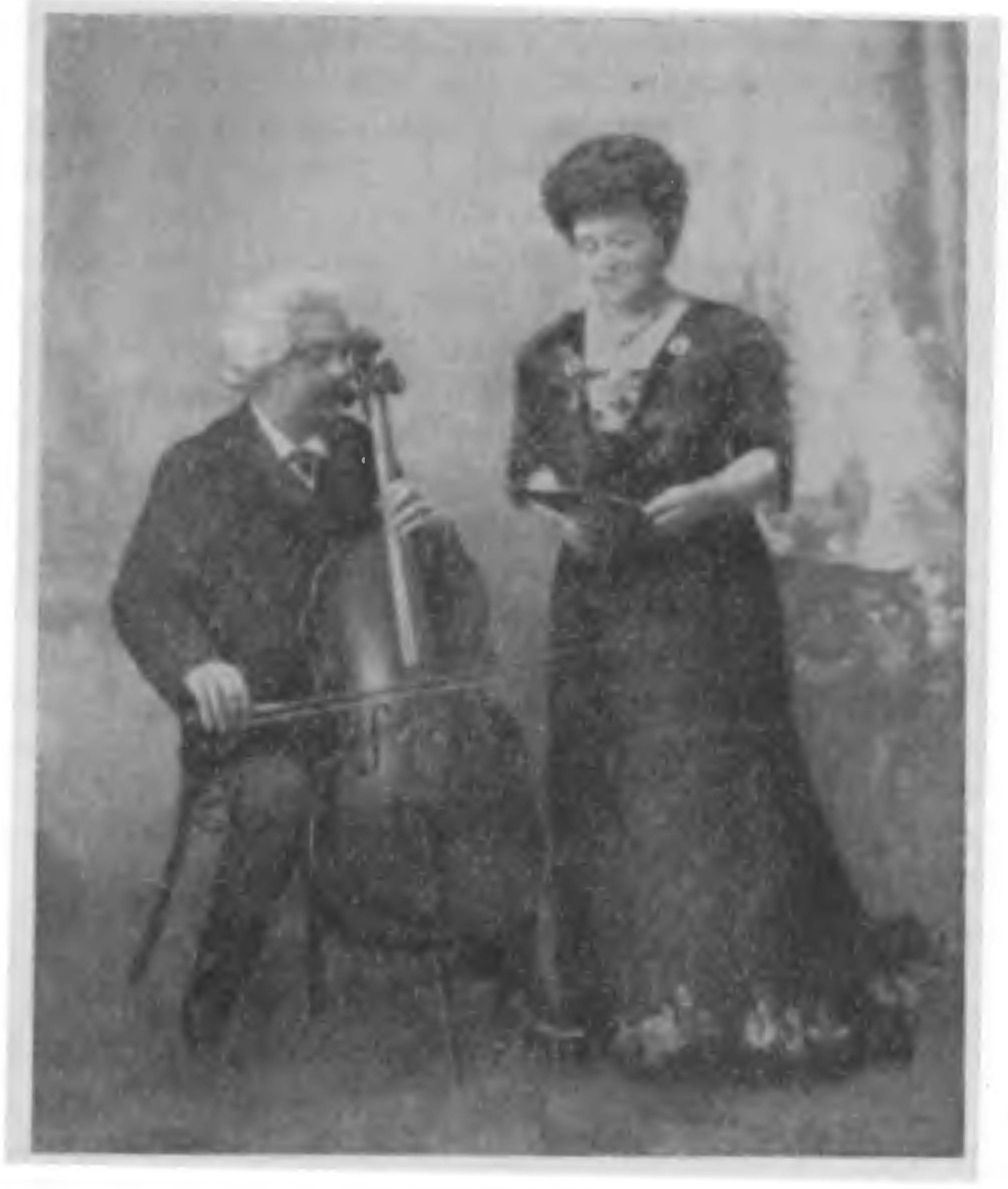
A. V. Verzhbilovich and M. I. Dolina.
community in St. Petersburg in 1903; the anniversary committee was headed by A. K. Glazunov.¹
On February 24 of that year, in the overcrowded Hall of the Nobility Assembly, the artist's anniversary concert took place, attracting the entire artistic community of the capital, broad circles of St. Petersburg music lovers, and the mass of students, of whom the talented cellist was a genuine favorite. Alongside the most prominent composers, present at the concert were V. V. Stasov,² the singers I. V. Yershov and I. V. Tartakov, the writer and artist N. N. Karazin, the painters V. A. Kotarbinsky and Ya. F. Tsionglinsky, and many others.
The concert program opened with a performance of Tchaikovsky's Trio, in which F. Blumenfeld, S. Barcewicz,
[p. 153]
and the honoree participated. Then S. Barcewicz performed Vieuxtemps's Concerto, and A. V. Verzhbilovich played Svendsen's Romance. In the second half, A. V. Verzhbilovich and F. M. Blumenfeld played Chopin's Sonata; Barcewicz performed Wilhelmj's paraphrase from Wagner's opera Die Meistersinger and Laub's Polonaise; Verzhbilovich played Glazunov's Chant du ménestrel and an Étude by Chopin.¹ The artists, and especially the honoree, played numerous encores. On this evening, Alexander Valerianovich played with particular expressiveness and enchantment.
During the intermission, a tribute was paid to the artist, who was presented with wreaths by his pupils, the cellists of the Russian Opera orchestra, and musical societies—the Polish society Lutnia and the German Liedertafel. In order not to tire the artist, the celebration continued after the concert, at dinner. Addresses were read from the directorate of the St. Petersburg Conservatory, the Russian Musical Society, the Society of Music Teachers, and others. More than five hundred congratulatory telegrams were sent to the honoree from various Russian cities and from abroad, including those from I. E. Repin, César Cui, S. I. Taneyev, A. S. Arensky, L. S. Auer, M. A. Slavina, G. A. Laroche, A. N. Essipoff, J. Svendsen, I. Paderewski, the members of the Quartet of the Duke of Mecklenburg, and many other representatives of Russian and foreign culture.
Toasts were proposed to Verzhbilovich, the “artist of sounds,” to the “precious bond between the two Slavic peoples—the Russians and the Poles,” and others. A poem dedicated to the honoree was read:
For thirty years, enchanting sounds
Your magic bow has brought to life;
The passions, joys, and sorrows of the heart
You poured into them with inspiration...
Sing on, dear friend, and cherish well
Your mighty, God-given talent!
It shines like a brilliant ray through the clouds
In the gloomy days of decadence.
It shines like a radiant star
For all who have devoted their lives to art,
Who, like you, have served it with their souls
And burned no incense to the golden calf.²
The artistic community of the capital sought to express its love and gratitude to the inspired artist, both as a remarkable, warmhearted person and as an outstanding musician, whose sincere and truthful, heartfelt and profoundly humane art stood in opposition to the formalistic
[p. 154]
decadence and cold aestheticism of certain champions of the “new” trends.
But it was not only among the inhabitants of St. Petersburg that Verzhbilovich enjoyed affection and popularity. Muscovites and the inhabitants of many other cities of the country where the artist appeared listened spellbound to his cello. He performed in the central and southern cities of Russia, in the cities of Transcaucasia and Central Asia, in Siberia and the Far East, in the Baltic region, and in the cities of Poland and Finland.
These concerts took place with enormous success and were of unquestionable significance for the development of musical life in a number of provincial Russian cities. Apart from the great artistic pleasure that the playing of the inspired artist afforded his listeners, it also contributed to the popularization of the cello as a solo instrument.
César Cui tells of the genuine triumph of A. V. Verzhbilovich's concert tour of Russia, which concluded with a concert given by him on April 9, 1898. He wrote of the artist's “sonority and beauty of cello tone,” of his “heartfelt, deeply felt, ardent, and captivating” performance, and of the public's “fanatical love for him.”¹
The art of Alexander Valerianovich attracted the broadest circles of listeners, finding its way to their hearts through its enchanting warmth, sincerity, and inspiration. His concerts in Kiev, Kharkov, Odessa, Kishinev, Samara, Kazan, Ekaterinodar, Rostov, Tiflis, Baku, Orenburg, Perm, Omsk, Tomsk, Novosibirsk, Irkutsk, Vladivostok, Khabarovsk, and other Russian cities took place as splendid musical celebrations, bringing joy to grateful listeners.
At the end of 1900, in one of his letters to his daughter, N. L. Sibor, L. S. Auer wrote that Verzhbilovich was setting out with Siloti on a six-month concert tour.
A. V. Verzhbilovich and A. I. Siloti undertook an even longer and highly successful tour in the following year. At that time, Verzhbilovich performed in his concerts both chamber sonatas (from Beethoven to Strauss) and solo cello pieces, particularly pieces by Russian composers (Davydov, Tchaikovsky, Arensky, Cui, Glazunov, Lyadov, and others).
An Odessa newspaper in 1901 emphasized Verzhbilovich's performance as “very substantial from the musical standpoint and imbued with great artistic enthusiasm.”²
Following the concert held in Kiev in October
[p. 155]
1901, a local reviewer, noting the “excellent qualities” of both concert artists, wrote, among other things:
“One does not often encounter such a brilliant and highly artistic performance of Beethoven's Cello Sonata... just as one does not often encounter so superb a cello virtuoso as Mr. Verzhbilovich...”¹
In 1904, a concert tour of Russia brought Alexander Valerianovich to Orenburg. There, a talented young cellist, Semyon Kozolupov, was introduced to him and played for him. Thanks to Verzhbilovich, who offered to take him into his class at the St. Petersburg Conservatory, the self-taught cellist, who came from a simple Cossack family, was afforded the opportunity to study in the capital and subsequently become a prominent musician.
The extensive tour undertaken by A. V. Verzhbilovich with S. I. Druzyakina and A. I. Alexeyev in the summer of 1908 was intended to extend as far as America. Its purpose, as reported in the press, was the popularization of Russian music.
“The cellist Professor A. V. Verzhbilovich, the singer S. I. Druzyakina, the pianist R. M. Rubinstein, and the baritone A. I. Alexeyev have undertaken a major tour to America through Central Asia, Siberia, Manchuria, China, and Japan. This first extensive tour to America has as its objective the promotion of Russian chamber music. The ensemble's first concert took place on May 9 in Samara.”²
This tour, however, came to an end two months later in the Far East.
Evlampiya Mikhailovna Savelova-Sozentovich (a pupil of A. N. Essipoff) tells of the enormous success that attended Verzhbilovich's appearance at their joint concert given in Harbin in July 1908 (after the termination of the tour with S. I. Druzyakina and A. I. Alexeyev). This pianist, who had heard Alexander Valerianovich play not only at public concerts but also in private, at A. N. Essipoff's home and in other St. Petersburg households, recalls:
“I have heard many first-rate cellists of international reputation, but I have never encountered such a sound, such a profound, soul-stirring tone. Bach's Air sounded particularly wonderful. At that time, he played principally small works by Popper, Davydov, and the like. These pieces were understood and enthusiastically received by any unprepared audience, and all his appearances were accompanied by enormous success.”
At the Harbin concert, A. V. Verzhbilovich played solo pieces by Bruch, van Goens, and others, and participated (with E. M. Sozentovich and L. P. Albrecht) in performances of trios by Glinka and Tchaikovsky.
When taking leave of E. M. Sozentovich, who at that time lived in the
[p. 156]
Far East, Verzhbilovich strongly recommended that she obtain the sonatas for cello and piano by Chopin, Strauss, and Rachmaninov. Rachmaninov's Sonata, written comparatively recently (in 1901), was already known to Verzhbilovich; its lyricism, singing quality, and poetry were particularly close to his artistic nature.
One cannot fail to note that Alexander Valerianovich's concerts abroad were likewise accompanied by great success. In the 1870s and 1880s, he appeared repeatedly in Paris. As early as 1875, on the recommendation of K. Yu. Davydov, he played at private musical gatherings in Paris, and in the 1880s he also appeared publicly. At the beginning of 1882, one of the St. Petersburg newspapers reported:
“The talented cellist A. V. Verzhbilovich has been invited to Paris to participate in the Pasdeloup concerts. The young cellist is well known to St. Petersburg and has always enjoyed great and entirely deserved success. We sincerely wish Mr. Verzhbilovich the same success in Paris and hope that the Parisian public will duly appreciate the talent of our artist.”¹
And indeed, his appearances in Paris, particularly at the Pasdeloup concerts, brought Verzhbilovich the full recognition of the French public.
The concerts organized by the French conductor Jules Pasdeloup in 1861 and continued until 1884 were of considerable educational significance. They were held in the Cirque d'Hiver, which accommodated thousands of listeners; affordable prices made it possible for the broadest circles of music lovers to attend the concerts. These concerts were called Concerts populaires (“Popular Concerts”). In February 1882, Verzhbilovich appeared at the Cirque d'Hiver, performing a concerto by Davydov with exceptional success, with an orchestra conducted by A. G. Rubinstein.² It was noted in the press that “Verzhbilovich made an extraordinarily strong impression on his listeners through his masterful and heartfelt playing.”³
Also known are the appearances of A. V. Verzhbilovich in musical circles in Vienna, in Constantinople (together with the harpist A. G. Zabel in 1890), in Warsaw, Copenhagen, Brussels, Naples, London, and in German cities (particularly Berlin, Leipzig, and Frankfurt am Main).
In February 1900, A. V. Verzhbilovich and A. I. Siloti made an exceptional impression at the Leipzig Gewandhaus. Verzhbilovich's concert took place on February 15 (the seventh subscription concert). The Leipzig correspondent of Russkaya Muzykalnaya Gazeta reported:
“The last two
[p. 157]
symphonic concerts, on February 15 and 22, took place with the participation of Russian artists. At the first of these, our talented A. V. Verzhbilovich appeared as soloist with Davydov's Fourth Concerto (E minor) and Bach's Air with string orchestra accompaniment. The artist enjoyed great success... The full and rich tone of his bow enchanted the listeners. Bach's Air, played with great feeling, gave one of the local critics occasion to find a certain passion of expression inappropriate; it seemed to him that Bach demanded a more cold-blooded performance! Cui's Cantabile, performed as an encore, pleased the public both through its content and through its outstanding performance.”¹
The Leipzig critic who wrote of an “inappropriate passion of expression” apparently belonged to those who found in Bach's works nothing but rationalistic austerity and abstract grandeur. The Russian artist, on the other hand, as far as one can judge from his surviving recording of Bach's Air, sought to reveal in it a profoundly human and emotional element. At the same time, in performing this piece warmly and expressively, he played it considerably more strictly than he played pieces by his contemporary composers.
Of the same concert at the Gewandhaus, the well-known German critic E. Bernsdorf wrote:
“The cellist Verzhbilovich was received with exceptional friendliness. As a performer, he distinguished himself by noteworthy finger and bow technique and a beautiful tone, although not entirely free from harshness (?!). But his chief merit lies in his deeply felt performance of cantilena, as was particularly evident in the Adagio from Davydov's Fourth Concerto (E minor) and in the celebrated Air from J. S. Bach's Suite in D major. At the insistent demand of the public, Mr. Verzhbilovich performed as an encore a Romance (Cantabile. — L. G.) by César Cui (with piano accompaniment), in which he once again displayed the aforementioned principal quality.”²
At the end of 1900, Verzhbilovich and Siloti again undertook a concert tour abroad, giving a number of concerts in Germany, Holland, and England.
“The tour lasted a month and a half,” wrote a correspondent of a St. Petersburg newspaper, “and was accompanied by great success for both concert artists. With their participation, Arensky's new Quintet was performed for the first time in Germany (Frankfurt). In the majority of the foreign
[p. 158]
cities, A. V. Verzhbilovich was making his debut and produced a great impression through his wonderful tone.”¹
Despite the success that accompanied Verzhbilovich's appearances abroad, he agreed to foreign tours very reluctantly. According to the testimony of the well-known Swiss music critic Aloys Mooser, who knew him well (Mooser lived in St. Petersburg from 1896 to 1909, where he studied with M. A. Balakirev), Verzhbilovich repeatedly declined proposals from P. Casals, A. Siloti, and other musicians to undertake concert tours abroad. In doing so, he found all manner of pretexts, and on one occasion jokingly declared to A. Mooser:
“You know, my dear fellow, all that is very well... But I am accustomed to eating pickled cucumbers with my dinner; I adore them, and over there, abroad, they have none...”²
The surviving impressions and accounts of contemporaries concerning A. V. Verzhbilovich's playing (some of which have already been quoted by us), as well as gramophone recordings of his performances, allow us to draw certain conclusions concerning the performing style of this outstanding artist.
A. V. Verzhbilovich appears before us as a brilliant representative of the Russian school of musical performance, with its characteristic profound expressiveness, truthfulness, and sincerity.
The exceptional power of emotional influence upon listeners inherent in Verzhbilovich's art was explained above all by the expressiveness and penetrating lyricism, inspiration, and artistry of his performance. The press repeatedly noted the artist's “captivating and deeply felt rendering” and the “genuine expressiveness and deeply felt quality of his performance.”³
He never played with indifference; consequently, the listener never remained indifferent to his playing. The audience was usually captivated by his playing, which, according to contemporaries, literally moved them to tears. It seemed to everyone that the beloved artist was addressing him personally in the language of his art, that it was precisely his own feelings and experiences that the artist was expressing.
“He was the genuine favorite of musicians and the public,” wrote the critic V. S. Baskin in one of the numerous obituaries devoted to Verzhbilovich. “His mighty tone of uncommon power, his singing bow, his temperament, and his musical phrasing
[p. 159]
could not fail to captivate everyone, even those indifferent to music.”¹
The following lines, written on the occasion of the thirtieth anniversary of the artist's career, testify no less vividly to the power of Verzhbilovich's art to influence an audience:
“The wonderful talent of this remarkable cellist has this particular quality: no matter how many times you may have heard Mr. Verzhbilovich's playing, it always produces a fresh impression and irresistibly affects the listener through its warmth. Inspired interpretation in music is such a powerful element that even an overplayed piece, literally known measure by measure, constantly and invariably holds one's attention when performed by Mr. Verzhbilovich—so powerful is his playing in its expressiveness and its inexhaustible beauties.
“The chief and rare quality of Mr. Verzhbilovich's playing is his bel canto on the cello, the charm and variety of his phrasing, and those wonderful gradations of sound that distinguish the singing of his bow.
“While playing, Mr. Verzhbilovich transports himself into the broad realm of poetry and carries the listener's imagination with him, compelling the listener to experience truly beautiful moments.”²
Verzhbilovich's interpretation was characterized by a genuinely creative element. The pieces he performed seemed to come to life under his bow and were revealed to the listener in the artist's artistic, emotionally warmed, and penetrating rendering. His phrasing was natural, spontaneous, and always poetic.
Particularly characteristic of Verzhbilovich's phrasing was his distinctive use of rubato, perhaps justified only in his own performance. The vividness and relief of his musical phrasing were greatly enhanced by such performing devices as emphasizing and bringing out the culminating moments of the musical thought and its principal intonations. This was achieved now by prolonging the culminating note, now by an expressive glissando (portamento), and now by intensive vibrato. Examples of such vividly delineated climaxes may be heard in his gramophone recordings of Glinka's Doubt or Davydov's Romance sans paroles.
Verzhbilovich had fathomed the nature of the cello so profoundly that to listeners the artist and the instrument appeared to be one. To an astonishing degree, he possessed a culture of expressive sound, which he commanded in all its dynamic and timbral gradations. Verzhbilovich's beautiful, warm tone, distinguished at the same time by its fullness and richness, was employed by him in complete accordance with the artistic
[p. 160]
content of the work being performed and was characterized by a richness and variety of nuances.
The broad “breathing” of the bow, in combination with the heartfelt quality of the musical phrase, imparted a vocal character to his cantilena and brought the sounds of his cello close to those of the singing human voice.
Verzhbilovich made excellent use of the timbral characteristics of the different registers of the cello. Particularly impressive in his playing were the tenderness and at the same time the temperament of the tenor register, and the Chaliapin-like—manly and velvety—sound of the bass register.
Contemporaries constantly describe Verzhbilovich's bow as magical and enchanting. “His tone was enchanting, full, caressing, and soft,” recalls A. I. Bryullova, who heard Verzhbilovich on numerous occasions.¹
“His magic bow,” writes one of the reviewers, “long ago won for him all the hearts of St. Petersburg. Having inherited from his celebrated teacher K. Yu. Davydov the rare softness of his bow, he further intensified the latter's enchantment through an extraordinary passion that, by virtue of its exceptional character, completely captivated each and every one of his listeners.”²
“His enchanting bow,” recalls another contemporary of the artist, “exerted just as irresistibly charming an effect upon the ear as the voice of a chosen singer. In the realm of sound and tone drawn from his instrument, Verzhbilovich positively knew no rival. The extraordinary richness, beauty, and singing quality of his magic bow were combined with a manly power and fullness of tone, particularly apparent in compositions of a singing and energetic character.”³
Of unquestionable importance to Verzhbilovich's sound were also such expressive means specific to bowed instruments as vibrato and portamento. These devices were employed by the artist with extraordinary breadth, but always in accordance with his own understanding of the content of the music being performed. And even if, at times, particularly in the final years of his life, certain elements of salon style appeared in his interpretation through the use of these expressive means, they were redeemed by the rare sincerity and profound feeling of his playing.
According to the testimony of a number of contemporaries, in addition to his beautiful sound, Verzhbilovich possessed a natural technique that enabled him to perform the concertos of Davydov and Schumann or the fantasies of Servais. M. I. Yampolsky, who heard him in his youth (in
[p. 161]
Kiev) Verzhbilovich's performances of the concertos of Davydov and Goltermann (A minor), as well as Servais's fantasy Le Désir, recalls not only the artist's beautiful and expressive sound but also his technical mastery (particularly his double-stop technique and bouncing bow strokes).
This was still the period of the flourishing of Verzhbilovich's performing career. From the end of the 1890s, however, he apparently did very little work on perfecting and maintaining his technique, which subsequently could not fail to affect his performance of certain works and the quality of individual technical devices. But even in these instances, the audience, captivated by the artistry and inspiration of the performer, seemed not to notice any of this and received the artist enthusiastically. Numerous accounts by contemporaries testify to this, particularly a review in a Moscow newspaper in 1902. Noting that Verzhbilovich, confident in the public's unwavering affection for him, worked insufficiently on the details of the works he performed, the author writes:
“His great artistic temperament or, more simply, his ability to become carried away by the music he performs and to carry his listeners along with him nevertheless compels one to forgive him these shortcomings.”¹
N. D. Kashkin approached the same problem somewhat differently in a review of 1900:
“A. V. Verzhbilovich belongs among the most individual artistic personalities in his manner of playing. There is scarcely another cellist who can rival him in the power, nobility, and beauty of his tone. He does not particularly pursue minor virtuoso effects, and indeed, in his own playing they pale beside merits of a greater order and more suited to the character of the instrument.”²
Being, as Alexander Valerianovich's pupil E. V. Wolf-Israel wrote, “a convinced adherent of the performing principles of his teacher Davydov, Verzhbilovich... was renowned for the exceptional expressiveness of his performance. Following Davydov's principles, he never made technique an end in itself, always subordinating it to a definite artistic objective.”
“Verzhbilovich did not possess brilliant virtuoso technique,” recalls the same pupil of the artist, “but he performed works of a cantabile character in such a way that few cellists of international reputation could compare with him.”³
And indeed, the performing style of this cellist-artist manifested itself with particular vividness in cello miniatures. Following one of Verzhbilovich's Moscow concerts, which took place in 1898 and was confined principally
[p. 162]
to the performance of small pieces, I. V. Lipaev wrote:
“It was exceedingly regrettable that this wonderful, noble artist had not presented his listeners with a more or less substantial program... But how he played it all! What life, inspiration, and musicality, what power in the tone of his instrument, what finish in his technique!”¹
The genre of the small piece of emotional and lyrical content was the artist's true element. In this realm, as no one else, he knew how to express much with little.
“The culture of tone in small-scale cello works of a cantabile character reaches its expressive apogee in the performing art of Davydov's pupils, A. V. Verzhbilovich and N. N. Loganovsky,” observes B. A. Struve in one of his articles.² This thought of the Soviet researcher finds confirmation in Verzhbilovich's gramophone recordings, particularly in his performances of Bach's Air, Glinka's Doubt, Tchaikovsky's Chanson triste, and Davydov's Romance sans paroles.
Verzhbilovich's performing mastery stood at a high level even in comparison with that of the greatest foreign cellists.
“Verzhbilovich long ago became the favorite of our public,” wrote one of the artist's contemporaries at the end of the preceding century. “There is something enchanting in his bow. Among the contemporary cellists with whom I have had occasion to play, such as Servais the younger, Léon Jacquard, Lois, Piatti, Édouard Jacobs, Jules Delsart, and others, I have not encountered a tone as expressive and as stirring to the heart as Verzhbilovich's, and it is in this, essentially, that the principal charm of cello playing consists.”³
When, in 1898 in St. Petersburg, the well-known cellist Henry Bramsen performed Davydov's Concerto in A minor with an orchestra conducted by V. I. Safonov, Nik. Findeizen, noting the good quality of the performance and the virtuoso technique of the concert artist, reproached him for insufficient poetry in his interpretation.
“His cello,” he wrote, “does not sing as Verzhbilovich's cello sings, weeps, and captivates.”⁴
In reviews of Verzhbilovich's concerts, one could frequently encounter responses such as the following:
“We may boldly say that of all the cellists we have heard, Russian and foreign alike, not one possesses so full, mighty, powerful, and at the same time singing a tone as Mr. Verzhbilovich. He sings on the cello, and this singing sinks deep into the soul for a long time to come.”⁵
[p. 163]
The foreign historians of the art of the cello—Wilhelm Joseph von Wasielewski,¹ Cornélis Liégeois and Édouard Nogué,² and E. van der Straeten³—speak with praise of Verzhbilovich's performing art, particularly of his beautiful, expressive sound. The last of these, a prominent musicologist of the end of the preceding and beginning of our century, notes Verzhbilovich's exceptional talent and names him the foremost among Russian cellists.
The prominent foreign cellists David Popper, Louis (Lajos) Hegyesi, Julius Klengel, who said that “not a single European cellist has a tone such as Verzhbilovich's,”⁴ and others held their Russian contemporary in high esteem. According to the recollections of A. Mooser, Pablo Casals likewise admired the expressiveness of Verzhbilovich's playing; A. Mooser finds much in common in the phrasing of both cellists.
“Verzhbilovich's sound,” he writes, “was wonderful, pure (I never heard Verzhbilovich play out of tune), exceptionally powerful, full, singing, and particularly noble. His performing style recalls that of Casals: extraordinarily simple and expressive, without any affected sentimentality. The rhythm is firm, but always flexible. And in all this there is life, warmth, and emotion.”⁵
One of the outstanding musicians of our time, Efrem Zimbalist, a pupil of the St. Petersburg Conservatory, who was in Moscow in 1958 in connection with the International Tchaikovsky Competition, declared in response to our question about Verzhbilovich, whose playing he had frequently heard:
“I shall never forget the musicality of his phrasing, his warm, expressive sound. He was a remarkable artist, a wonderful person, and a fine colleague.”
Finally, let us cite the impressions of the art of the celebrated cellist recorded at our request by A. B. Goldenweiser:
“I heard Alexander Valerianovich Verzhbilovich on numerous occasions, both as a member of a quartet and as a soloist. A vivid impression of him has remained with me. Verzhbilovich was a very talented cellist and musician with a strongly pronounced individuality and great nobility.
“The distinctive quality of Verzhbilovich as a performer was a sound of astonishing beauty and power. I heard such a sound only from the Czech cellist Hanuš Wihan, a member and artistic director of the celebrated Czech Quartet.
[p. 164]
“The brilliant sound and nobility of Verzhbilovich's performance left me with such a memory that I seem to hear him even now, after the passage of many decades.”
Although Verzhbilovich's principal significance in the history of Russian musical culture lies in his remarkable performing art, one must not forget his pedagogical activity. If we recall that with the development of Russian musical life the demand for cellists as performers (orchestral players, chamber musicians, and concert artists) and teachers increased considerably,¹ it will not be difficult to imagine the role and significance of A. V. Verzhbilovich, I. I. Seifert, A. E. von Glehn, and several other cellists who taught at Russian conservatories at the end of the preceding century and the beginning of our own, training young musicians in this specialty.
Alexander Valerianovich taught at the St. Petersburg Conservatory from 1882 to 1884 and, following the departure of K. Yu. Davydov, from 1887² to 1911.³ Verzhbilovich held the title of Honored Professor of the conservatory. Among those who studied in his class at various times were Raimund von Bööcke, D. Bzul, G. Bloch, Yu. Bologovskaya, A. Borisyak, Stefan Wilkoński, E. Wolf-Israel, M. Gordel, N. Grinberg, V. Gutor, A. Davydov, V. Dobrokhotov, S. Kozolupov, B. Kuznetsov, E. Malmgren, M. Miklashevsky, E. Petrov, N. Popov, Ya. Rosenthal, Leopold Rostropovich, Ar. Rubinstein, B. Stepinsky, P. Fedorov, Oto Fogelmanis, G. Yatsentkovsky (Gheorghe Iațencovschi), and others.
But one learned from Verzhbilovich not only in lessons but also at concerts. In this sense, the circle of his pupils was not confined to those enrolled in his class.
A. V. Verzhbilovich devoted comparatively little
[p. 165]
attention to pedagogy; his temperament drew him principally toward concert activity. The artist's frequent concert tours, and during the final decade his deteriorating health as well, interfered with systematic and regular work in the classroom. Nevertheless, his influence upon his pupils was very great. According to the testimony of some of them, he frequently played himself during lessons, which aroused the particular interest of the young cellists.
In his class, little attention was devoted to scales and études. The concertos of Haydn, Saint-Saëns, Davydov, Romberg, Molique, and de Swert, the fantasies of Servais, and pieces by Davydov, Cui, Glazunov, Chopin, and Popper were studied. In Romberg's concertos, Verzhbilovich altered the fingerings in accordance with Davydov's principles (the “linear” principle of fingering).¹
He attached particular importance to the development of an expressive and dynamically varied sound. Stefan Wilkoński recalls Verzhbilovich's explanations concerning the development of “sensitivity of the right hand.” At the same time, Alexander Valerianovich masterfully demonstrated on the cello how sounds should be played so as to recede or approach (“sound perspective”).
“A. V. often told us that the cello, in its tonal character and range, approaches the human voice,” continues Wilkoński, “and that the more cello playing resembles the voice, the greater the impression it will produce upon the audience. He demonstrated the truth of these words through his own playing.”
In speaking to his pupils about cantilena, Verzhbilovich frequently held up as examples the outstanding singers of his time—Masini, Battistini, Caruso, Chaliapin, and Sobinov.
Concerning rubato and other performing devices, he “explained them not as a caprice of the artist but as a striving to introduce the truth of life into the performance of musical phrases—to free oneself, as far as possible, from a dry, literal performance pursuing only an impeccably faultless technical form.” He said that “the most important thing is the composer's artistic conception, without the revelation of which the performance will be dry and dead.”
In this, as in many other respects, A. V. Verzhbilovich, while preserving his striking individual characteristics, was close to his teacher, K. Yu. Davydov. Their mutual contemporary was right in observing that “if Davydov and Verzhbilovich
[p. 166]
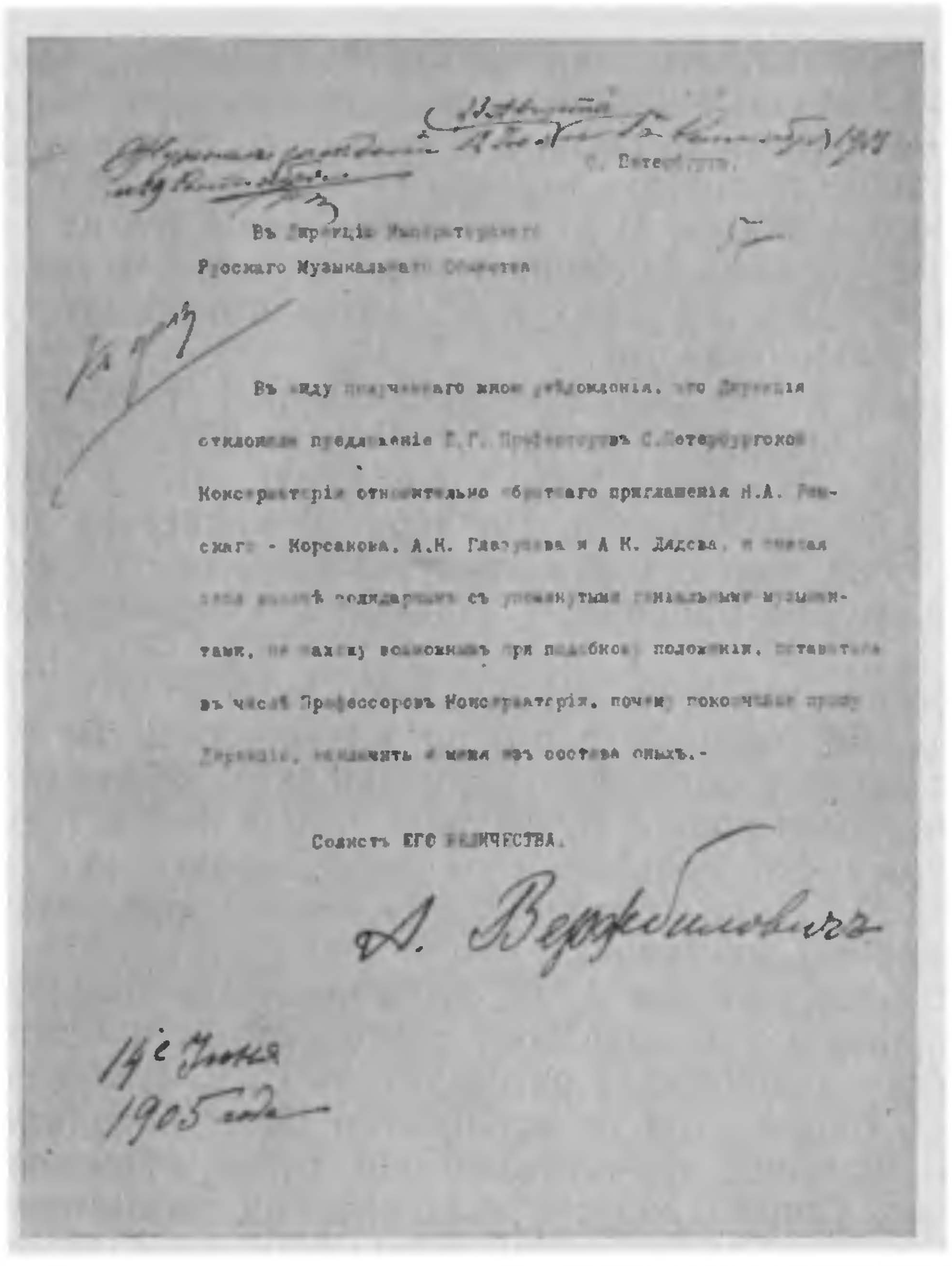
Petition of A. V. Verzhbilovich (1905) (GIALO).
were not twin brothers in their art, they complemented and blended with one another remarkably. Verzhbilovich quite worthily occupied the chair of his former professor, preserving the principles of his school while at the same time imparting to his pupils a part of his own artistic personality.”¹
A. V. Verzhbilovich treated his pupils warmly and cordially, displaying rare patience and tact. He frequently lent them his valuable instrument (Montagnana) for important performances. If a pupil was in need, Verzhbilovich was always prepared to teach him without remuneration (as was the case, for example, with Ya. S. Rosenthal²).
The deeply humane attitude
[p. 167]
of A. V. Verzhbilovich toward students, as well as the nobility of his nature in general, manifested itself with particular vividness during the Revolution of 1905, when, without hesitation, he sided with the most progressive portion of the professorial staff that supported the revolutionary students. A. V. Verzhbilovich was among those who signed the statement calling for the removal of the director of the conservatory, A. R. Bernhard—a conservative and narrow-minded man—for the closing of the conservatory in accordance with the demands of the progressive portion of the conservatory community, and for the protection of students from police persecution.¹
When, following the dismissal of N. A. Rimsky-Korsakov, A. K. Glazunov and A. K. Lyadov resigned from the professorial staff of the St. Petersburg Conservatory, A. N. Essipoff, F. M. Blumenfeld, A. V. Verzhbilovich, and several other professors likewise left the conservatory as a sign of solidarity with them and in protest against the provocative policies of the reactionary directorate of the Russian Musical Society.
In June 1905, E. P. Glazunova (the mother of A. K. Glazunov) reported in a letter to N. A. Rimsky-Korsakov:
“Yesterday Verzhbilovich wrote to Sasha that he considered it humiliating for himself to remain at the conservatory any longer, and that he had written to them to that effect.”²
Verzhbilovich's statement to the directorate of the Russian Musical Society concerning his solidarity with Rimsky-Korsakov, Glazunov, and Lyadov and his departure from the conservatory is dated June 14, 1905.³ And some time later, A. K. Lyadov wrote to N. I. Abramychev:
“I rejoice at Verzhbilovich's departure from the conservatory... since it proves that the entire conservatory has not yet become rotten with servility.”⁴
V. Kolomiytsev wrote at the time of Verzhbilovich's civic courage.⁵
In November 1905, A. V. Verzhbilovich, together with A. K. Glazunov, A. I. Siloti, Efrem Zimbalist, I. V. Tartakov, and others, participated in a concert for the benefit of a fund for the establishment of a mutual assistance fund for the conservatory's students. On December 4 of that year, he appeared with great success at a concert organized by N. A. Rimsky-Korsakov “for the benefit of the families of needy workers.” The concert, in which F. M. Blumenfeld, I. V. Tartakov, A. I. Siloti, and others also participated, concluded with the singing of revolutionary songs.⁶
[p. 168]
A. V. Verzhbilovich, together with the other professors, returned to the conservatory only in December 1905, when the Artistic Council of this educational institution was granted certain rights and A. K. Glazunov was elected its director.¹
Despite his illness, Verzhbilovich continued to appear in his class even during the final years of his life, overcoming his indisposition, although he frequently asked either I. I. Seifert or P. P. Fedorov to substitute for him.
“This season I wish to make every effort to be regular in my lessons at the conservatory,” he wrote in the summer of 1907 to the inspector of the conservatory, N. I. Abramychev.²
At this time, Alexander Valerianovich also conducted a chamber ensemble class at the St. Petersburg Conservatory, which naturally attracted his attention as a sensitive chamber musician. Of interest in this connection is his letter of November 22, 1907, addressed to A. K. Glazunov, who was then director of the conservatory:
“Dear friend Sasha,
“My eyes are driving me to despair. I am feeling so unwell again that the doctor has confined me to a dark room and strictly forbidden me to read and, above all, to look at music. My only consolation is the cello.
“I ask you, dear friend, to convey to the dear young ladies of my classe d'ensemble that I grieve for them endlessly, and to ask them to believe that it pains me greatly to miss the class that I have come to love with all my heart. My imprisonment in the dark room will probably last no more than one more day.
“Entirely yours, who adores you,
“A. Verzhbilovich.”³
As soon as his health permitted, Verzhbilovich was once again with his pupils and once again appeared at numerous charitable concerts, particularly for the benefit of students, whom he sincerely loved. Verzhbilovich's name alone on the poster of a charitable concert was sufficient to ensure its financial success. And his name is constantly encountered in the programs of concerts for the benefit of mutual assistance funds for conservatory students, for the benefit of needy conservatory students, “for the benefit of needy pupils of the Kolomna Girls' Gymnasium,” “for the benefit of the widows and orphans of fallen soldiers,” “for
[p. 169]
the benefit of a collection to purchase warm clothing for sick and wounded soldiers,” “for the benefit of the Assistance Fund for Musical Artists,” “for the benefit of the fund for the assistance of widows and orphans of musical artists in Moscow,” simply for the benefit of an ailing St. Petersburg musician, and so forth.¹
The artist's responsive heart was always ready to answer an appeal, whether it was necessary to intercede on behalf of the unjustly accused orchestral cellist Brattsev,² to petition “for the issuance of a passport to a poor but very talented artist (a Jew),”³ or in many other instances requiring his assistance.
We encounter the name of A. V. Verzhbilovich among the founders of the People's Conservatory established in St. Petersburg in 1908, alongside the names of N. A. Rimsky-Korsakov, A. K. Lyadov, E. I. Zbrueva, V. V. Andreyev, M. M. Fokine, and other prominent musical figures. Alexander Valerianovich repeatedly participated in other educational initiatives as well, particularly in the conservatory's public educational concerts.
In December 1909, he participated in a symphonic concert (conducted by A. K. Glazunov) devoted to the fiftieth anniversary of the Russian Musical Society, at which he performed pieces by Davydov. At the beginning of January 1910, he played poetically and with inspiration at a concert organized in connection with the seventy-fifth birthday of César Cui.
Although the artist's health continued to deteriorate in the ensuing years, he retained his class at the conservatory and still appeared occasionally on the concert platform. When the fiftieth anniversary of the Russian Musical Society was celebrated in Odessa on January 15, 1910, A. V. Verzhbilovich appeared at a symphonic meeting (conducted by V. I. Maliszewski) and successfully performed Glazunov's Chant du ménestrel and Chant espagnol, Arensky's Chanson triste, and Davydov's Waltz.
“What a wonderful musician! What a beautiful interpretation of everything he performs!” exclaims the reviewer of this concert.⁴
“Enormous technique, a broad, singing tone, and beautiful phrasing enchant the listener,” wrote another reviewer.⁵
Two days later, at a chamber music meeting, the artist participated
[p. 170]
in performances of Grieg's Sonata (with S. V. Tarnovsky), Beethoven's Trio in C minor (with S. V. Tarnovsky and Jaroslav Kocián), and Schubert's Quintet (with the local quartet consisting of Jaroslav Kocián, František Stupka, I. Perman, and Ladislav Zelenka).
On February 13, 1910, in the Small Hall of the St. Petersburg Conservatory, what was apparently Alexander Valerianovich's last solo concert took place.¹ His friends, professional St. Petersburg musicians (the pianist M. A. Iordan, the singer A. V. Osokina, and the accompanist M. T. Dulov), participated in it, as did the artist's very young pupil E. Zamshteigman, who played K. Schuberth's Nocturne élégiaque with his teacher.²
“Mr. Verzhbilovich's magic bow positively bewitched the public,” wrote one of the reviewers of this concert. “With what extraordinary singing quality, for example, with what nobility of tone, the wonderful artist rendered Chopin's Étude, played as an encore... Indeed, all the other pieces, too... came off as beautifully as one could possibly wish.”³
Thus, literally until his last concert, the celebrated artist retained the finest qualities of his inspired art.
At approximately this time, a malignant tumor was discovered on Verzhbilovich's leg. The illness progressed rapidly. On the advice of physicians, who considered an operation useless, he traveled to the Caucasus; his two-month stay there, however, brought no improvement in his health. By autumn his eyesight had deteriorated considerably, and he was admitted to the Alexandrovskaya Hospital. Despite the assistance of friends,⁴ he found himself during these years in extremely straitened circumstances bordering on poverty.
After suffering for more than a year, Alexander Valerianovich died at his home on March 2, 1911.
There was scarcely a newspaper or even a journal in Russia that did not devote at least a few warm lines to the beloved artist.
Here are some of the responses to the death of A. V. Verzhbilovich:
“There are not many names in the arts as popular as that of the departed artist. With his beautiful
[p. 171]
lyre, he invariably awakened kindly feelings—this is why he was so popular and beloved... Who did not know his expressive, inspired face, his stately figure, his distinctive, handsome head whitened by a silvery lock of hair... And now he is no more!..”¹
“The cello of the departed artist produced enchanting sounds; it sang now with the voices of heaven, now with the passionate melodies of earth. The departed artist was recognized and appreciated abroad, where his concerts were an uninterrupted triumph, while in Russia he was a genuine favorite of the public, which not only admired his playing but also welcomed in him the responsive artist who selflessly participated in a multitude of charitable concerts.”²
“Everything made him appealing: his great talent, his playing full of passion and tenderness, his lovely character, and finally his very appearance disposed one in his favor. Wherever he appeared, at a large or small concert or at evenings in private homes, they would not let him go once he took up his bow, so singing, soft, and caressing...”³
“Fullness and at the same time softness of tone and profound expression—these were the distinguishing characteristics of the departed artist, qualities that scarcely any of the Western cellists of our time possessed to the same degree as Verzhbilovich.”⁴
“His name, like an enchanting harmony, is passed on to posterity. 'Verzhbilovich'—how extraordinarily soft, lyrical, and even elegiac it sounds. No other virtuoso possessed such unrestricted access to every human heart. When this handsome old man with his mane of gray hair appeared on the concert platform and... sat down at his beloved instrument, the entire hall became motionless... for it knew that it was about to hear something very intimate, sad or joyful, but extraordinarily understandable, familiar, and dear. And so it always was...”⁵
On March 5, a solemn funeral took place in the presence of the professors and students of the conservatory, headed by its director, A. K. Glazunov (classes at the conservatory were canceled that day), as well as numerous representatives of the musical and theatrical community and broad circles of music lovers. A. V. Verzhbilovich was buried near the grave of P. I. Tchaikovsky.
The artist's appearance has been preserved not only in photographs but also in a number of works by prominent painters and sculptors, captivated by the combination of his inner and outward
[p. 172]
beauty. In their conception of him, visual and musical impressions merged into a single whole, conditioned by Verzhbilovich's characteristic human warmth, artistic perfection, and genuine artistry.¹
Among these works, which seem to bring Verzhbilovich's appearance to life, one may name the portraits by I. E. Repin and N. I. Kravchenko, the bronze statuette by V. A. Beklemishev, the sculpture by I. Ya. Ginzburg, and many others.
In the gallery of portraits of musicians created by I. E. Repin, our attention is drawn to the portrait of A. V. Verzhbilovich dating from 1895. The painter had heard the artist on numerous occasions and had met personally with this musician, whose instrument was capable both of “stirring the conscience”² and of bringing consolation. G. A. Tyumeneva's supposition³ is entirely justified that it was precisely of the cello in Verzhbilovich's hands that the great painter wrote, during a period of anguish and suffering, in a letter to E. N. Zvantseva dated April 24, 1889:
“The heavenly cello sounded irresistibly sweet, and I felt relieved, as though I had wept out my grief upon a friend's breast...”⁴
A year before the aforementioned portrait of Verzhbilovich of 1895 (first exhibited at the twenty-fifth exhibition of the Association of Traveling Art Exhibitions in 1897), Repin made a pencil sketch of the musician playing the cello. The drawing bears the following inscription by M. K. Tenisheva:
“I. Repin. November 16. At my evening gathering on the occasion of the opening of the studio.”
This refers to Tenisheva's studio, opened in St. Petersburg in 1894.⁵
Both the portrait and the pencil drawing convey with astonishing fidelity not only the outward appearance of Alexander Valerianovich and his manner of playing his instrument, but also the inner spirituality of the artist.
The artistic career of A. V. Verzhbilovich lasted more than forty years. In his creative biography there were
[p. 173]
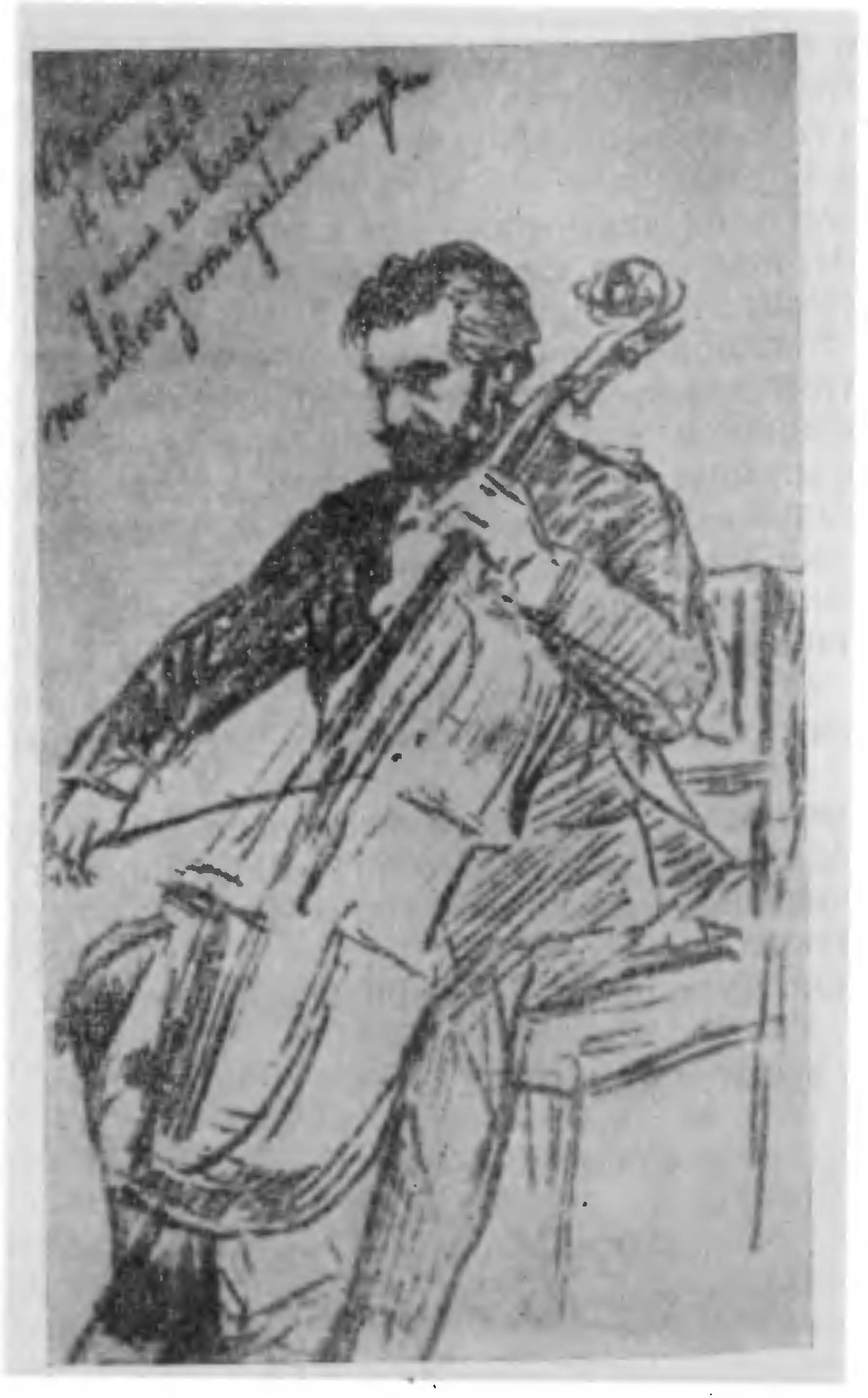
A. V. Verzhbilovich (drawing by I. E. Repin).
both ascents and declines. The brilliant artistic achievements of this musician during the final decades of the preceding century and the flourishing of his performing mastery gave grounds for hoping for further growth and new, major musical revelations. And if these did not follow, the reason, it seems, lay not only in the artist's deteriorating health but also in the generally unfavorable conditions for the development of art in tsarist Russia, particularly during the years of reaction that followed the defeat of the Revolution of 1905.
The author of one of the obituaries devoted to Verzhbilovich was to a considerable extent right in writing that the development of his enormous talent at a certain stage (and earlier
[p. 174]
than one would have wished) seemed to come to a halt, and that the “atmosphere prevailing in the country at that time concealed from him the artistic horizon that might have been open to him.”¹
But even during the difficult years for Russian art, when the pernicious influences of decadence and aestheticism made themselves perceptibly felt, Verzhbilovich remained faithful to the realist and democratic traditions of Russian classical music. And this, to a great extent, determines his significance in the history of Russian musical performing culture.
The greatest and most talented representative of the Davydov school, whose interpretation was distinguished by exceptional heartfelt expression and warm human feeling, Verzhbilovich knew how to address the broadest circles of listeners sincerely and movingly in the language of his instrument. He invariably awakened their love and gratitude because, as few other performing artists could, he was capable of warming their hearts and bringing them both consolation and joy.
An inspired artist and an incomparable singer on the cello, Alexander Valerianovich Verzhbilovich occupies an honored place not only in the history of Russian classical cello art but also in the history of the entire Russian classical school of musical performance.
Original Footnotes
p. 122
¹ According to certain sources, A. V. Verzhbilovich was born in Warsaw (see Zvezda, 1903, no. 18; Novoe Vremya, 1903, no. 9688); however, most other sources (see the personal file of A. V. Verzhbilovich, preserved in TsGIA; J. Reiss, Mała Encyklopedia Muzyki, Warsaw, 1960, as well as Novoe Vremya, 1899, no. 8320) identify St. Petersburg as the artist's birthplace. His father, apparently, was a native of Warsaw and of Polish origin (his mother, Elizaveta Ivanovna, was Russian); possibly he was distantly related to Tadeusz Wierzbiłłowicz, a musician in the Grodno chapel at the end of the eighteenth century, mentioned in J. Prosnak, Kultura muzyczna Warszawy XVIII wieku (Kraków, 1955), vol. 1, p. 90.
p. 123
¹ From the Rules of St. Anne's School in St. Petersburg (St. Petersburg, 1865), p. 9, it appears that if a pupil wished to learn to play an instrument, “the responsibility for this was left to the parents or guardians themselves.”
² His surname was spelled in this manner at the time.
³ The petition bears a resolution dated May 16, 1867, written in A. G. Rubinstein's hand, granting leave until September 1 (GIALO, fond 361, inventory 30, no. 38, fol. 37).
⁴ See the articles devoted to the thirtieth anniversary of Verzhbilovich's artistic career, the numerous obituaries, the article in the Russian edition of H. Riemann's Musik-Lexikon, and others.
p. 124
¹ See Syn Otechestva, 1869, no. 115, p. 1.
² A. Unkovskaya, Memoirs. Petrograd, 1917, p. 233.
³ Ibid., p. 253.
p. 125
¹ Literary supplement to Nuvellist, August 1871, p. 62.
² A music notebook containing entries by A. V. Verzhbilovich has survived (preserved in the Central Music Library). It contains entries of scales, chords, and inversions (1871), romances (some unfinished) to words by Pushkin (“Revët li zver' v lesu glukhom”), to Polish and German texts, sketches of cello pieces, an almost completed Waltz for Cello and Piano, and other sketches from 1873. The Waltz, composed by Verzhbilovich in November 1873 and prepared for publication by the author of this book (Moscow, 1963), reveals the composer's melodic gifts and musicality. An Étude for Cello and Piano, dated 1895 and also published by Muzgiz (edited by A. Stogorsky, who used a manuscript formerly belonging to F. M. Blumenfeld) in 1954, is likewise attributed to him.
³ Report of the St. Petersburg Branch of the Russian Musical Society ... for the Year 1870/71. St. Petersburg, 1872, p. 120.
p. 126
¹ See Echo Muzyczne i Teatralne, 1897, no. 5, pp. 51–52.
² Vechernyaya Gazeta, 1874, no. 74. (This was a concert “for the benefit of the Society for the Assistance of Poor Women.”)
³ Russkii Mir, 1874, no. 62.
⁴ Golos, 1874, no. 96.
⁵ Vsemirnaya Illyustratsiya, 1874, no. 277, p. 272 (the author of the review was Dmitry Magir).
p. 128
¹ Birzhevye Vedomosti, 1875, no. 34 (the author of the review was K. Galler).
² Birzhevye Vedomosti, 1875, no. 91.
³ Muzykalnyi Listok, 1875, no. 2.
⁴ See Novoe Vremya, 1876, no. 279.
⁵ Muzykalnyi Listok, 1876, no. 6.
p. 129
¹ For a favorable response to Verzhbilovich's performance, see the journal Muzykalnyi Svet, 1877, no. 8.
² Verzhbilovich's mastery of the bow and rich tone are noted in a review of this concert published in the journal Muzykalnyi Svet, 1877, no. 14.
³ Muzykalnyi Svet, 1877, no. 16.
⁴ Vechernyaya Gazeta, 1877, no. 104.
p. 130
¹ At that time, opera theater orchestral musicians were required not only to be able to sight-read but also to possess skills in transposition and in accompanying recitatives from a figured bass (L. G.).
² The original is preserved in TsGIA.
³ See S.-Peterburgskie Vedomosti, 1877, no. 287. See also the obituary in Ezhegodnik Imperatorskikh Teatrov (1911, issue VII, p. 136), where 1876 is given as the year of Verzhbilovich's entry into the orchestra of the Italian Opera in St. Petersburg.
p. 131
¹ Novoe Vremya, 1903, no. 9688.
² The documents quoted are preserved in the file of A. V. Verzhbilovich in the Archive of the Imperial Theaters (located in TsGIA). From documents in the same archive it is apparent that in 1898 the artist wished to return to the theater, but the directorate replied that Emil Herbeck played the solos in the operas and N. Loganovsky those in the ballets, and that “there are no available funds in the budget for the maintenance of the orchestras.”
p. 132
¹ Nikolai Andreevich Rimsky-Korsakov: The Memoirs of V. V. Yastrebtsev, vol. 1. Leningrad, 1959, p. 244.
² Novoe Vremya, 1911, no. 12563.
p. 133
¹ Vsemirnaya Illyustratsiya, 1878, no. 519, pp. 493–494.
² Golos, 1878, no. 338.
p. 134
¹ Muzykalnoe Obozrenie, 1888, no. 2.
p. 135
¹ Grazhdanin, 1888, no. 13. See also Bayan, 1888, no. 2; Peterburgskii Listok, 1888, no. 10, and others.
² Novosti, 1895, no. 178.
³ Muzykalnoe Obozrenie, 1886, no. 15.
p. 136
¹ A. V. Verzhbilovich performed this concerto with an orchestra conducted by A. G. Rubinstein on October 2, 1880, at an extraordinary meeting of the St. Petersburg branch of the Russian Musical Society. The proceeds from the concert, whose entire program consisted of works by A. G. Rubinstein, were intended for the Assistance Fund for Musical Artists.
² See the second book of History of the Art of the Violoncello. Moscow, 1957, pp. 493–496.
³ Molva, 1880, no. 275.
⁴ P. I. Tchaikovsky, for his part, highly esteemed Verzhbilovich. In 1890 he intended to undertake a joint tour with him, which, however, did not take place.
⁵ As is apparent from N. A. Rimsky-Korsakov's letter to V. I. Safonov (dated January 29, 1890), he took a lively interest in this appearance by Alexander Valerianovich.
p. 137
¹ Novoe Vremya, 1890, no. 5022.
² Gramophone Concert Record, 27881. This performance is analyzed by us in the supplement to the book On Working on a Musical Composition. Moscow, 1953 (second edition, Moscow, 1960).
³ Reporting in a letter to M. S. Kerzina dated November 28, 1906, on an evening at the Polish circle at which works by César Cui were performed, including the Cantabile for cello, the composer writes: “Verzhbilovich played beautifully” (C. A. Cui, Selected Letters. Leningrad, 1955).
p. 138
¹ The pieces were first performed (from the manuscript) by Verzhbilovich with orchestral accompaniment under the direction of the composer at the fourth Russian Symphonic Concert on December 17, 1888.
² According to A. V. Ossovsky, Glazunov improvised it in Verzhbilovich's presence at the apartment of the latter's pupil, the amateur cellist N. P. Ruzsky. This piece was first performed by Verzhbilovich on March 5, 1902.
³ See Nik. Findeizen, Sketches of the Activities of the St. Petersburg Branch of the Russian Musical Society (appendices). St. Petersburg, 1909.
⁴ M. F. Gnesin, Thoughts and Reminiscences of N. A. Rimsky-Korsakov. Moscow, 1956, p. 230.
p. 139
¹ Verzhbilovich first performed two pieces by Nápravník (the Élégie and Allegro giocoso) in St. Petersburg on November 18, 1900. A response to this performance also appeared in a Leipzig journal: “Mr. Verzhbilovich enjoyed great success, as usual, with two new, effective, and rewarding pieces—the Élégie and Allegro giocoso by Nápravník” (Signale für die musikalische Welt, 1901, no. 2).
² See Artist, 1894, no. 35, p. 224. Verzhbilovich first performed the pieces in Glazunov's orchestration and under his direction on February 5, 1894.
³ Mention may also be made here of R. N. Hildebrandt's Chanson norvégienne, K. K. Bach's Souvenir de Mathildenhof, and other cello pieces by the artist's contemporaries dedicated to A. V. Verzhbilovich.
p. 140
¹ Kindly made available to us by Professor I. F. Belza.
² See, for example, the review of the concert held in Warsaw on January 29, 1897, at which Verzhbilovich appeared as a soloist and as an ensemble player in Tchaikovsky's Trio (with S. Barcewicz and A. Michałowski) and in a quartet by Saint-Saëns. See Echo Muzyczne i Teatralne, 1897, no. 6, pp. 67–68.
³ See Muzykalnoe Obozrenie, 1887, no. 19.
p. 141
¹ At this same concert A. V. Verzhbilovich played Cui's Cantabile (with Erazm Dłuski).
² S.-Peterburgskie Vedomosti, 1899, no. 306.
³ Letter of November 7, 1899 (Pushkin House).
⁴ Letter of November 24, 1899 (Pushkin House). Thus, not a week and a half, but two and a half weeks had elapsed since the performance.
⁵ See Russkaya Muzykalnaya Gazeta, 1900, no. 46, col. 118, and 1903, no. 46, col. 1168.
p. 142
¹ The autograph, dated July 6, 1897, is preserved in the Manuscript Department of the M. E. Saltykov-Shchedrin State Public Library. In Verzhbilovich's transcription, the cadenza-like piano passages have been preserved almost in their entirety, and, in view of their difficulty, he added fingering indications to them. The original key (C-sharp minor) is changed to E minor; Glazunov, who was probably acquainted with Verzhbilovich's transcription, preferred the same key in his transcription for cello and piano.
² See, for example, Novoe Vremya, 1894, no. 6516; Novosti, 1895, no. 178; Russkaya Muzykalnaya Gazeta, 1901, no. 41, col. 993.
³ See Novosti i Birzhevaya Gazeta, 1900, no. 309, and also Russkaya Muzykalnaya Gazeta, 1900, no. 46, col. 1118.
⁴ See Novoe Vremya, 1887, no. 3952; Peterburgskaya Gazeta, 1902, no. 13; Russkaya Muzykalnaya Gazeta, 1902, no. 11, col. 337, and others.
p. 143
¹ See Russkie Vedomosti, 1890, no. 86.
² See Novosti i Birzhevaya Gazeta, 1897, no. 332.
³ See Russkaya Muzykalnaya Gazeta, 1898, no. 2, col. 203.
⁴ See ibid.
⁵ Novosti i Birzhevaya Gazeta, 1898, no. 19.
p. 144
¹ Teatr i Iskusstvo, 1897, no. 5, p. 91.
² Teatr i Iskusstvo, 1897, no. 22, p. 410.
p. 145
¹ Muzykalnoe Obozrenie, 1887, no. 25.
² Russkie Vedomosti, 1890, no. 75.
³ Artist, 1890, no. 7, p. 135.
⁴ Muzykalnoe Obozrenie, 1886, no. 4.
⁵ Moskovskie Vedomosti, 1900, no. 286.
p. 146
¹ Artist, 1895, no. 46, p. 167.
² See, for example, the journal Russkaya Muzykalnaya Gazeta, 1903, no. 47, col. 1168.
p. 147
¹ Golos, 1880, no. 292.
² Golos, 1880, no. 306.
³ Molva, 1880, no. 280.
⁴ This refers to the Andante con moto—the theme with variations, in the second variation of which the cello sings a melodious and expressive theme (L. G.).
⁵ Muzykalnyi i Teatralnyi Vestnik, 1883, no. 15, p. 4.
p. 148
¹ Novosti i Birzhevaya Gazeta, 1898, no. 30.
² One of the organizers of the St. Petersburg Chamber Music Society was the well-known violinist (a pupil of F. David) and prominent musical figure E. K. Albrecht (1842–1894), the first violinist in the Society's quartet. From 1877, E. K. Albrecht held the position of inspector of music of the Imperial Theaters in St. Petersburg.
p. 149
¹ Letter of July 14, 1890. Preserved in the Central Music Library.
p. 150
¹ See the letters of A. V. Verzhbilovich to E. K. Albrecht dated June 4/16 and July 22, 1891, preserved in the Central Music Library.
² See the journal of the meetings of the directorate of the St. Petersburg branch of the Russian Musical Society. Statement by A. G. Rubinstein at the meeting of May 3, 1890 (GIALO, fond 408, file 508, fol. 43). L. A. Barenboim drew our attention to this document.
³ Russkie Vedomosti, 1890, no. 71.
p. 151
¹ In the program of this tour, in addition to solo works, A. V. Verzhbilovich performed Glinka's Doubt with the baritone A. I. Alexeyev, and with S. I. Druzyakina the elegy Do Not Fly Away by Zolotaryov and other works.
² See Muzykalnoe Obozrenie, 1887, no. 28 (concerning the performance of romances with the singer Pimenko-Chistovich).
p. 152
¹ See the letter of A. K. Glazunov to L. B. Bertenson dated February 17, 1903, preserved in the Manuscript Department of the M. E. Saltykov-Shchedrin State Public Library.
² “I attended Verzhbilovich's concert yesterday evening (a complimentary ticket on the platform),” wrote V. V. Stasov to D. V. Stasov on February 25, 1903. “The hall was absolutely packed, the concert fairly interesting, but I did not go to the dinner...”
p. 153
¹ The anniversary program, designed by the artist N. Stepanov, lists a sonata by R. Strauss; judging by the press, however, it was replaced at the concert by Chopin's Sonata.
² Poem by E. B. Bauer. Birzhevye Vedomosti, 1903, no. 100.
p. 154
¹ See Novosti i Birzhevaya Gazeta, 1898, no. 97.
² See Odesskii Listok, 1901, no. 267.
p. 155
¹ Kievlyanin, 1901, no. 282. Concerning the artists' Kharkov concert, see Yuzhnyi Krai, 1901, no. 7204.
² Russkaya Muzykalnaya Gazeta, 1908, nos. 20/21, col. 479.
p. 156
¹ Novoe Vremya, 1882, no. 2120.
² Novoe Vremya, 1882, no. 2140.
³ Russkie Vedomosti, 1882, no. 64.
p. 157
¹ Russkaya Muzykalnaya Gazeta, 1900, no. 10, col. 294.
² Signale für die musikalische Welt, 1900, no. 18, p. 274. In this notice, the reference to a certain harshness (Schärfen) in Verzhbilovich's sound causes bewilderment, since his tone, as is well known, was distinguished precisely by its soft, velvety, singing character. Perhaps some accidental circumstances occasioned this observation by the reviewer, who subsequently, admiring Verzhbilovich's cantilena, himself withdraws his reproach.
p. 158
¹ Novoe Vremya, 1901, no. 8966.
² From the reminiscences of Aloys R. Mooser concerning A. V. Verzhbilovich, written for the author of this book on January 18, 1960.
³ See S.-Peterburgskie Vedomosti, 1883, no. 102; Muzykalnyi Svet, 1877, no. 16.
p. 159
¹ Niva, 1911, no. 12.
² Birzhevye Vedomosti, 1903, no. 101.
p. 160
¹ A. I. Bryullova, Four Fifths of a Century (reminiscences). Manuscript, 1929.
² Novoe Vremya, 1903, no. 9688.
³ Peterburgskii Listok, 1911, no. 60.
p. 161
¹ Moskovskie Vedomosti, 1902, no. 95.
² Russkie Vedomosti, 1900, no. 284.
³ E. Wolf-Israel, “A. V. Verzhbilovich,” Muzyka, 1937, no. 22.
p. 162
¹ Russkaya Muzykalnaya Gazeta, 1898, no. 4, col. 406.
² B. A. Struve, The Principal Tasks in the Investigation of the History of Russian Violin and Cello Performance. Manuscript, 1943.
³ B. A. Fitingof-Shel [Vietinghoff-Scheel], World Celebrities. St. Petersburg, 1899, p. 127.
⁴ Russkaya Muzykalnaya Gazeta, 1898, no. 2, col. 192.
⁵ Niva, 1903, no. 8.
p. 163
¹ See Wilh. Jos. v. Wasielewski, Das Violoncell und seine Geschichte, third edition. Leipzig, 1925.
² See C. Liégeois and E. Nogué, Le Violoncelle, son histoire, ses virtuoses. Paris (1920).
³ See E. Van der Straeten, History of the Violoncello... London, 1915.
⁴ See Ogonyok, 1911, no. 11.
⁵ From the previously quoted reminiscences concerning Verzhbilovich.
p. 164
¹ In the final decades of the preceding century, the number of cellists studying at Russian conservatories was comparatively limited (in 1872, for example, not a single cellist entered the St. Petersburg Conservatory). The situation changed noticeably with the development of musical life and musical education in the provinces. In 1905, it was noted in the press that the number of requests from provincial music schools “specifically for cello teachers” had considerably increased and that “there is a complete shortage of cellists” (see Russkaya Muzykalnaya Gazeta, 1905, no. 41, col. 992).
² From January 9, 1887, Verzhbilovich was listed as a senior teacher. In that year, K. Yu. Davydov invited him “to direct the advanced cello class” (see Report of the St. Petersburg Branch of the Russian Musical Society and the Conservatory for 1886/87. St. Petersburg, 1888, XVII).
³ When V. F. Fitzenhagen, professor of the Moscow Conservatory, died in 1890, its director, V. I. Safonov, wished to invite A. V. Verzhbilovich as a representative of the Davydov school. He did not do so only because he feared a conflict with A. G. Rubinstein, who at that time directed the St. Petersburg Conservatory and valued Verzhbilovich highly (see V. I. Safonov's letter to P. I. Tchaikovsky of February 12, 1890).
p. 165
¹ For the maintenance of his technical “apparatus,” Verzhbilovich regarded practicing on the lower strings, using their entire range, as particularly beneficial. In his opinion, this strengthened both finger technique and sound. “I practice little,” he said, “but I make a habit of going over the lower strings along the entire length of the fingerboard.”
p. 166
¹ Novoe Vremya, 1903, no. 9688.
² A note by A. V. Verzhbilovich from 1883, in which he expresses his willingness to accept Ya. S. Rosenthal into his class and teach him without remuneration, is preserved in the Manuscript Department of the M. E. Saltykov-Shchedrin State Public Library (P. L. Vaksel collection, no. 848).
p. 167
¹ See N. A. Rimsky-Korsakov, Collection of Documents, edited by V. A. Kiselev. Moscow–Leningrad, 1951, pp. 139 and 224.
² Letter of June 17, 1905 (preserved in the Manuscript Department of the M. E. Saltykov-Shchedrin State Public Library).
³ Preserved in GIALO (fond 361, inventory 30, bundle 388, fol. 72).
⁴ Letter of August 1, 1905 (preserved in the Manuscript Department of the M. E. Saltykov-Shchedrin State Public Library).
⁵ See Rus', 1905, no. 19.
⁶ See Nikolai Andreevich Rimsky-Korsakov: The Memoirs of V. V. Yastrebtsev, vol. 2. Leningrad, 1960, p. 366.
p. 168
¹ See the fifth chapter of the anniversary historical survey 100 Years of the Leningrad Conservatory. Leningrad, 1962.
² See materials for A. S. Famintsyn's manuscript dictionary in the Manuscript Department of the M. E. Saltykov-Shchedrin State Public Library (notes and letters to the inspector of the conservatory, N. I. Abramychev, and others).
³ Preserved in the archive of A. K. Glazunov (no. 819, fol. 8) in the Manuscript Department of the M. E. Saltykov-Shchedrin State Public Library.
p. 169
¹ Verzhbilovich also appeared repeatedly at charitable concerts in Moscow. A. K. Glazunov wrote to V. V. Stasov concerning one of these concerts, organized by S. A. Tolstaya (February 9, 1901), reporting Verzhbilovich's constant readiness to participate in such concerts.
² See Nikolai Andreevich Rimsky-Korsakov: The Memoirs of V. V. Yastrebtsev, vol. 2. Leningrad, 1960, pp. 182–183.
³ See A. V. Verzhbilovich's letter to M. T. Dulov dated February 19, 1902. Preserved in the A. A. Bakhrushin State Central Theater Museum.
⁴ Russkaya Muzykalnaya Gazeta, 1910, no. 12, col. 339 (the author of the correspondence was R. Engel).
⁵ Odesskii Listok, 1910, no. 12.
p. 170
¹ According to the recollections of A. I. Kuznetsov, the son of K. Yu. Davydov's pupil I. M. Schmidt (Kuznetsov), the last concert took place in the hall of the St. Peter and St. Paul School, where the artist performed, among other works, A. V. Kuznetsov's First Suite for Four Cellos with his pupils.
² This ten-year-old cellist aroused extraordinary interest among the public, displaying “solid technique beyond his years and, what is even more astonishing, a fairly powerful tone” (Peterburgskii Listok, 1910, no. 44).
³ Ibid.
⁴ In particular, in October 1910, the pianist Lucyna Robowska, who had come from Moscow, gave a concert in St. Petersburg for the benefit of the ailing artist; her program consisted of works by Chopin. Even earlier, a subscription had been announced for the benefit of the musician who had fallen ill (see Novosti, 1910, no. 12397).
p. 171
¹ Peterburgskii Listok, 1911, no. 60.
² Ezhegodnik Imperatorskikh Teatrov, 1911, issue VII, p. 137.
³ Novoe Vremya, 1911, no. 12563.
⁴ Muzyka i Zhizn', 1911, no. 3, pp. 11–12.
⁵ Novoe Vremya, 1911, no. 12563.
p. 172
¹ This fusion is also reflected in the recollections of one of A. V. Verzhbilovich's pupils, A. A. Borisyak: “The artist's rich and tremendously powerful tone, in conjunction with his vivid nuances and remarkable dynamic variety, as well as the distinctive and inimitable timbre of the Montagnana cello—all this was furthermore combined with an extraordinarily fortunate outward appearance, with the graceful nobility of Verzhbilovich's pose and general bearing on the concert platform.”
² Letter of I. E. Repin to E. N. Zvantseva dated December 9, 1888 (preserved in the Manuscript Department of the State Tretyakov Gallery, fond 50, no. 2). It is apparent from the letter that Repin heard the cello at the Benois home, which Verzhbilovich also frequented.
³ See Khudozhestvennoe Nasledstvo: Repin, vol. 1. Moscow–Leningrad, 1948 (article by G. A. Tyumeneva, “Music in Repin's Life”).
⁴ The letter is preserved in the same collection (fond 50, no. 13).
⁵ This drawing was acquired in 1938 by the Smolensk Regional Museum of Local History. In connection with the tenth anniversary of the death of I. E. Repin, it was reproduced in the Smolensk newspaper Rabochii Put', 1940, no. 226.
p. 174
¹ Novoe Vremya, 1911, no. 12563.