(Excerpted from Lev Ginzburg’s History of the Art of the Violoncello, Vol. 3, The Russian Classical Cello School (1860–1917), Moscow, 1965, pp. 214–223, translated by Yuriy Leonovich.)
[p. 214]
Alfred (Konstantin) Edmundovich von Glehn was born on January 6, 1858, in Reval (now Tallinn), in present-day Estonia, into a noble family. In 1876, he graduated from the Reval Gymnasium, while simultaneously studying the cello. Glehn came to St. Petersburg to receive specialized training at the Institute of Transportation Engineers. However, having become acquainted with Alexander Wierzbilowicz and following his advice, he entered the Conservatory in 1877, against the wishes of his parents, who consequently deprived him of their support, and joined the class of Karl Davydov.
Davydov considered his pupil very capable and repeatedly enlisted him to participate in the “Symphonic Exercises.” As early as the end of 1877, Glehn performed an Air by Bach with orchestra. In January of the following year, he played the Adagio from Romberg’s Second Concerto at the “Third Symphonic Exercise.” That same year, Glehn played concertos by Molique and Davydov (the Second), and at the spring examination of 1879, Lindner’s concerto, for which he received an excellent mark. In the chairman’s lists of the examination commission for that year, Davydov wrote beside Glehn’s name in his own hand: “Very capable and sufficiently diligent.”
Only a few months later (January 24, 1880), Glehn appeared at one of the “Symphonic Exercises,” organized “for the benefit of fellow students in need,” performing Schumann’s concerto under the direction of his teacher, Davydov.
In 1881, Glehn completed his studies at the St. Petersburg Conservatory in Davydov’s class, and in May 1882, he received the diploma of Free Artist and the large silver medal.
In the aforementioned letter to the editor of Novoe vremia, Anton Rubinstein, enumerating the finest graduates of the St. Petersburg Conservatory (Tchaikovsky, Lyadov, Arensky, Essipova, Safonov, Tartakov, Stravinsky, the violinists Galkin, Krasnokutsky, Pushilov, Pustarnakov, Kolakovsky, Krüger, and others), names Glehn immediately after Wierzbilowicz.¹
During the 1881–1882 season, Glehn performed in Russia and abroad. He appeared successfully in Leipzig, Dresden, Würzburg, Vienna, Paris, and London.
On May 30, 1882, Glehn performed Saint-Saëns’s concerto with
[p. 215]
an orchestra conducted by Anton Rubinstein at the Art and Industrial Exhibition in Moscow. The reviewer assessed this performance critically, reproaching the artist for insufficient strength of tone and a lack of creative inspiration.¹
For about a year, the cellist served in the orchestra of the Italian Opera in St. Petersburg. Then, following concerts in London, he became principal cellist of the Berlin Philharmonic Orchestra. However, the very next year he accepted an offer to work in Kharkiv, and on September 1, 1884, he assumed direction of the cello and quartet classes at the Music School of the Kharkiv branch of the Russian Musical Society. For six years, he was a senior instructor at this school.
At the same time, Glehn participated in the quartet of the local branch of the Russian Musical Society (its other members were Pestel, Dochevsky, and Alekseenko), as well as in other chamber ensembles, for example, in a trio with Alexander Siloti and A. F. Pestel (1887).
Glehn also appeared repeatedly as a soloist. Following his performance in January 1887, a reviewer wrote: “Glehn, a worthy pupil of his maestro Karl Davydov, performed on the cello the second movement of Servais’s concerto, and a Nocturne and Waltz by Chopin. His playing is full of nobility and is very reminiscent of Davydov’s playing, as was apparent in Chopin’s Nocturne, which we have had the opportunity to hear performed by both artists.”²
In 1888, Glehn organized a student orchestra at Kharkiv University and conducted it. On occasion, he combined the teachers and pupils of the Music School, musicians from the local dramatic theater, and the university student orchestra into one large ensemble, conducting its concerts.
Glehn frequently appeared before the Kharkiv public as a soloist as well. For example, during the 1888–1889 season, he performed “with his characteristic nobility” the cello concerto dedicated to him by Andrejs Jurjāns,³ a talented Latvian composer (a pupil of Nikolai Rimsky-Korsakov) who also taught at the Kharkiv Music School.
“The orchestral concerts of Mr. von Glehn were also of considerable interest, affording our music lovers the opportunity to enjoy the sound of an orchestra more frequently,” wrote a Kharkiv correspondent. “It should be noted that Mr. Glehn is not only an excellent cellist but also a good
[p. 216]
conductor …”¹ The author of the correspondence went on to note the interesting programs of Glehn’s concerts (at one of which, in particular, Davydov’s Suite was performed).
During the summer season of 1888, Glehn appeared repeatedly at symphonic concerts at the Aquarium in St. Petersburg, performing Romberg’s Ninth Concerto, Servais’s concerto, and other works traditional in the cello repertoire of that time. The choice of these virtuoso compositions was hardly particularly fortunate, not least because the cellist’s virtuoso capabilities were, after all, not very great. Alongside certain technical shortcomings in his playing, the St. Petersburg press noted the artist’s talent and his characteristic “serious musical orientation, musicality of performance, and pleasing and beautiful tone.”²
In 1890, following the death of Wilhelm Fitzenhagen, Glehn was invited to join the faculty of the Moscow Conservatory. Although Tchaikovsky considered it necessary to invite Anatoly Brandukov to this position, the director of the Conservatory, Vasily Safonov, insisted on inviting Glehn, explaining his decision by the desire to entrust the cello class to a representative of the Davydov school.³
In his memoirs, Mikhail Ippolitov-Ivanov later wrote: “Although Pyotr Ilyich was very indignant at Safonov’s unwillingness to yield, in the end he acknowledged that he was right …”⁴ It should be noted that Glehn justified Safonov’s invitation as a talented teacher who sincerely loved his work and devoted much of his energy to it for more than thirty years.
“Although he did not possess a brilliant virtuoso gift,” wrote Ippolitov-Ivanov, “he was an altogether exceptional teacher, having absorbed from his brilliant teacher, Karl Davydov, all the characteristics of his school and the rare gift of transmitting his own artistic achievements to his pupils … Listening to Alfred Edmundovich’s pupils, one senses the distinctive character and superiority of the Davydov school over others …”⁵
Mikhail Ippolitov-Ivanov, who was director of the Moscow Conservatory from 1906 to 1922, includes Glehn among the
[p. 217]
professors “who took a greater part than others in the life of the Conservatory.”
In December 1905, the Artistic Council of the Conservatory elected Glehn (alongside Mikhail Ippolitov-Ivanov, Nikolai Kashkin, and Jan Hřímalý)¹ to the Temporary Commission for the Administration of the Conservatory.
Glehn regularly participated in Conservatory concerts. In particular, when in October 1893 the Conservatory student orchestra, in the presence of Tchaikovsky (this was his last visit to the Moscow Conservatory), performed his Sixth Symphony from manuscript under Safonov’s direction, several professors of the Conservatory played in the orchestra alongside the students, among them Glehn.²
Until approximately 1905, Glehn combined his pedagogical activity with performing. He appeared on numerous occasions as a soloist at concerts of the Russian Musical Society in Moscow and St. Petersburg, performing concertos by Davydov (1890–1891), Saint-Saëns’s concerto (1896), Tchaikovsky’s Variations on a Rococo Theme (1905), Aleksey Davydov’s Fantasy (1905), and other works. In 1896, he also performed the cello solo in Ippolitov-Ivanov’s orchestral suite Pastoral Scenes, conducted by the composer.
Shortly after his invitation to Moscow, Glehn appeared at a symphonic concert of the Russian Musical Society (November 1890), performing the first movement of Davydov’s Fourth Concerto. At the insistence of the public, the soloist also performed the second movement of the work (the piano accompaniment was played by Vasily Safonov, who had conducted the concert).
Noting the artist’s “brilliant technique, resonance, and mellowness of tone,” a reviewer wrote: “The noble playing of Mr. von Glehn, full of elegance, is reminiscent in its manner of that of his brilliant teacher, Davydov. One therefore cannot but approve the appointment of von Glehn in particular as a professor of the Conservatory. Having assimilated the exemplary methods of playing and teaching of the late Davydov, he is capable of transmitting them in turn to his pupils, and thus the school of our celebrated cellist will continue to live even after his death. Mr. von Glehn had enormous success and apparently won the sympathies of the Moscow public immediately.”³
Of Glehn’s success,
[p. 218]
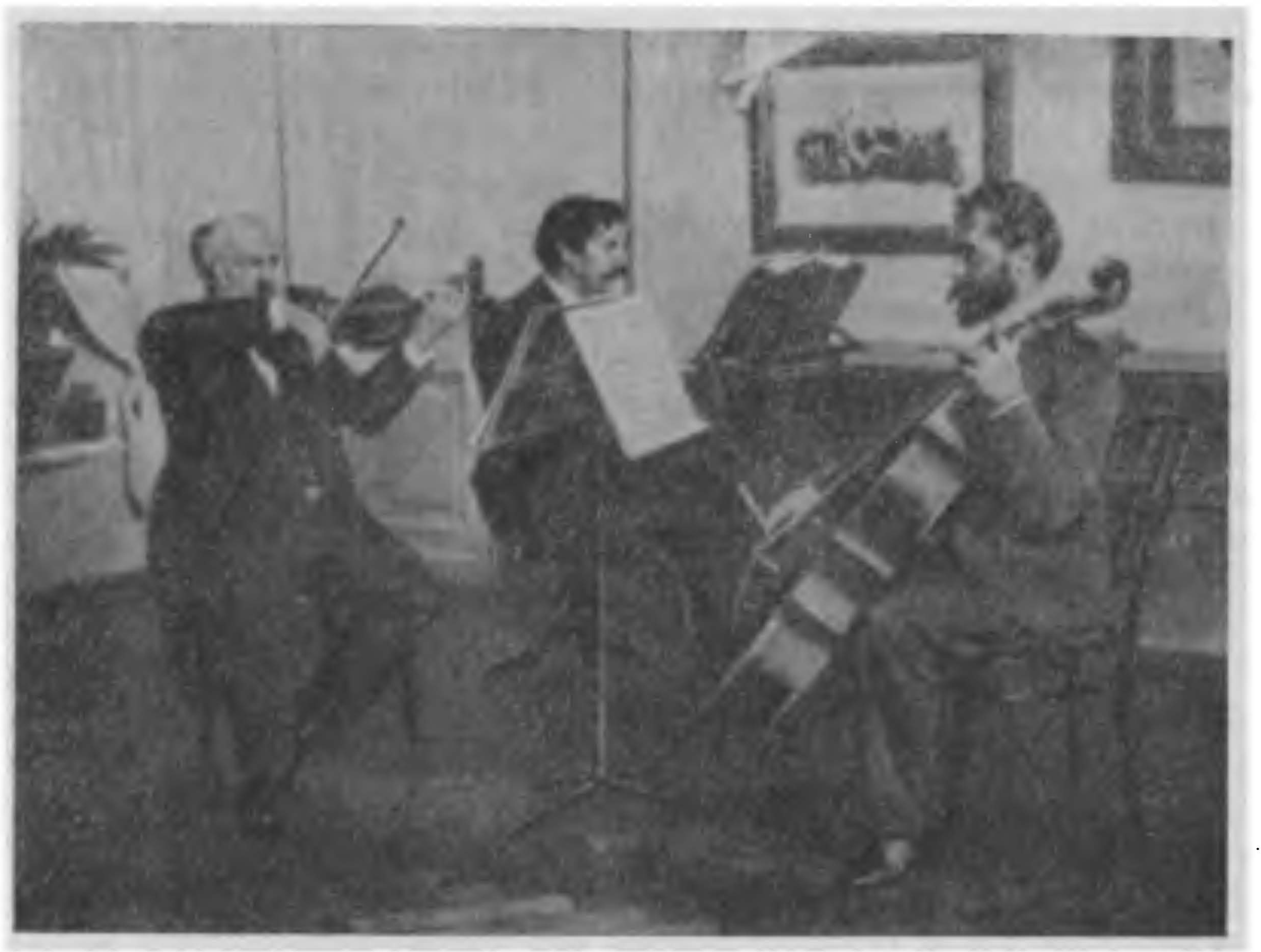
[Trio. From left to right: Jan Hřímalý, E. Pauer, Alfred von Glehn.]
Nikolai Kashkin also wrote, emphasizing in his playing “the gentleness of his bowing, the nobility of his tone, and the elegance of his phrasing.”¹
Following Glehn’s appearance in November 1891 with the first movement of Davydov’s Third Concerto (the orchestra was conducted by Vasily Safonov), Kashkin again reported the great success of the soloist: “In the artist’s playing,” he wrote, “one may note above all the nobility of cantilena that is characteristic of the pupils of the late Karl Davydov.”² Another reviewer, who wrote of the performer’s taste and virtuosity, noted that he was particularly reminiscent of his teacher in the opening episodes of the concerto.³ Among the reviews, however, we also find the reproach that Glehn performed only the first movements of concertos (see Novosti dnia, 1891, no. 3008).
During his very first years in Moscow, Glehn established himself as a good chamber musician. One may mention, for example, his appearances in trios with Sergei Taneyev
[p. 219]
and Jan Hřímalý (Tchaikovsky’s Trio), as well as with Paul Pabst and Hřímalý (Beethoven’s Trio, Op. 97) in 1892.
In the same year, he performed Chopin’s Sonata with Paul de Schlözer. The newspaper noted the impeccable ensemble: “Besides the purity and technical perfection of their performance of this brilliantly virtuoso sonata, both artists displayed much taste and feeling, so that the excellently performed Largo was repeated.”¹
With Vasily Safonov and Sergei Rozanov, Glehn participated in the first performance in Moscow of Brahms’s Trio for Piano, Clarinet, and Cello, which took place in 1893. Two years later, he participated in a performance of Paul Pabst’s Trio together with the composer and Hřímalý, and in 1897, with Josef Hofmann and Leopold Auer, he performed Beethoven’s B-flat-major Trio. In 1899, Glehn participated in an evening of chamber music featuring Ignacy Jan Paderewski, who was appearing in Moscow. With this celebrated Polish pianist and Hřímalý, he played Beethoven’s Trio, Op. 97. Together with Nikolai Sokolovsky, these musicians performed a quartet by Brahms. Good ensemble and inspiration were noted by a reviewer in Glehn and Nikolai Medtner’s performance of Beethoven’s D-major Sonata in 1900.²
Glehn repeatedly performed in other cities as well. In March 1905, he played a concerto by Davydov with orchestra in Kyiv. Following his performance of the same concerto in Kharkiv (at the fourth symphonic concert of the Kharkiv branch of the Russian Musical Society, dedicated to the memory of Davydov and Anton Rubinstein, held on April 3, 1905, under the direction of Ilya Slatin), Rostislav Genika wrote: “The beauty and mellowness of tone, the delicacy of the nuances, and the artistry of expression—all this enchanted the public in Mr. von Glehn’s playing, and with incomparable poetry he went on to play a number of pieces by Schumann and Davydov.”³
In October of the same year, Glehn performed the Variations on a Rococo Theme in St. Petersburg. Warmly received by the listeners, the artist played Schumann’s Abendlied as an encore. The reviewer (Alexander Koptyaev) noted Glehn’s elegance of phrasing and his beautiful, though not powerful, tone.⁴
After 1905, Glehn rarely appeared as a soloist, limiting himself to participation in chamber ensembles, and above all in the quartet of the Moscow branch of the Russian Musical Society, of which he was a member from 1890 to 1910. Until 1905, this quartet was led by
[p. 220]
Jan Hřímalý; the second violin part was played by David Krein, Michael Press, and Georgy Dulov, and the viola part by Nikolai Sokolovsky.
As is well known, the quartet, distinguished by its high artistic standard, played an important role in the development of chamber music performance and in popularizing chamber music among Moscow listeners at the end of the last century and the beginning of the present one. With the aforementioned personnel, the quartet gave the first performances of a number of outstanding works, particularly Taneyev’s first two quartets.
In characterizing the ensemble, the press noted its musicality and technical perfection, the performers’ ability to subordinate their individuality to the interests of the whole, and their characteristic understanding of the style of the music being performed.¹
In 1906, as Nikolai Kashkin reports, Glehn was the initiator of and a participant in concerts of contemporary foreign chamber music. In November of that year, he played a sonata by the French composer Samuel Rousseau with Konstantin Igumnov and participated in performances of a trio by Max Reger and a piano quintet by Ernő Dohnányi (with Konstantin Igumnov, Alexander Mogilevsky, V. I. Pakelman, and V. N. Emme).²
In 1907, Glehn traveled to New York to participate in a symphonic concert of Russian music.³
As late as the 1920–1921 season, we find Glehn among the performers of Beethoven’s trios at concerts dedicated to the 150th anniversary of the great composer’s birth.
Some of Glehn’s contemporaries were inclined to explain the relatively early reduction of his solo concert activity by characteristics of his temperament, a certain timidity on the concert platform. At the same time, they noted Glehn’s merits as a chamber musician and orchestral soloist (emphasizing, for example, the expressiveness of his performance of the cello solo from Liszt’s Mephisto Waltz).
Alexander Ossovsky and several other musicians who heard Glehn play in 1905–1907 speak of his playing with considerable reserve. Other contemporaries, particularly Sergei Shirinsky, who subsequently studied with Glehn, confirm the musicality and technical perfection of his playing, his beautiful though not very powerful tone, and the purity of his intonation. Despite all these merits, Glehn’s playing was nevertheless not distinguished by great brilliance.
[p. 221]
Particular mention must be made of Glehn’s pedagogical activity at the Moscow Conservatory, where he became a bearer of the Davydov traditions. Accepting Safonov’s invitation, he wrote: “My most fervent desire to contribute to the continuation, at the Conservatory entrusted to you, of the school of the unforgettable Karl Yulievich overcomes my fear that I may perhaps not justify the hopes you place in me. For my part, I can only promise that I shall exert every effort to rise to the demands of the task you have outlined.”¹
Glehn taught at the Moscow Conservatory for more than thirty years and during this time trained many talented cellists. Under him, the cello class grew enormously; at times the number of pupils in his class exceeded thirty.
Among them may be named such musicians as Evsey Belousov, Joseph Press, Konstantin Minyar-Beloruchev, Mikhail Bukinik, Gregor Piatigorsky, Vladimir Podgorny, Modest Altschuler, Anna Luboshutz, D. Zisserman, I. Dubinsky, Kazimierz Wiłkomirski, E. Berzinsky, Alexander Krein, Vladimir Matkovsky, A. Banovich, Alexander Mogilevsky, Sergei Shirinsky, Alexander Egorov, and many others.²
Konstantin Minyar-Beloruchev recalled that in his time Glehn devoted considerable attention to artistic phrasing, inherited from Davydov. He permitted neither dry, formal playing on the one hand nor mawkishly sentimental playing on the other.
Recalling his teacher, Alexander Egorov relates: “Alfred Edmundovich was a very good, erudite musician of great taste, and, being a pupil of Davydov, he undoubtedly possessed an instinctive understanding of the nature and possibilities of the cello. He had also inherited Davydov’s method of acquiring mastery of the instrument … He had a definite plan of work with each pupil, depending on the pupil’s advancement and capabilities … Working systematically, he carefully and patiently began work on a new composition that the pupil brought to the lesson after having worked it out. He could spend a great deal of time on the character of a particular bow stroke and always demanded that the pupil work it out at a comfortable tempo, but invariably with the musical character required by the particular composition … In his aesthetic principles, too, he was a faithful pupil of Davydov. He regarded technique as a means of embodying the musical image and was very demanding with regard to the comprehension of the content of a composition.”
[p. 222]
Observing that some of the more advanced pupils were critical of Glehn as a teacher, Alexander Egorov was inclined to explain this by the fact that Glehn was characterized by “a certain restraint in the manifestation of emotional and creative impulses” and that he “lacked the brilliant creative temperament necessary for a major performer.”
At the same time, in these same recollections, Alfred Edmundovich appears as “a very good teacher” who “knew his work, knew how to do it, and loved it.”
Under Glehn, the repertoire of Conservatory students was considerably expanded by the inclusion of cello works of artistic merit, particularly works by Russian composers. Student programs were not limited to compositions by Goltermann, Romberg, Servais, and Klengel. Glehn, who repeatedly performed Davydov’s works himself, allotted them a significant place in his pupils’ repertoire. In the programs of student concerts of this period, we repeatedly encounter Tchaikovsky’s Variations on a Rococo Theme, performed both by Glehn himself and by his pupils, as well as works by Bach, Boccherini, Locatelli, Beethoven, Rubinstein, Schumann, Saint-Saëns, Dvořák, and others.
To these should be added a number of works by Russian composers in Glehn’s own transcriptions for cello: Tchaikovsky’s Romance, Op. 5, Sérénade mélancolique, Op. 26, and Pauline’s Romance from The Queen of Spades; Arensky’s Barcarolle, Op. 36, No. 11; and others.
Glehn also directed a chamber music class at the Conservatory. Professor E. M. Guzikov, who studied in this class, remembers Glehn as “an excellent musician,” a man of “great musical and general culture,” who devoted his principal attention in the class to the artistic side of performance.
This is confirmed by Vladimir Matkovsky, Anna Luboshutz, Sergei Shirinsky, Alexander Egorov, and other pupils of Alfred Edmundovich. Judging by their accounts, Glehn was a sensitive musician who thoroughly understood different styles. He played the piano excellently and masterfully demonstrated many things on that instrument.
Glehn demanded thoughtful and conscientious work from his pupils. To those sufficiently gifted and musical, he granted complete freedom in the development of their individual artistic aspirations. Hence the great diversity of artistic personalities among his pupils (Belousov and Press, Podgorny and Piatigorsky, Wiłkomirski and Shirinsky).
Glehn must also be mentioned as an inventor in the field of bowed string instruments. Around 1910, at his suggestion and according to his design, the well-known Moscow instrument maker E. F. Vitachek (1880–1946) constructed a tenor viola—a four-stringed bowed instrument of the violin family,
[p. 223]
somewhat smaller than the cello, tuned a fifth higher than the cello and, like that instrument, held vertically.
Glehn demonstrated this instrument in February 1912,¹ and again in March 1913, when, together with F. S. Tal and Alexander Medtner, he participated in a performance of Taneyev’s Trio for Violin, Viola, and Tenor Viola, Op. 31, published in 1911.²
The press acknowledged certain merits of the tenor viola (its resonant upper register and timbre) in the performance of chamber music.³ Other composers also became interested in Glehn’s instrument. Vasily Zolotarev employed it in his quintet, and in the first version of his Second Symphony, Sergei Vasilenko used three tenor violas (their parts at the first performance in 1913 were played by Evsey Belousov, D. Z. Zisserman, and Rudolf Ehrlich). Nevertheless, the tenor viola failed to establish itself in musical practice.
In 1921, Glehn returned to his homeland, to Reval (Tallinn), where for some time he engaged in teaching and, to a certain extent, performing. Beginning in 1925, he was a professor at the Klindworth-Scharwenka Conservatory in Berlin.
Alfred von Glehn died in Berlin in 1927.⁴
Notes
p. 214
¹ See the appendix to Nikolai Lisovsky’s commemorative volume, Anton Grigorievich Rubinstein: Fifty Years of His Musical Activity (St. Petersburg, 1889).
p. 215
¹ See Golos, 1882, no. 152.
² Muzykalnoe obozrenie, 1887, no. 18, p. 141.
³ See Bayan, 1889, no. 16, p. 140.
p. 216
¹ Bayan, 1889, no. 16, p. 140.
² See Novosti i Birzhevaia gazeta, 1888, nos. 153 and 172; Novoe vremia, 1888, no. 4412; Peterburgskaia gazeta, 1888, no. 158.
³ For more details concerning this matter, see the chapter devoted to Anatoly Brandukov. The resolution of the Artistic Council of the Moscow Conservatory inviting Glehn to the position of professor of the second rank was adopted on May 19, 1890. The rank of professor of the first rank was conferred upon him on May 14, 1909.
⁴ Mikhail Ippolitov-Ivanov, Fifty Years of Russian Music in My Recollections (Moscow, 1934), p. 74.
⁵ Ibid., p. 120.
p. 217
¹ In the file of Alfred von Glehn preserved in the archive of the Moscow Conservatory (TsGALI), it is stated: “In 1905, upon the introduction of autonomy, he was chairman of a commission of five professors temporarily administering the Conservatory.”
² See Konstantin Saradzhev, Recollections from the Life of Tchaikovsky (manuscript in the Tchaikovsky House-Museum). The first public performance of this symphony under the composer’s direction took place several days later (October 16) in St. Petersburg.
³ Moskovskie vedomosti, 1890, no. 906 [sic].
p. 218
¹ Russkie vedomosti, 1890, no. 305.
² Russkie vedomosti, 1891, no. 304. (In the program of this concert, the performance of Davydov’s Third Concerto is erroneously listed as the first; in fact, this concerto had already been performed in Moscow by its composer in March 1874.) For favorable reviews of Glehn’s performances of Saint-Saëns’s concerto and Aleksey Davydov’s Fantasy, see Moskovskie vedomosti, 1896, no. 291, and 1905, no. 72.
³ See Moskovskie vedomosti, 1891, no. 305.
p. 219
¹ Moskovskie vedomosti, 1892, no. 282. In November 1892, Glehn played Beethoven’s A-major Sonata with Alfred Grünfeld, and in December, Rubinstein’s Sonata with N. N. Kalinovsky.
² Moskovskie vedomosti, 1900, no. 333.
³ Russkaia muzykalnaia gazeta, 1905, no. 18, p. 535.
⁴ S.-Peterburgskaia gazeta, 1905, no. 253.
p. 220
¹ See, for example, Moskovskie vedomosti, 1896, no. 283. Let us note that in a review by Nikolai Kochetov published in the journal Artist, 1894, no. 42, the weakness of the cello’s sound in the quartet is mentioned, but the reviewer attributes this to the shortcomings of Glehn’s instrument.
² See the review by Nikolai Kashkin in Russkoe slovo, 1906, no. 287.
³ See the file of Alfred von Glehn in the archive of the Moscow Conservatory (TsGALI), questionnaire of the Russian Musical Society, 1911.
p. 221
¹ See the letter from Alfred von Glehn to Vasily Safonov, May 28, 1890. File of Alfred von Glehn in the archive of the Moscow Conservatory (TsGALI).
² It was in Glehn’s class that female cello students first appeared at the Moscow Conservatory. The first of them, Maria Lvova, entered his class in 1890. The first female cellist to graduate from the Moscow Conservatory was Glehn’s pupil Anna Luboshutz (see below).
p. 223
¹ See Moskovskie vedomosti, 1912, no. 41.
² See the letters of Alfred von Glehn to Sergei Taneyev in the Tchaikovsky House-Museum. The aforementioned trio by Taneyev was republished by Muzgiz (1960) in a version for violin, viola, and cello edited by Lev Ginzburg and Yuri Olenev (see our preface to this edition).
³ See Russkaia muzykalnaia gazeta, 1913, nos. 15–16, cols. 148–149.
⁴ An obituary devoted to Alfred von Glehn appeared in Allgemeine Musikzeitung, 1927, nos. 51–52, pp. 1340–1341.