(Excerpted from Lev Ginzburg’s History of the Art of the Violoncello, Vol. 3, The Russian Classical Cello School (1860–1917), Moscow, 1965, pp. 277–292, translated by Yuriy Leonovich.)
[p. 277]
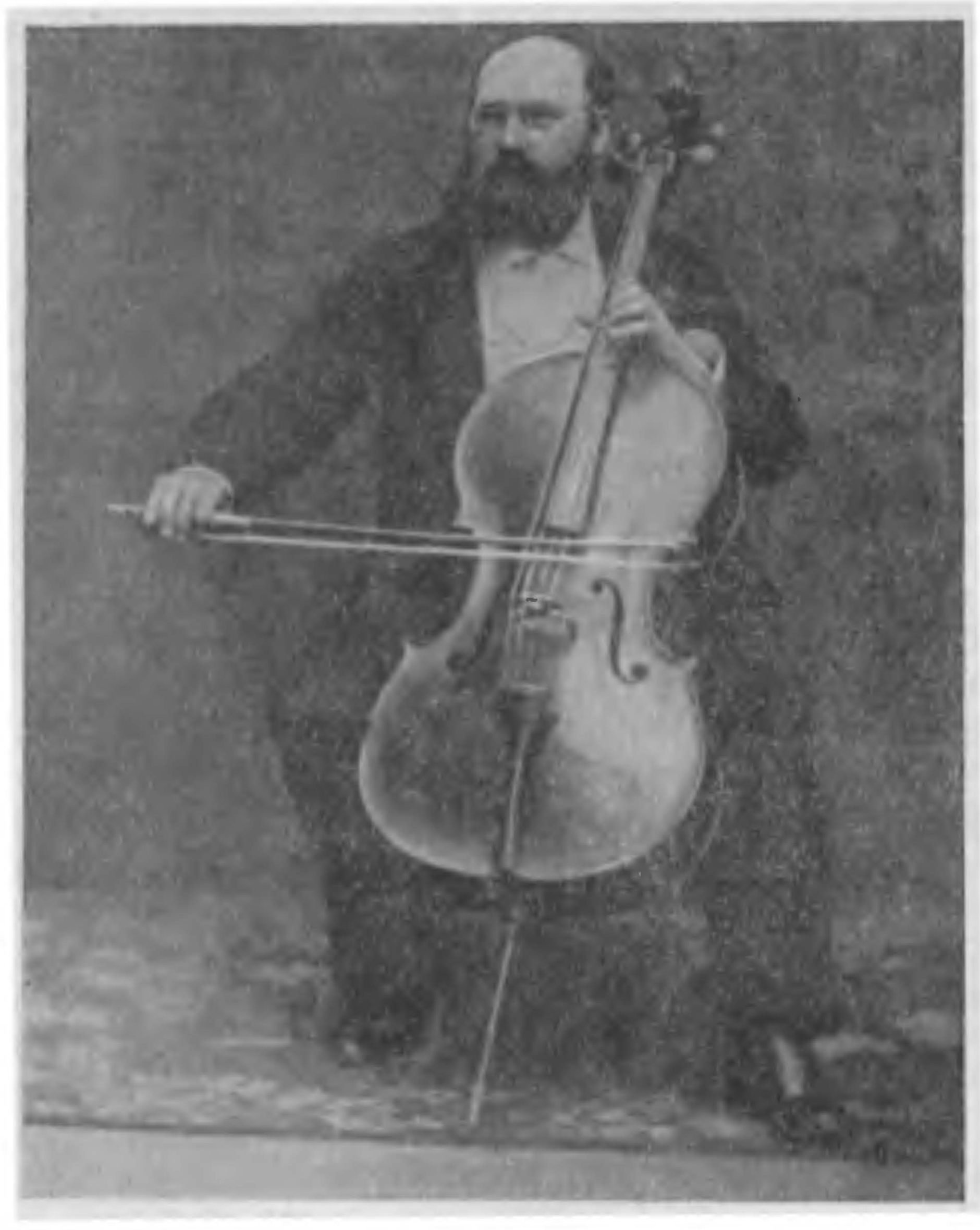
Although the artistic significance of Bernhard Cossmann’s successor, the equally well-known cellist Wilhelm Fitzenhagen, was perhaps more modest, his role in the formation of the Moscow cello school was quite considerable. He directed the cello class of the Moscow Conservatory for twenty years. Throughout this period, Fitzenhagen performed regularly as both a soloist and a chamber musician. Having come to Russia at the age of twenty-two, he became much more closely acquainted with Russian musical culture and its most prominent representatives, who exerted a beneficial influence on his musical outlook. His participation in the musical life of Moscow was also more active.
[p. 278]
Wilhelm (or, as he was known in Russia, Vasily Fedorovich) Fitzenhagen was born on September 15, 1848, in the small town of Seesen, near Braunschweig. His father, who directed the municipal orchestra, began teaching the boy to play the piano in early childhood and the cello at the age of eight. Some time later, the young musician, having also learned to play the violin and wind instruments, was capable of replacing almost any member of his father’s orchestra. On the cello, to which Fitzenhagen soon gave preference, he studied with Plock in Braunschweig and, beginning in 1862, with Theodor Müller. In 1868, having completed his education under Friedrich Grützmacher, he joined the Saxon court orchestra. At the same time, Fitzenhagen performed successfully in Leipzig, Weimar, and other German cities. When Franz Liszt heard him play in 1870, he expressed a desire to invite the cellist to join the Weimar court orchestra. At this time, however, Fitzenhagen received an invitation to become a professor at the Moscow Conservatory in place of Cossmann, who had returned to his homeland. Having accepted this invitation, Fitzenhagen worked in Russia for the remainder of his life.
At his very first appearance at a symphonic concert of the Russian Musical Society (November 6, 1870), Fitzenhagen established himself as a serious musician, performing not only a concerto by his teacher Grützmacher but also movements from a solo suite by Bach—the Sarabande and Gavottes. Subsequently, he appeared as a soloist at symphonic concerts, performing concertos by Rubinstein (both of them), Servais, Molique, Raff, Lindner, Eckert, Vieuxtemps, and his own compositions. A particular achievement of the artist was the first performance of Tchaikovsky’s Variations on a Rococo Theme, dedicated to him, of which more will be said below. Fitzenhagen also performed pieces by Davydov, Rubinstein, Tchaikovsky, Handel, Locatelli, Mozart, Schubert, Schumann, Popper, Neruda, and himself, among others.
His participation in performances of Beethoven’s Triple Concerto (with Nikolai Rubinstein and Jan Hřímalý in 1878) and Brahms’s Double Concerto (with Jan Hřímalý in 1888) deserves mention. Noting the “excellent interpretation of Brahms’s concerto” (this was the first performance of the concerto in Moscow), a Moscow reviewer reported that the performers played as an encore “an interesting canon from a Bach sonata, arranged by Professor Fitzenhagen for violin and cello with double bass accompaniment.”¹
Fitzenhagen sought to expand the limited cello repertoire of his time, particularly through
[p. 279]
arrangements of works by Russian composers for cello and piano. His numerous transcriptions include pieces by Tchaikovsky, Arensky, Bach, Handel, Locatelli, and others. His arrangement of Tchaikovsky’s piano Nocturne (Op. 19, No. 4) became firmly established in the cello repertoire.¹
Most of Fitzenhagen’s own compositions have become outdated. In his time, however, Tchaikovsky acknowledged the achievements of this musician not only as a performer (see below) but also as a composer;² while expressing a negative opinion of Fitzenhagen’s First Concerto (1871), he spoke favorably of his Concert fantastique (1872) and Ballade.³ The Moscow critic Sergei Flerov expressed a critical opinion of Fitzenhagen’s Third Concerto, which the composer first performed with an orchestra conducted by Anton Rubinstein in 1880.⁴ Bruno Weigl, on the other hand, spoke approvingly of Fitzenhagen’s Fourth Concerto (published in 1889 with a dedication to Professor Robert Hausmann), noting its effective use of the cello and colorful orchestration.⁵
Nikolai Kashkin favorably assessed Fitzenhagen’s suite for cello and orchestra (performed by the composer in 1888), consisting of a Gavotte, Elegy, and Serenade,⁶ although critical observations were also made about this work.⁷
Fitzenhagen’s virtuoso fantasy on themes from Rubinstein’s opera The Demon, published by V. Bessel in St. Petersburg, deserves attention. Finally, mention must be made of a series of potpourris from Russian operas and ballets arranged by Wilhelm Fitzenhagen for cello and piano and published by P. Jurgenson in Moscow. This series, comprising twenty-six potpourris from works by Tchaikovsky, Rubinstein, Arensky, Nápravník, Ippolitov-Ivanov, and other composers, satisfied the needs of a broad circle of Russian music lovers in its time.⁸
[p. 280]
We may judge Fitzenhagen’s playing from the accounts of his contemporaries that have come down to us. Judging by these accounts, although the cellist was not an especially brilliant figure in the history of cello performance, he was distinguished by excellent training and accomplished technique.
When Fitzenhagen performed his First Concerto in Moscow in 1871, Herman Laroche, like Tchaikovsky, criticized this weak composition but noted that it had been performed excellently. “Fitzenhagen is an artist,” wrote Laroche, “on whose acquisition the Conservatory can only be congratulated, particularly when one remembers that cellists in general, and good ones in particular, are very scarce in the world.”¹
In 1872, Tchaikovsky called Fitzenhagen a “serious and talented virtuoso” and noted his “talent and skill.”² In another review, written two years later, Tchaikovsky wrote that Fitzenhagen “plays intelligently, skillfully, with talent and feeling, and possesses exceptionally strong technique.”³ In his performance of a virtuoso fantasy by Servais, Tchaikovsky emphasized the “great bravura and finish in the treatment of details.”⁴
When Fitzenhagen performed Anton Rubinstein’s First Concerto at a symphonic concert with an orchestra conducted by Nikolai Rubinstein, a reviewer wrote: “Mr. Fitzenhagen’s technique leaves nothing to be desired. Difficulties of the kind presented by Rubinstein’s concerto, particularly those of the final (third) movement, were overcome by the artist with genuine mastery. Mr. Fitzenhagen’s playing, full of charm and gentleness, is that of a fully accomplished and distinguished virtuoso. The conscientiousness with which he brings to perfection such ungrateful and difficult passages as those found in the third movement of Anton Rubinstein’s concerto is decidedly worthy of admiration.”⁵
The Russian press repeatedly criticized certain compositions of Fitzenhagen’s own and other works that he performed—concertos by Vieuxtemps, Eckert, Servais, and the like. This was excused, however, on account of the limited cello repertoire, a limitation that the artist nevertheless sought to overcome. “The appearance of the distinguished professor at concerts of the Musical Society,” wrote the Moscow critic of Russkie vedomosti, “can be appropriate only
[p. 281]
when some interesting novelty from the cello concerto literature is presented, with which it is desirable to acquaint the public. Thus, we were very grateful to him when he introduced us to the cello concertos of Rubinstein and Raff. In such cases, his thoughtful playing, combined with the interest of the work itself, can afford pleasure … Why not acquaint us with the concerto by Saint-Saëns, or with Davydov’s concertos? But, my God! To listen to the three-act exercise in empty prattling that is Vieuxtemps’s concerto is beyond all endurance.”¹
Even at the beginning of Fitzenhagen’s activity in Moscow, Tchaikovsky, while doing justice to the young cellist as a performer, censured him for performing such insubstantial and outdated works as the Servais concerto. Bearing in mind both the increased sophistication of the Russian public and the educational and enlightening role of the performing arts, Tchaikovsky set Fitzenhagen the task of further cultivating the artistic tastes of his listeners.
“If Mr. Fitzenhagen supposed,” wrote Tchaikovsky, “that the public prefers music of a so-called light character, then, although this is true, light music, in order to please, must at the same time be good music. Servais’s concerto belongs to those works overflowing with passages but devoid of any semblance of music, to which our grandfathers and grandmothers listened in those memorable days when we recognized no music apart from virtuosity. But that time has passed irrevocably, particularly for the public of the Musical Society, which has, after all, been spoiled by constantly hearing only good compositions.
“Meanwhile,” Tchaikovsky continued, “Mr. Fitzenhagen is so serious and talented a virtuoso that he can afford to defy the aforementioned inclination of the public toward the lighter genre. Let him not succumb to the weakness of certain virtuosos who cater to the crude lack of cultivation of the masses. It is not he who should descend to their lack of understanding; rather, the public must ultimately rise to a just appreciation of his talent and skill, which, incidentally, are beyond all doubt.”²
In this way, the great Russian musician educated Fitzenhagen himself, drew his attention toward music of greater substance, and instilled in him a sense of responsibility in the selection of the repertoire offered to the public. This could not fail to influence the development of the artist’s musical outlook.
[p. 282]
When Fitzenhagen gave his concert at the Bolshoi Theatre in March 1873, Tchaikovsky wrote: “This artist possesses unquestionable merits. His playing is thoughtful and enhanced by strong, dexterous technique. Moreover, in his compositions Mr. Fitzenhagen reveals himself to be a good musician, educated on the classical models of the German musical school … In any case, Mr. Fitzenhagen deserves greater attention and sympathy than he enjoys here, judging by the meager proceeds of his concert, which scarcely covered even half the expenses …”
Noting the merits of Fitzenhagen’s Ballade, which he performed the following year, Tchaikovsky remarked that “Mr. Fitzenhagen overcame the technical difficulties of the entire work with complete success and played with such enthusiasm and captivating expression that he earned unanimous approval.” And when the artist performed Raff’s concerto in 1875, both the composition and its performance greatly pleased Tchaikovsky, who remarked in his review: “I am very glad that our public is beginning to appreciate this excellent virtuoso at his true worth. Mr. Fitzenhagen
[p. 283]
possesses tremendous technique, a resonant and mellow tone, and a fine sense of proportion in phrasing. What more could one demand of a virtuoso?”¹
Through his artistic association with outstanding Moscow musicians, the artist’s musical taste developed, his mastery matured, and his repertoire grew richer. Particularly noteworthy was Fitzenhagen’s inclusion in his programs of individual movements from Bach’s suites and other eighteenth-century works. The press especially noted the artistic finish of Fitzenhagen’s interpretation of pieces (transcriptions) by Locatelli and Mozart.² In 1876, he performed Boccherini’s First Sonata with Nikolai Rubinstein.
It was an indisputable achievement of Fitzenhagen’s that he included movements from Bach’s suites for solo cello in his own repertoire and in that of his pupils. It must not be forgotten that at the time (and, strictly speaking, until the beginning of our century, when Pablo Casals “discovered” them³), these suites were not performed in their entirety and were regarded by many as instructional rather than artistic works.
Editions of Bach’s suites bearing Fitzenhagen’s annotations are preserved in the library of the Moscow Conservatory. There is also a manuscript score of his arrangement for cello and orchestra of Bach’s Air and Gavotte (the Air in D major from the orchestral suite and the Gavotte from the Sixth Solo Suite⁴). Fitzenhagen’s interest in Bach’s music is also demonstrated by his aforementioned arrangement of a Bach canon for violin and cello.
Fitzenhagen repeatedly appeared in chamber music performances of sonatas with Nikolai Rubinstein (sonatas by Beethoven and Saint-Saëns), Paul Pabst (sonatas by Chopin and Saint-Saëns), Vasily Wilborg (a Mendelssohn sonata), Heinrich Barth (a Beethoven sonata), Vasily Safonov (Beethoven sonatas), and other prominent pianists.
When Fitzenhagen and Safonov performed one of Beethoven’s sonatas at a chamber concert in 1888, Nikolai Kashkin remarked in his review: “The second piece was Beethoven’s sonata for piano and cello, masterfully performed by Vasily Safonov and Wilhelm Fitzenhagen. Although compositions of this kind do not present technical difficulties, they may nevertheless serve as a touchstone for the musician, since the virtuoso element recedes into
[p. 284]
the background … The artists played the sonata with attention to the finest nuances and with the most complete unity of ensemble.”¹
The performance of Beethoven’s sonatas by these artists is connected with a concert worthy of attention both in the history of the art of the cello and in the performance history of these sonatas. This was the last concert of the celebrated Karl Davydov, which took place in Moscow on January 29, 1889. Although already seriously ill, the great musician arranged a free morning concert for students, at which he was to perform three Beethoven sonatas with Safonov. After the very first sonata, Davydov felt so unwell that he was unable to continue the concert.
As Nikolai Kashkin reports, “Wilhelm Fitzenhagen, who happened to be in the hall, agreed with truly artistic readiness to Karl Yulievich’s request that he replace him in the remaining numbers of the program. Without rehearsal and on another person’s instrument (a matter of great importance to a cellist), he played both difficult Beethoven sonatas with complete success. Such rare obligingness was particularly valuable at a concert of this kind, where the young listeners assembled would otherwise have been deprived of a pleasure so rarely available to them.”²
Fitzenhagen also participated in performances of trios with the pianists Anton and Nikolai Rubinstein, Sergei Taneyev, Vasily Safonov, Paul Pabst, and Alexandra Zograf, and with the violinists Ferdinand Laub, Adolph Brodsky, and Jan Hřímalý. Together with Taneyev and Hřímalý, he participated in the first public performance of Tchaikovsky’s Trio, which took place on October 18, 1882.³
Throughout his twenty years in Russia, Fitzenhagen was a member of the quartet of the Moscow branch of the Russian Musical Society. His partners in the quartet were Ferdinand Laub (first violin), Jan Hřímalý (second violin until 1864 [sic], and subsequently first), Adolph Brodsky, Iosif Kotek, A. A. Hilf, David Krein (second violin), Yuri Gerber, K. O. Babushka, and Vasily Salin (viola).
This ensemble, with the participation of Fitzenhagen, performed many works of the Russian and foreign classical quartet repertoire. Alongside chamber works by Haydn, Mozart, Beethoven, Schubert, Schumann, Mendelssohn, Brahms, and Svendsen, the quartet performed compositions by Tchaikovsky, Davydov, Borodin, Rimsky-Korsakov, Taneyev, and other Russian composers during these years. Many of these works, particularly the quartets of Tchaikovsky
[p. 285]
and certain quartets by Taneyev (in E-flat major, C major, and E minor), received their first performances by the Moscow quartet with Fitzenhagen’s participation.
Speaking of the quartet consisting of Hřímalý, Hilf, Gerber, and Fitzenhagen, a reviewer remarked in 1879: “Nothing but good can be said about the dome and foundation of this quartet edifice.”¹ The following year, concerning a performance of Schubert’s G-major Quartet, the same author wrote: “The Andante of the quartet, in which the singing of the cello plays such an important role, was performed excellently. Mr. Fitzenhagen was entirely in his element here as an experienced and capable quartet player.”²
Fitzenhagen’s musical activity from 1870 to 1890 took place principally in Moscow, although he occasionally performed in other Russian cities and abroad. At times, Fitzenhagen gave concerts in neighboring cities (for example, in Tula in 1871), and he also performed in Kharkiv, St. Petersburg, and other cities of the country.
In November 1871, while in Kharkiv, Fitzenhagen appeared not only as a soloist but also as a member of the local quartet (Gustav Frieman, Lanzetti, Pavlovich, and Fitzenhagen). A Kharkiv correspondent spoke enthusiastically of the cellist’s playing and wrote: “This artist combines tremendous technique and purity of execution with remarkable warmth and attractiveness of tone. His phrasing and nuances distinguish him as a man of profound musical education.”³ As an encore at this concert, Fitzenhagen played Davydov’s At the Fountain with particular success.
In St. Petersburg, Fitzenhagen was always drawn to Davydov, for whom he had enormous respect. His first appearance in that city took place in 1873, when, at a concert given by Nikolai Rubinstein, he performed a fantasy by Servais, his own Résignation, and Popper’s Butterfly.
“The name of this virtuoso is fairly well known in the musical circles of St. Petersburg,” we read in a review of this performance. “It remained only to hear him in public, and we must confess that Mr. Fitzenhagen justified the reputation that he enjoys in Moscow. His playing is very solid, his tone excellent, and his technique highly satisfactory. Moreover, Mr. Fitzenhagen is an excellent musician and phrases with great taste.”⁴
Such an assessment of Fitzenhagen in a city whose listeners had been spoiled by the highly artistic and masterful playing of Davydov
[p. 286]
testifies to the merits of his younger colleague’s playing.
In 1881, the Moscow cellist appeared at a symphonic concert of the St. Petersburg branch of the Russian Musical Society under Davydov’s direction. On this occasion, he performed Lindner’s concerto, his own Concert Mazurka No. 2, and two pieces in his own arrangements: an Air by Lotti and Schumann’s Nachtstück.
Performing abroad from time to time, Fitzenhagen made his own contribution to the popularization of Russian music, particularly the works of his favorite composer, Tchaikovsky, at a time when the latter was still almost unknown there. Even before the appearance of the great composer’s works for cello, Fitzenhagen arranged certain of his compositions for the instrument and performed them.
Like Ferdinand Laub, who arranged the Andante cantabile from Tchaikovsky’s First Quartet for violin, Fitzenhagen arranged this remarkable piece for cello¹ and performed it in Russia and abroad.
In 1872, a correspondent of Muzykalnyi listok reported: “In Kassel, during the festivities of the Allgemeiner Deutscher Musikverein, at one of the musical morning concerts, the cellist Fitzenhagen (professor at the Moscow Conservatory) ventured to perform an adagio by the composer Mr. Tchaikovsky, arranged for cello with piano accompaniment, and naturally made an impression on the small but musical audience assembled there. How gratifying it is to hear,” added the correspondent, “that the Germans have at last taken a liking to Russian music by a good composer. Until now, they have not known our composers and have not had the slightest confidence in them.”²
Besides this piece, Fitzenhagen arranged for cello the aforementioned Nocturne (Op. 19, No. 4) and Song Without Words (Op. 2, No. 3).
Fitzenhagen’s friendship and artistic ties with Tchaikovsky deserve our attention not only because of the beneficial influence that the great Russian composer exerted on this cellist.
One cannot fail to emphasize Fitzenhagen’s achievement in bringing about the appearance of such transcriptions as the quartet Andante cantabile and the piano Nocturne, which enriched the cello repertoire. As is well known, Tchaikovsky orchestrated both of Fitzenhagen’s transcriptions for cello and string orchestra in 1888, and Anatoly Brandukov performed them that same year at a concert of the composer’s works in Paris.³
[p. 287]
Particular mention must be made, however, of Tchaikovsky’s dedication of his magnificent Variations on a Rococo Theme to their first performer in Russia and abroad, Wilhelm Fitzenhagen.
We have already put forward the supposition that Tchaikovsky was inspired to create this work by Davydov’s exceptionally expressive and impressive playing. The dedication of the Variations to Fitzenhagen rather than to Davydov may be explained by the friendly relations that existed between the composer and this cellist,¹ as well as by Tchaikovsky’s recognition of his musical and performing qualities. Furthermore, it was apparently to a certain degree under the influence of Fitzenhagen’s persistent requests that the composer created his remarkable work for cello in 1876–1877.²
Fitzenhagen became the first performer of the Variations, which were first heard with an orchestra under the direction of Nikolai Rubinstein on November 18, 1877, at the third symphonic concert of the Moscow branch of the Russian Musical Society. Tchaikovsky was in Venice at the time.
The first performance of the Variations abroad took place during the music festival in Wiesbaden on June 8, 1879. As early as April, Fitzenhagen wrote to Tchaikovsky:
“A great musical festival is to take place in Wiesbaden, at which I shall have the honor and pleasure of playing your Variations with orchestra, for which purpose I am leaving on May 8. I am informing you of this pleasant news so that, if you have the time and desire, you too may come to Wiesbaden … I am happy not only to have been the first cellist to play this piece in Russia but also to have the opportunity to perform it for the first time in Germany …”³
Both the piece and its performance were an enormous success. There was applause after the D-minor variation, and after the conclusion of the work the soloist was recalled several times. Among those present were prominent cellists of the time—Friedrich Grützmacher, Bernhard Cossmann, and Jules de Swert—as well as Franz Liszt, who said to Fitzenhagen: “You played magnificently. Here, at last, is real music!”
In a letter to Tchaikovsky, Fitzenhagen wrote: “I realized that with this piece I shall be successful everywhere and shall always keep it in my repertoire …”⁴ He went on to
[p. 288]
report Hans von Bülow’s successful performance of Tchaikovsky’s Piano Concerto, the interest aroused in Germany by the Russian artist’s compositions, and Liszt’s intention to write a fantasy or paraphrase on themes from Eugene Onegin.
It is interesting that in both of the letters quoted, Fitzenhagen insistently reminds Tchaikovsky of his promise to compose a cello concerto. “Will you soon begin the cello concerto?” he asks in the first letter. “I beg you not to forget it; I shall gladly participate in editing the cello part.” And in the second letter, following the performance of the Variations, he wrote: “Dear friend! I think that now you will soon compose a concerto for cello! I hope to assist you with advice and practical help, and I shall be happy if you finally fulfill my wish!”
As is well known, Fitzenhagen edited the Variations on a Rococo Theme twice. The first edition of the piano reduction of the Variations (1878) represents his second version, the one most widely used in performance practice. Eleven years later, the score of the Variations was published in this same version.
That the composer accepted Fitzenhagen’s edited version may be judged, if only from the fact that throughout these eleven years he did not dispute it, and that in 1893 he himself conducted the orchestra when the Variations were performed in this version by Ladislav Aloiz.¹ (For a more detailed discussion of the Variations, see the chapter “The Cello in the Works of Russian Composers.”)
At the same time, there is no documentary evidence whatsoever of Tchaikovsky’s dissatisfaction with Fitzenhagen’s edition. (There can be no doubt that had Tchaikovsky disagreed with Fitzenhagen’s edition, he would not have hesitated to declare it, as he had done two years before composing the Variations in his dealings with Nikolai Rubinstein concerning the latter’s proposed changes to the First Piano Concerto.²) In subsequent years, too, Tchaikovsky
[p. 289]
repeatedly entrusted Fitzenhagen with editing the cello parts of his compositions. This was the case, in particular, with the part of his Piano Trio, as it was with the part of Pezzo capriccioso, a piece for cello and orchestra dedicated to Brandukov. In 1887, when this piece was being published, the composer, who was staying in Maidanovo, wrote to Pyotr Jurgenson (August 30): “Today I am sending you the cello piece dedicated to Brandukov. Be so kind as to send it to Fitzenhagen … and ask him on my behalf to look over the cello part and insert all kinds of signs and indications of a specialized nature.”¹
All this gives grounds for believing that the published version of the Variations prepared by Fitzenhagen and accepted by the majority of contemporary performers has a right to continued life on the concert platform alongside the composer’s original version. Naturally, Fitzenhagen’s performance markings should not be considered obligatory (including certain of his dynamic markings as well as his outdated fingering practices).
Fitzenhagen’s friendship with Tchaikovsky continued until the end of his life. This is demonstrated, in particular, by two further letters addressed by Fitzenhagen to the composer and preserved in the Tchaikovsky House-Museum.
In one of them (dated February 27, 1885), he asked Tchaikovsky to support him in the new responsibility that he had undertaken, namely, that of director (conductor) of the Moscow Musical Circle, composed of amateur musicians. In the letter, Fitzenhagen wrote of his desire “to spread among amateurs a genuine love of art, to teach them, to contribute to their education, so that, through their better understanding of art, one might also achieve a better understanding of it on the part of artists.” (In the same letter, Fitzenhagen wrote of organizing a chamber concert of Mozart’s works for Tchaikovsky: “Everything Mozartian for you.”)
Under Fitzenhagen’s direction, the Moscow Musical Circle achieved considerable success in the following years, and its activities possessed a certain educational significance. In 1888, a correspondent of one of the Moscow newspapers wrote:
“The purpose of the circle, whose members meet
[p. 290]
weekly on Tuesdays at the Slavyansky Bazaar, is to afford music lovers the opportunity to perform orchestral, choral, and solo works. The circle has become especially interesting in recent years, since the well-known professor of the Moscow Conservatory, Wilhelm Fitzenhagen, became its director in 1885.
“Thanks to his name, his profound knowledge of music, his experience, his taste cultivated on strict classicism, and, most importantly, his love for the undertaking, he succeeded in bringing together a very large number of Moscow amateurs and creating a fairly sonorous orchestra …
“Thanks to Fitzenhagen, many first-class performers have visited the meetings of the circle and, in a completely informal and cordial manner, have acquainted its members with the subtleties of performance and phrasing.”¹
In another letter (dated September 20, 1888), Fitzenhagen expressed his boundless admiration for Tchaikovsky’s new (Fifth) Symphony, which Taneyev and Alexander Siloti had played at the Conservatory that evening.²
Tchaikovsky remembered his friend even during the final months of Fitzenhagen’s life. Modest Tchaikovsky, reporting that his brother had settled in Moscow in the autumn of 1889, wrote: “At this time, a great friend of his, the cellist Fitzenhagen, was dying of a painful illness.”³
Illness struck the artist in the prime of his powers and at a time when he was absorbed in the idea of organizing popular concerts accessible to a broad circle of listeners. Fitzenhagen gave a number of such concerts, with serious classical programs, using an orchestra of amateur musicians.
Shortly before the aggravation of his illness, Fitzenhagen had also been offered the direction of the Conservatory’s student orchestra. He contemplated arranging concerts with the combined forces of these two orchestras. Illness confined him to his bed, but he continued to teach his pupils. On February 1, 1890, he passed away.
In his obituary, Nikolai Kashkin noted that for twenty years Fitzenhagen had faithfully served the cause of the Moscow Conservatory. Having moved to Russia in his youth, Fitzenhagen “became sincerely attached to his new homeland and devoted all his powers and abilities to its service.
[p. 291]
He was a man of honest and straightforward character, incapable of doing anything by halves, and such he was in his relations with both people and art.”
Having paid tribute to the performing, pedagogical, and compositional activities of this musician, Kashkin expressed his conviction in conclusion that “the memory of this good and honest worker and excellent artist will forever be preserved by all those who knew him.”¹
At the memorial service held on February 2, Fitzenhagen’s finest pupil, Brandukov, played with profound feeling.²
As a teacher, Fitzenhagen revealed himself at his best. Although the cello class under Fitzenhagen increased numerically only from four to ten students,³ during the twenty years of his teaching activity in Moscow the professional standard in the training of young cellists rose considerably. Among them were talented musicians who brought renown to the Moscow cello school.
Among Fitzenhagen’s pupils, particular attention should be paid to those who graduated from the Conservatory in his class with gold and silver medals: Anatoly Brandukov (to whom a separate chapter of this book is devoted), Pyotr Danilchenko, Józef Adamowski, and Ivan Saradzhev.
“Under Fitzenhagen’s direction,” wrote one of his contemporaries, “many remarkable Russian cello virtuosos were trained, among whom Mr. Brandukov deservedly occupies an outstanding place.”⁴
One of the obituaries devoted to Fitzenhagen notes this musician’s attachment to the Moscow Conservatory (he had repeatedly “declined brilliant offers from abroad and did not wish to leave Russia, with which he had become united”). It continues:
“That his residence among us as a teacher did not pass without leaving a trace is demonstrated by the great renown of his pupils Anatoly Brandukov and Józef Adamowski in the Old and New Worlds. Not a single concert marked by the highest artistic integrity takes place without Brandukov, who has settled in Paris, and his name on a poster ensures good receipts. Adamowski, meanwhile, is reaping laurels in America and bringing honor to our city on the other side of the ocean.”⁵
According to Nikolai Kashkin, Fitzenhagen
[p. 292]
“was impeccably conscientious in his lessons with the students.”¹
“As a teacher, Wilhelm Fitzenhagen could serve as a model of conscientiousness in his work and of complete devotion to his calling,” wrote Nikolai Kashkin in his obituary. “All his former and present pupils will remember with kind words their good and talented mentor, who rejoiced in their successes perhaps even more than in his own. Already half overcome by a cruel illness, he found consolation in the successes of his former Conservatory pupil Adamowski, who occupied a prominent position in that most musical of American cities, Boston. With no less attention and sympathy did he follow Brandukov, who had likewise once been a pupil of the deceased.”²
Information regarding the method of instruction in Fitzenhagen’s class is almost entirely lacking. From his pupils’ appearances at Conservatory concerts, we may judge the repertoire they studied. These were works by Romberg, Servais, de Swert, Goltermann, Popper, Molique, Lindner, Raff, Svendsen, Davydov, Tchaikovsky, and Fitzenhagen himself.
His pupils publicly performed works by Bach (R. Semashko in 1886, 1887, and 1889), Tchaikovsky’s Variations on a Rococo Theme (Józef Adamowski in 1883), concertos by Raff and Svendsen, and pieces by Davydov and Rubinstein. They also frequently participated in cello ensembles.
Characteristic of Fitzenhagen’s pedagogical method was his involvement of pupils in professional musical activity. They frequently performed both at Conservatory evenings and at professional concerts. Fitzenhagen often enlisted his pupils to participate in chamber concerts of the Russian Musical Society, entrusting them with the second cello parts in ensembles employing two cellos.
For example, in 1884, Pyotr Danilchenko participated in a performance of a Brahms sextet, and in 1889, R. Semashko took part in a performance of Davydov’s quintet at a concert dedicated to the memory of this outstanding musician, who had exerted a beneficial influence both on Fitzenhagen himself and on his pupils.³
Notes
p. 278
¹ Moskovskie vedomosti, 1888, no. 316.
p. 279
¹ The performance of Tchaikovsky’s Nocturne in Fitzenhagen’s transcription is compulsory for cellists participating in the International Tchaikovsky Competition.
² Fitzenhagen’s quartet was awarded a prize by the St. Petersburg Society of Chamber Music Lovers.
³ Pyotr Tchaikovsky, Complete Works, vol. 2 (Moscow, 1953), pp. 137 and 168.
⁴ See Moskovskie izvestiia, 1880, no. 311.
⁵ See Bruno Weigl, Handbuch der Violoncell-Literatur (Vienna–Leipzig, 1929), p. 25.
⁶ See Russkie vedomosti, 1888, no. 78.
⁷ See Moskovskie vedomosti, 1888, no. 79. The Moscow critic Osip Levenson was critical in his assessment of Fitzenhagen’s compositions.
⁸ Certain compositions by Fitzenhagen have partly retained their pedagogical significance, such as the Technical Studies, Op. 28. One of these studies is included in a collection compiled by the department of the Moscow State Conservatory.
p. 280
¹ Sovremennaia letopis, 1871, no. 4.
² Pyotr Tchaikovsky, Complete Works, vol. 2 (Moscow, 1953), p. 93.
³ Ibid., p. 223 (review of 1874).
⁴ Ibid., p. 255 (review of 1875).
⁵ Literary supplement to Muzykalnyi vestnik, 1872, no. 1, p. 6.
p. 281
¹ Osip Levenson, In the Concert Hall (Musical Feuilletons), vol. 1 (Moscow, 1880), pp. 74–75 (the review dates from 1878).
² Pyotr Tchaikovsky, Complete Works, vol. 2 (Moscow, 1953), p. 93.
p. 283
¹ See Pyotr Tchaikovsky, Complete Works, vol. 2 (Moscow, 1953), pp. 137, 168, and 285.
² See Muzykalnyi svet, 1876, no. 17.
³ See Lev Ginzburg, Pablo Casals (Moscow, 1958), pp. 16, 79–81, and 129–133.
⁴ The arrangement was made on the basis of Friedrich Grützmacher’s transcription for cello and piano.
p. 284
¹ Russkie vedomosti, 1888, no. 26.
² Russkie vedomosti, 1899 [sic], no. 31.
³ Earlier, on the anniversary of the death of Nikolai Rubinstein, to whom the Trio is dedicated, the same performers played it at the Conservatory (March 11).
p. 285
¹ Osip Levenson, In the Concert Hall (Musical Feuilletons), vol. 1 (Moscow, 1880), p. 136.
² Ibid., vol. 2 (Moscow, 1881), pp. 45–46.
³ Literary supplement to Muzykalnyi vestnik, 1872, no. 1, p. 4.
⁴ Muzykalnyi listok, 1873, no. 22, p. 349.
p. 286
¹ Both transcriptions were published in Moscow by P. Jurgenson.
² Muzykalnyi listok, 1871, no. 1.
³ The transcriptions of both pieces in the composer’s orchestration were published in volume 30b of Tchaikovsky’s Complete Works, prepared by Viktor Kubatsky (Moscow, 1956).
p. 287
¹ Tchaikovsky visited Fitzenhagen’s home and was the godfather of his daughter Elizaveta.
² See R. Stein, Tschaikovsky (Berlin–Leipzig, 1927), p. 433.
³ Letter from Wilhelm Fitzenhagen to Tchaikovsky, Moscow, April 29, 1879 (Tchaikovsky House-Museum, no. 4511). In this letter, Fitzenhagen informed Tchaikovsky that at the festival he intended to present Franz Liszt with the piano-vocal score of Eugene Onegin and request that he write a piano fantasy on themes from the opera.
⁴ Letter from Wilhelm Fitzenhagen to Tchaikovsky, June 13, 1879 (preserved in the same repository).
p. 288
¹ During Tchaikovsky’s lifetime, other cellists also played the Variations on a Rococo Theme in Fitzenhagen’s edition, of which the composer was aware. Let us also note that during the engraving and proofreading of the Variations (April–November 1878), Tchaikovsky, while in Russia (and in Moscow in July, September, October, and November), did not alter the version proposed by Fitzenhagen, although he could, of course, have done so. Furthermore, having received editions of a number of his compositions, including the Variations, while in Florence, he confined himself in his letter to Pyotr Jurgenson of December 10/22 to a jocular remark concerning misprints he had discovered in the edition of this piece.
² See Tchaikovsky’s letter to Nadezhda von Meck, January 21, 1878.
p. 289
¹ Pyotr Tchaikovsky, Correspondence with Pyotr Jurgenson, vol. 2 (Moscow–Leningrad, 1952), p. 68.
Tchaikovsky’s correspondence with Jurgenson reveals an unfriendly attitude toward Fitzenhagen on Jurgenson’s part. Might this have been connected with the fact that immediately after the composition of the Variations, Fitzenhagen sent them to the Berlin publisher Leuckart? (The financial difficulties of this firm, which soon went bankrupt, delayed publication, and the Variations were returned to Moscow at the composer’s request.)
p. 290
¹ Moskovskie vedomosti, 1888, no. 272. See also Muzykalnoe obozrenie, 1885, no. 2, p. 13, and no. 12, p. 95.
² In this letter, Fitzenhagen, exercising the privileges of friendship, ventured to propose two or three minor alterations to the symphony (in one instance, he proposed cutting twelve measures; in another, adding eight to sixteen measures; and in a third, transferring the clarinet melody to the cello). These suggestions were not accepted by Tchaikovsky.
³ Modest Tchaikovsky, The Life of P. I. Tchaikovsky, vol. 3 (Moscow, 1902), p. 322.
p. 291
¹ See Russkie vedomosti, 1890, no. 34.
² Brandukov dedicated six cello pieces to his teacher (see below).
³ This number was limited by the contract with the Directorate of the Russian Musical Society. If the number of teaching hours exceeded ten per week, the Directorate would have had to pay additionally, which it did not consider possible (see the file of Wilhelm [Vasily Fedorovich] Fitzenhagen in the Moscow Conservatory fond at TsGALI).
⁴ Moskovskie vedomosti, 1888, no. 77. The “serious approach to teaching” in Fitzenhagen’s class was noted in the same newspaper in 1882 (no. 158) by Sergei Flerov.
⁵ Bayan, 1890, no. 2.
p. 292
¹ Nikolai Kashkin, The First Twenty-Five Years of the Moscow Conservatory (Moscow, 1891), p. 61.
² Russkie vedomosti, 1890, no. 34.
³ Let us note that, already being seriously ill, Fitzenhagen entrusted R. Semashko with teaching his class.