(Excerpted from Lev Ginzburg’s History of the Art of the Violoncello, Vol. 3, The Russian Classical Cello School (1860–1917), Moscow, 1965, pp. 353–397, translated by Yuriy Leonovich.)
[p. 353]
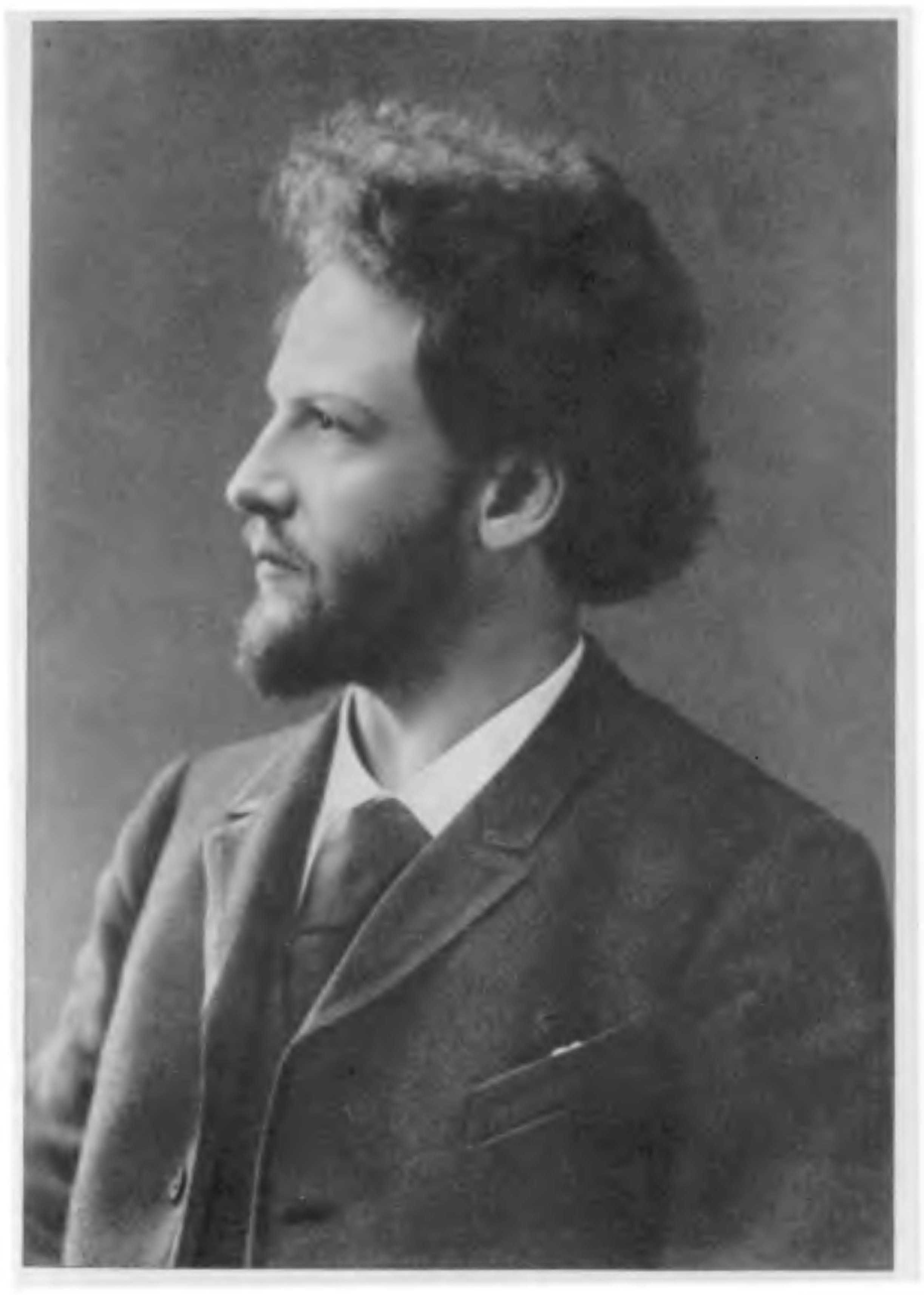
The outstanding artist, remarkable cello performer, and celebrated musical figure Anatoly Andreyevich Brandukov belonged to that generation of Russian musicians which, having been formed during the prerevolutionary period, took an active part in the development of the young Soviet musical culture. This generation carried the finest traditions of the Russian classical school and contributed greatly to the education of Soviet performers in the spirit of realistic art.
A graduate of the Moscow Conservatory, A. A. Brandukov, who in his time was connected through artistic collaboration and friendship with the geniuses of Russian musical art of the past, P. I. Tchaikovsky and S. V. Rachmaninov, played a significant role in the development of Soviet musical performance culture in the 1920s.
A. A. Brandukov’s musical activities, which extended over more than half a century, were characterized by different features at their various stages (his years of study at the Moscow Conservatory, his period of intensive concert activity in Russia and abroad, his directorship of the Music and Drama School of the Moscow Philharmonic Society, and his years as a professor at the Moscow State Conservatory). These reflected his gradually developing maturity, the fruitful influences of the great Russian classical musicians, and changes in the musician’s social position.
[p. 354]
At the same time, however, certain features of Brandukov’s artistic personality remained characteristic of him throughout his life. Foremost among these were the profound integrity of a genuine artist and the strongly pronounced realistic orientation of his performing art, organically connected with the progressive traditions of the Russian classical school.
It is precisely these features, combined with Brandukov’s great gifts, that permit his name to be placed alongside those of such foremost Russian performers as his “comrades-in-arms” K. Yu. Davydov and A. V. Verzhbilovich, the pianists A. G. Rubinstein and S. V. Rachmaninov, and the singers F. I. Chaliapin, L. V. Sobinov, and A. V. Nezhdanova.
* * *
Anatoly Andreyevich Brandukov, who was born in Moscow on December 10, 1856,¹ spent his childhood with his mother (he lost his father early) and his aunts, who apparently had close connections with the world of art. Frequently visiting the backstage areas of the Bolshoi Theatre, where his cousins danced in the ballet, the impressionable boy acquired a passion for the theater in early childhood. At home, he enthusiastically occupied himself with a puppet theater, displaying much inventiveness and artistic taste. The child’s musical gifts soon became apparent as well; this was stimulated to a considerable extent by his early attendance at concerts. Under the impression of a symphonic concert by H. Berlioz (Berlioz visited Moscow in the winter of 1867/68), the boy organized an “ensemble” of clattering saucepans in his courtyard, which in his childish imagination became a fantastic orchestra that he conducted.
At the age of eleven (from the autumn of 1868), Brandukov was enrolled among the students of the Moscow Conservatory in the class of B. Cossmann. In 1870, Cossmann was succeeded by Fitzenhagen, under whom Brandukov graduated from the conservatory in 1877, receiving a gold medal for his outstanding achievements and the diploma of Free Artist. His name is inscribed on the marble honor roll of the Moscow Conservatory.
Already during his student years, Brandukov successfully participated in various concerts. His appearances took place in
[p. 355]
Moscow and in other cities (for example, Nizhny Novgorod). In 1876, at a symphonic concert of the Russian Musical Society (RMS), Brandukov performed Fitzenhagen’s Ballade with the orchestra under the direction of N. G. Rubinstein. The success of his appearance was noted in the press.¹
Alongside the professional quartet, an excellent quartet of conservatory students, consisting of Barcewicz, Arends, Kotek, and Brandukov, repeatedly appeared at Moscow quartet concerts. In the year of his graduation from the conservatory, Brandukov participated in a quartet concert of the RMS, playing the second cello part in Mendelssohn’s Octet (the first cello part was played by his teacher Fitzenhagen). That same year, he participated in a concert by conservatory students organized for the benefit of the Red Cross Society. As reported in the press, he played the first movement of Molique’s concerto beautifully;² in addition, he was among the performers of the Andante cantabile from Tchaikovsky’s First Quartet and led a quartet of four cellists.
In a review of one of the young cellist’s appearances, the well-known music critic N. D. Kashkin was already predicting a brilliant future for Brandukov.³
The formation of the talented musician was by no means confined to assimilating the instructions he received from his immediate teachers, Cossmann and Fitzenhagen. An incomparably greater influence on Brandukov’s sensitive artistic nature was exerted by the fruitful creative environment surrounding the young musician in Moscow during the 1860s and 1870s, particularly at the Moscow Conservatory. Among the professors of this institution, still young at the time, were such outstanding musicians as P. I. Tchaikovsky, N. G. Rubinstein, N. S. Zverev, F. G. Laub, and many others. N. Rubinstein and Tchaikovsky took a particularly warm interest in Brandukov. Tchaikovsky directed the talented cellist’s theoretical studies; along with Taneyev and Siloti, he was one of his favorite pupils. In Laub’s chamber music class, Brandukov acquired his first skills in ensemble playing; a lively interest in this sphere of musical art was already instilled in him there, subsequently playing a considerable role in his activities. Brandukov’s piano studies were also marked by considerable success.⁴
[p. 356]
The first Russian conservatories, those of St. Petersburg and Moscow, differed substantially from certain foreign conservatories of the time, which had stagnated in the routine of lifeless traditions and scholastic “academicism,” by virtue of their pronounced artistic orientation and close connection with musical life.
A particular influence on Brandukov during his conservatory studies (and also subsequently) was exerted by Tchaikovsky, who by that time had already composed his first symphonies and all his quartets, and who, a year before Brandukov graduated from the conservatory, had written his remarkable cello composition, Variations on a Rococo Theme. Later, when he was already a mature artist, Brandukov repeatedly stated that he owed his musical development above all to Pyotr Ilyich Tchaikovsky.
Of enormous educational significance for the young musician were his frequent visits to opera performances, as well as to concerts of the Moscow branch of the Russian Musical Society, which at that time had greatly expanded its activities. At the symphonic concerts of the 1860s and 1870s, held under the direction of N. G. Rubinstein, works by Glinka, Balakirev, Tchaikovsky, Rimsky-Korsakov, Rubinstein, Bach, Beethoven, Schubert, Schumann, and other outstanding composers were performed. The soloists at these concerts included the pianists A. G. and N. G. Rubinstein and A. N. Yesipova; the violinists F. G. Laub, A. D. Brodsky, and L. S. Auer; and the cellists K. Yu. Davydov, B. Cossmann, and W. F. Fitzenhagen.
A prominent role in Moscow’s musical life was played by the appearances of the Moscow Quartet, led by F. G. Laub and subsequently by I. V. Grzhimali [Jan Hřímalý.—Trans.], as well as by the numerous solo concerts held principally during Lent.
The concerts of the remarkable Russian cellist K. Yu. Davydov made a particular impression on Brandukov. The artistic depth and truthfulness of his interpretation, and the extraordinary expressiveness and sincerity of his performing style, attracted the young cellist and greatly stimulated his development as a musician and artist.
In Davydov’s masterful playing, Russian listeners, Brandukov among them, were especially attracted by his expressive phrasing and his rich yet warm and noble tone.
There is no doubt that even then these features of Davydov’s performing art left an indelible mark on the consciousness of his younger contemporary and to a considerable extent determined the direction of his artistic development.
Although there is no evidence of systematic study
[p. 357]
by Brandukov under Davydov,¹ there is no doubt that Brandukov, having repeatedly heard the great cellist, having been in personal contact with him on numerous occasions over the course of ten to fifteen years, and finally having frequently performed his compositions, followed his principles and artistic orientation in many respects. This is borne out by the profound respect that Brandukov subsequently expressed on more than one occasion for Davydov and his work. In this sense, one may speak of Brandukov’s continuation of the finest traditions of the Davydov school.
* * *
On March 5, 1878, the successful debut of A. A. Brandukov, who had recently graduated from the conservatory, took place in Moscow. The concert, organized with the assistance of N. G. Rubinstein and held in the hall of the City Duma on Vozdvizhenka, also featured the violinist Loiko, who had graduated from the Moscow Conservatory in Laub’s class, the pianist Konev, and the singer Lyutsenko; Brandukov performed Saint-Saëns’s concerto,² Bach’s Air, and a number of other pieces.
This concert provided Brandukov, who had been unable to find a position in his homeland, with the means to travel abroad. Under the conditions of that epoch, when foreign musicians enjoyed special and often undeserved privileges from court and official circles, both on the concert stage and in musical educational institutions, Russian artists were frequently obliged to seek recognition abroad.
During the ensuing years of his concert activities abroad, Brandukov was particularly closely associated with Paris. The city attracted him with its highly developed concert life, musical societies, artistic salons, and artists’ circles. The concerts of Pasdeloup, Colonne, and Lamoureux, the Société Nationale de Musique, the chamber music societies (particularly La Trompette), and the musical evenings at P. Viardot’s home³ and in other homes of the capital—all these sufficiently characterize the musical world of Paris during the final decades of the nineteenth century.
[p. 358]
Naturally, Paris at that time cannot be regarded as something homogeneous and unified in its aesthetic outlook and artistic tastes. Here, the still-living traditions of the Commune clashed with the reactionary policies of the Third Republic, and the progressive democratic aspirations of broad sections of the population, the progressive intelligentsia, students, and townspeople clashed with the conservatism of “fashionable Paris” and with the empty and limited demands of “idlers pursuing the latest fashion.” Romain Rolland (to whom the latter words belong), in characterizing this “nervous, passionate, and inconstant city” and its “vigorous life, everywhere filled with contradictions,” rightly distinguishes between “the Paris of fashionable society, the Paris of the bourgeoisie, the Paris of the intelligentsia, and the Paris of the common people.”¹
In the sphere of musical tastes, Paris in the last quarter of the previous century presents a colorful picture of contradictory views and various aesthetic tendencies. Here one could encounter adherents of Bach and Beethoven, followers of Berlioz and Saint-Saëns, ardent Wagnerians, and the precursors of French Impressionism. Alongside this, the progressive musical circles of Paris displayed an increasingly lively interest in Russian music, and particularly in Tchaikovsky, who repeatedly visited the French capital and conducted concerts of his own works there.
Using R. Rolland’s terminology, the artistic environment surrounding Brandukov in Paris may be characterized primarily as the “Paris of the intelligentsia.” Naturally, Brandukov was closest to the considerable circles of the Russian artistic intelligentsia then residing in Paris. Here the young cellist found warm support in the person of the great Russian writer I. S. Turgenev, who for many years had taken an active interest in the fortunes of Russian painters, writers, musicians, and students in Paris. The numerous Russian colony in this city, the continual visits of Russian artists, and Turgenev’s warm solicitude did much to ease Brandukov’s living conditions abroad and helped him endure the separation from his homeland that weighed upon him.
Throughout almost his entire stay abroad, Brandukov experienced financial hardship. Many of his letters home testify to this. Constant worries about earning a living, the difficulties of organizing concerts under conditions of fierce competition, wandering from city to city, and the unscrupulous conduct of impresarios who exploited
[p. 359]
the young artist—all this depressed his spirits and undermined his health. Before settling in Paris, he had to spend a considerable period in Switzerland, where living conditions were somewhat easier. Informing V. M. Lavrov,¹ who had supported him, of the successes of his first concerts in Lausanne, Bern, and other Swiss cities, Brandukov complains of his deteriorating health and of the practices of the concert promoters who deceived him; he is troubled by the thought of the debt that he is not yet in a position to repay Lavrov.
“In general, my greatly esteemed Vukol Mikhailovich,” he writes to Moscow, “I shall tell you frankly that earning one’s bread through music is the most wretched thing that could possibly have been invented … It is sad, sad to live in this world!…”²
In this state of mind, but with hopes for better prospects, Brandukov arrived in Paris. I. S. Turgenev introduced his talented compatriot into the home of his friend, the celebrated singer Pauline Viardot, where Brandukov was able to become closely acquainted with Saint-Saëns, Pasdeloup, and other leading French musicians; Brandukov soon acquired considerable popularity in Paris.
Here is how one contemporary subsequently described Brandukov’s arrival in Paris: “… Russian male and female singers and musicians flocked, one might say, in crowds to the kindly giant (I. S. Turgenev.—L. G.) … I remember that the handsome young cellist Brandukov arrived in Paris and went, of course, to Turgenev. The latter introduced him to Viardot, who found that the young man had great talent … Mme. Viardot arranged musical evenings and mornings at her home to introduce him to her numerous musical friends. Ivan Sergeyevich promoted him in every Russian and non-Russian home he visited, including, incidentally, the Russian embassy. Brandukov was invited everywhere, honored, and admired.”³
The foundation of Brandukov’s successful concert career in Paris was laid by his brilliant performance of Saint-Saëns’s concerto. Admiring the depth of the young Russian artist’s interpretation and his mastery, Saint-Saëns invited him to participate in concerts of his own works organized in Angers. The performance of Saint-Saëns’s concerto (with the composer conducting the orchestra) was accompanied by enormous success; Brandukov was elected an honorary member of the local musical society.
[p. 360]
The talented artist’s subsequent appearances in Paris at the widely renowned public concerts conducted by J. Pasdeloup (and subsequently at the concerts of É. Colonne) firmly established Brandukov’s reputation in the musical world of Paris.
P. I. Tchaikovsky, who visited Paris in 1883, wrote of Brandukov’s great success.¹
At one of the musical evenings in honor of F. Liszt, in the presence of Liszt, Saint-Saëns, Gounod, Thomas, Viardot, and other musicians, Brandukov performed Chopin’s sonata with the celebrated pianist Planté, after which Liszt expressed a desire to accompany Brandukov in his own Elegy for cello and piano. The young cellist’s playing delighted him: the venerable musician embraced and kissed Brandukov.
Reviews in the French press of this period contain abundant praise for the Russian artist, who was compared with the cellists D. Popper and J. Klengel, then enjoying European renown. While noting Brandukov’s great mastery and virtuosity, the reviewers particularly emphasized the expressiveness of his playing, the depth and sincerity of his feeling, and the nobility, naturalness, and creative character of his interpretation.
Already at this early stage of Brandukov’s artistic career, contemporaries testified to the exceptional emotional impact of his playing upon listeners. His playing “moves one and penetrates deeply into the soul”; “it is entirely free of pedantry and scholasticism”; “he [Brandukov] plays as a bird sings”; “under the bow of this artist, the cello seems like a human voice telling of the sorrows and joys of life.”²
The performing style characteristic of Brandukov as a representative of the progressive Russian performing culture, which adhered to the principles of artistic realism, was far from commonplace on the concert stages of Western countries, where musicians of a purely virtuoso or salon orientation predominated. This is why many Parisian listeners, who could not fail to be captivated by the Russian cellist’s truthful and profound interpretation, characterized his playing as “unusual” and “special.”³
[p. 361]
I. S. Turgenev spoke enthusiastically of Brandukov’s playing. Of interest are the recollections of the well-known Russian singer M. L. Vasilenko, who met Turgenev and Brandukov in Paris in 1882, that is, a year before the death of the great writer.
“The cellist Brandukov,” writes M. L. Vasilenko, “visited Ivan Sergeyevich fairly regularly. He was a particularly frequent guest during Ivan Sergeyevich’s illness. I remember that on one occasion he said to Brandukov:
“‘I am very glad you have come; now we can settle our personal accounts.’
“Brandukov looked apprehensively at Ivan Sergeyevich, who continued:
“‘I have come to the conclusion that it is precisely you who are responsible for my illness …’
“‘Perhaps this is a misunderstanding, or … slander,’ Brandukov attempted to protest.
“But Ivan Sergeyevich suddenly burst out laughing and said jokingly:
“‘No, this is not slander; I am telling the absolute truth. You, sir, have poisoned me with your cello. You are responsible for my having come to love the cello more than other instruments.’
“Ivan Sergeyevich,” continues M. L. Vasilenko in her recollections, “repeatedly told me that he preferred the cello to any other musical instrument, particularly when it was in the hands of Brandukov or Davydov. He often advised me and many of P. Viardot’s pupils to listen attentively to cello playing and to try to sing like Davydov or Brandukov. Pauline Viardot herself fully agreed with this advice and entirely shared Ivan Sergeyevich’s enthusiasm.
“He depicted Brandukov’s playing very vividly in poetic ‘sketches.’ I regret that he did not write down these ‘sketches’; they would have been beautiful portraits of the talented Russian artist.
“But I remembered several phrases. Ivan Sergeyevich maintained that when Brandukov played, the cello disappeared from his hands and it seemed that he was singing with a human voice. He maintained that he really did not see the cello and did not notice his hands touching anything. Ivan Sergeyevich spoke of this so convincingly that we began to believe every word and even agreed entirely with him.
“We often had occasion to convince ourselves that Ivan Sergeyevich loved Russian cellists and was their passionate admirer. When he had to organize charitable musical evenings, he invariably insisted that, above all, the program must provide for the appearance of a cellist.
[p. 362]
“Brandukov was the most frequent participant in these evenings, readily responding to Ivan Sergeyevich’s proposals.”¹
From time to time, Anatoly Andreyevich also gave concerts in other countries. In particular, his concerts in London in 1884 and 1885 were marked by great artistic success.
Chamber music occupied a significant place in the performing activities of A. A. Brandukov, who was not satisfied with the rather limited solo virtuoso literature of that time. The finest examples of this genre, created by Tchaikovsky, Borodin, Rachmaninov, Rubinstein, Arensky, Glazunov, Beethoven, Schubert, Mendelssohn, Chopin, Saint-Saëns, Grieg, and other foremost composers, continually attracted his attention and found in him an excellent interpreter.
Brandukov showed a particular interest in sonata and quartet ensembles. During his life in Paris, the quartet he organized in 1886 in collaboration with the violinist M. Marsick² acquired enormous popularity. Through the performances of this ensemble, Parisian listeners had the opportunity to become acquainted with the masterly quartets of Tchaikovsky, Borodin, and other outstanding Russian composers.
For more than a quarter of a century, Brandukov acted as an advocate of Russian musical art abroad, performing compositions by Tchaikovsky, Davydov, Rubinstein, Rachmaninov, Arensky, and other Russian composers. He frequently included his own compositions in his programs as well; in his performances, these aroused considerable interest among listeners.
During his stay in Paris, Brandukov frequently gave concerts with such musicians visiting from Russia as A. Rubinstein, Tchaikovsky, Yesipova, Siloti, Auer, and many others.
On April 28, 1886, Brandukov performed a sonata by A. G. Rubinstein in an ensemble with the composer; at another concert (at
[p. 363]
which Liszt was present), they also played A. Rubinstein’s Second Sonata. In February–March 1888, Brandukov participated in concerts devoted to the works of P. I. Tchaikovsky. The great composer was then in Paris, and the concerts took place under his direction. At these concerts, Brandukov performed Tchaikovsky’s Pezzo capriccioso, which was dedicated to him, and two arrangements by the composer: the Nocturne, Op. 19, No. 4 (originally for piano), and the Andante cantabile (the second movement of the Quartet, Op. 11).¹ Brandukov repeatedly appeared in Paris, London, and other cities with the outstanding pianist A. N. Yesipova; the performances of these talented Russian musicians (particularly their performances of Rubinstein’s sonata and Chopin’s Polonaise) enjoyed enormous success everywhere.
When, in 1888, the celebrated French pianist Louis Diémer, to whom P. I. Tchaikovsky had dedicated his Third Piano Concerto, organized an evening in honor of the composer, who was then in Paris, he invited Brandukov to play Tchaikovsky’s pieces and, together with him and Marsick, his trio. At the same evening, A. Brandukov performed Chopin’s cello sonata.²
Brandukov was a regular participant in Russian concerts held in Paris for public and charitable purposes. He repeatedly appeared at concerts of the Society of Russian Artists in Paris. In April 1888, he performed Tchaikovsky’s pieces at a concert organized for the benefit of the recently opened Glinka Music School in Smolensk, the native region of the great composer; in March 1889, he performed at a concert whose proceeds were intended for the construction of a monument to Pushkin, and so forth.
Brandukov’s close artistic and friendly connections with Russian musicians in Paris are vividly illustrated by examples of his association with the Rubinstein brothers, P. I. Tchaikovsky, and many others. This association was not confined to the moral and artistic support extended to the young artist by these musicians; A. A. Brandukov also endeavored to be of assistance to his compatriots in every possible way. On more than one occasion, he rendered substantial assistance to Russian artists arriving in Paris. Thus, for example, at Tchaikovsky’s request, Brandukov helped arrange a concert in Paris by the celebrated
[p. 364]
Russian singer and professor at the Moscow Conservatory, E. A. Lavrovskaya.
While in Paris in 1886 and suffering terribly from homesickness, P. I. Tchaikovsky found consolation in the company of Brandukov, whom he loved and valued greatly both as a musician and as a human being. “Ah, Modichka,” he wrote to his brother on May 27, 1886, “if only you knew how I count the days and hours that bring me closer to my departure. Truly, it seems that I shall never go abroad again. Brandukov is almost inseparable from me. He is very dear and likable.” And in another letter (June 1/13, 1886): “Brandukov is almost inseparable from me and brings me much benefit and comfort.” “Brandukov, whom I love very much, spends his time almost inseparably with me,” Tchaikovsky wrote on the same day to Praskovya Vladimirovna Tchaikovskaya.¹
In March 1889, Brandukov attentively cared for Tchaikovsky when the latter fell ill in Paris (Tchaikovsky wrote of this to Modest Ilyich in a letter dated March 10/22, 1889).
Despite the exceptional success that accompanied Brandukov’s concerts in Paris, his living conditions in that city continued to be far from easy. Constant dependence upon outside support, the irregularity of concert earnings, and the necessity of devoting much time to private lessons, which held no particular interest for the young artist, greatly restricted him and interfered with his artistic aspirations.
During his stay in Paris in the summer of 1886, P. I. Tchaikovsky found Brandukov in poor condition. “Of the Russians, I see Brandukov here every day,” he wrote in one of his Paris letters (June 15, 1886). “The poor young man seemed to me very pale, thin, and exhausted. Although he enjoys the reputation of an excellent cellist in Paris, his financial circumstances are extremely straitened, and he dreams ardently of moving to St. Petersburg or Moscow, but alas, the positions there are occupied, and he is obliged to remain in Paris against his will …”²
Brandukov’s own letters also bear vivid testimony to his desire to return to his homeland. “… I cannot remain long among strangers; homesickness overcomes me,” he wrote to P. I. Tchaikovsky from Paris in July 1886. “I shall stay here another two days and go to Switzerland for about three weeks, and from there to Moscow. I am longing and rejoicing at the prospect of living in Moscow again … I feel somehow physically and morally exhausted …” The same subject occurs in another letter to Tchaikovsky (1889): Brandukov expresses the hope of “escaping as quickly as possible, first to
[p. 365]
Moscow, and then probably to Penza, to the countryside, to friends, or to Nizhny Novgorod—likewise to the countryside and likewise to friends.”¹
When, in 1887, K. Yu. Davydov was obliged to leave the St. Petersburg Conservatory, A. A. Brandukov’s friends conducted negotiations concerning his invitation to the position of professor of the cello class, and the matter was very close to a favorable resolution. This apparently hitherto unknown fact becomes clear from a letter we discovered from O. I. Chertkova² to Anatoly Andreyevich. Informing him that Davydov refuses to resume teaching, she continues: “If only the last hope of Davydov’s return to the conservatory is lost, and this is almost certain, then the vacant position will be offered to you, since you are at present the sole candidate for the aforementioned position. Now, I suppose, it is clear to you how great your chances are; were I not afraid of anticipating events, I would say with almost complete certainty that you will obtain the position at the conservatory here. I earnestly ask you, however, to keep this matter in complete secrecy and in no way, either by word or deed, give Rubinstein any indication that you know anything about it; otherwise, everything will be spoiled. Please do not fail to write me a few words in the Kyiv province, the town of Kaharlyk, informing me whether you still wish to obtain the professorship or whether your plans have changed.”³
As is known, K. Yu. Davydov’s position was taken by his pupil A. V. Verzhbilovich, and the engagement of a second professor of cello apparently proved impossible.
* * *
Almost every year, Brandukov visited Russia,⁴ gave concerts there, listened to Russian music and Russian musicians, and eagerly absorbed artistic impressions arising from progressive Russian musical life, which were close to his artistic tastes and enriched him. Many Russian musicians and musical figures, including Tchaikovsky, Davydov, Safonov, Albrecht, Hubert, and others, rendered considerable assistance to Brandukov in his visits to his homeland and in the organization of his concerts in Russia.
Among Brandukov’s Russian appearances during this period, mention should be made of his performance on November 5, 1883, in Moscow (and subsequently in St. Petersburg) of Davydov’s First Concerto, one of his favorite and most frequently performed works. Reviewers emphasized the young cellist’s “inimitable
[p. 366]
artistic skill and talent.”¹ Following the concert in St. Petersburg, which took place on November 19, 1883, under Auer’s direction, the press noted in Brandukov’s playing “good schooling, taste in phrasing, technical precision, and fire.”²
Brandukov’s performance also met with the approval of K. Yu. Davydov. Despite the influx of foreign touring artists, Davydov insisted upon the organization of Brandukov’s solo concert in St. Petersburg that same year. In a letter to K. Albrecht (November 28, 1883), Brandukov, informing him of his desire to appear in Moscow, wrote: “In St. Petersburg, I had hoped to give my concert a week after my participation in the symphonic concert, but Sarasate, d’Albert, and so forth interfered with my plans. I even wanted to abandon everything and return to Moscow, but Karl Yulyevich [Davydov] advises me to give the concert, which will accordingly take place on Wednesday in a week’s time.”³
The concert indeed took place in early December and met with great success (F. M. Blumenfeld accompanied Brandukov). The program included Saint-Saëns’s concerto, Bach’s Air, and pieces by Davydov, Schumann, Popper, and the concert artist himself.
Somewhat earlier, on November 24, Brandukov appeared at a chamber concert in St. Petersburg, participating in a quartet and a trio; Brandukov’s performance at this concert of two pieces by Davydov, who accompanied the young cellist himself, aroused considerable interest.
On December 22 of the same year, at a concert in Moscow, Brandukov repeated his St. Petersburg program, adding Rubinstein’s sonata. The piano part was played by P. A. Pabst, a professor at the Moscow Conservatory and a friend of Anatoly Andreyevich.⁴
P. I. Tchaikovsky particularly assisted in obtaining invitations for Brandukov to Russia. In a letter to Jurgenson (June 23, 1886), he asks him to tell M. Erdmannsdörfer, the conductor of the Moscow symphonic concerts of the Russian Musical Society, that it is necessary to invite Brandukov as soloist at one of the Moscow concerts. “He [Brandukov],” writes Tchaikovsky, “ardently desires this, since it will afford him an opportunity to see his mother and relatives. His circumstances are poor.”⁵ Tchaikovsky’s wish was fulfilled: Brandukov appeared in Moscow on December 20, 1886, performing Popper’s concerto. In the following season (December 12,
[p. 367]
1887), Brandukov played a concerto of his own composition and pieces by Saint-Saëns and Schumann. Moscow reviewers noted the melodiousness of the concerto, its broad lyricism, the contrast between its dramatic and lyrical images, and its excellent orchestration. S. Kruglikov, who expressed a critical opinion of this composition, bestowed high praise upon the performer: “The soloist at the concert on this occasion was the marvelous cellist Brandukov, with his soft, enchanting tone, a sensitive and expressive musician with excellent technique. He sang captivatingly on his cello The Swan from Saint-Saëns’s Carnival of the Animals and Schumann’s likewise sustained and lyrical piece Im Volkston. Both these charming pieces were performed for the first time and were repeated.”¹
[p. 368]
Anatoly Andreyevich’s name is repeatedly encountered in Moscow programs of this period; as examples, let us mention his appearance in March 1897, when he played Saint-Saëns’s concerto and Bruch’s Kol Nidrei with the orchestra under the direction of A. Nikisch, and in December 1901, when, at a symphonic concert under the direction of A. I. Siloti, he performed the same concerto and two pieces: Glazunov’s Spanish Serenade and Davydov’s At the Fountain (orchestrated by Glazunov).
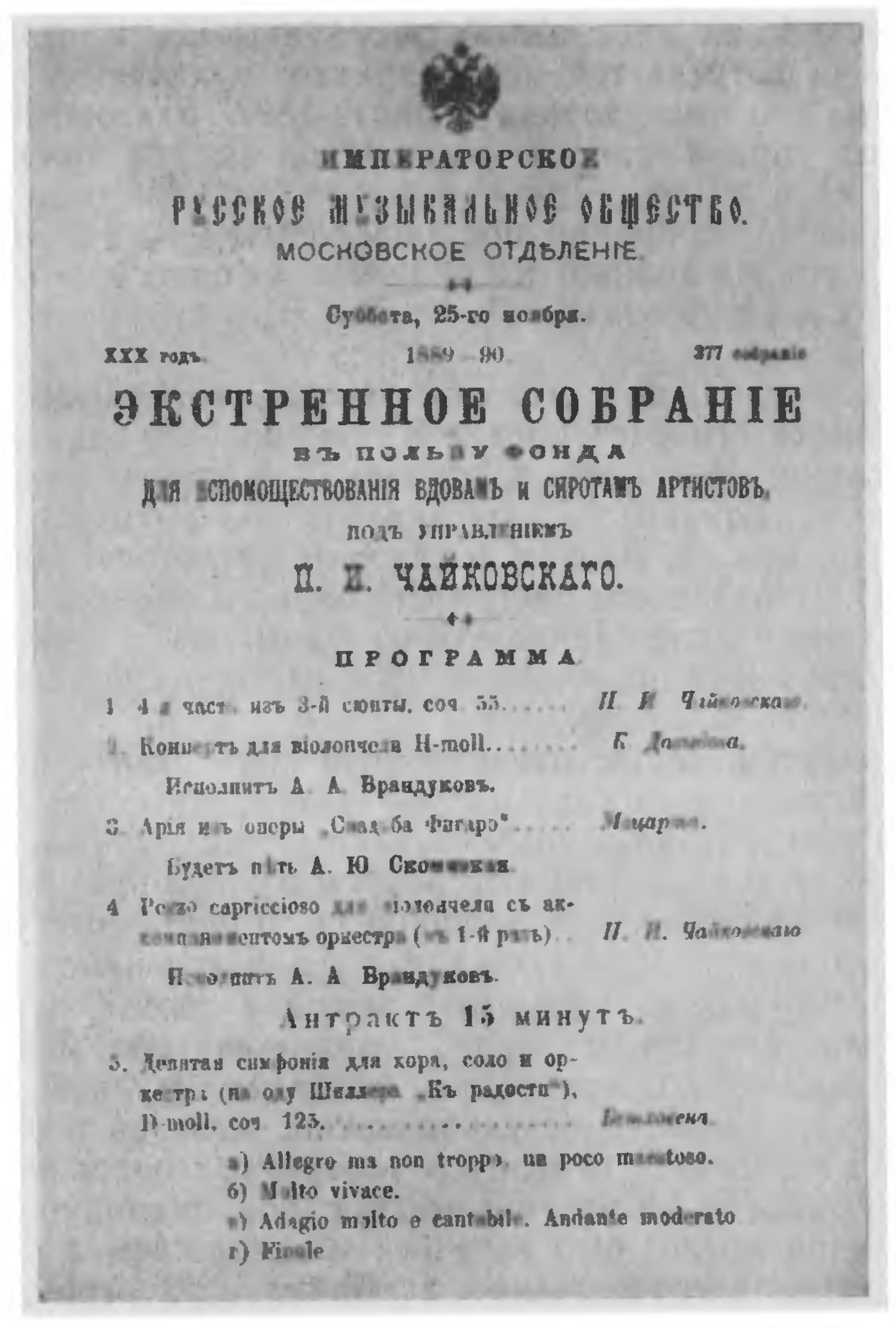
A brilliant page in Brandukov’s performing biography is his appearance on November 25, 1889, at a special concert of the Moscow branch of the Russian Musical Society; the concert was organized “for the benefit of the fund for the assistance of widows and orphans of artists.” P. I. Tchaikovsky conducted; the program of the first half consisted of works by Tchaikovsky, Davydov, and Mozart, while in the second half Beethoven’s Ninth Symphony was performed.
Brandukov played Davydov’s First Concerto with enormous success, as well as Tchaikovsky’s Pezzo capriccioso, dedicated to the concert artist and performed in Moscow for the first time. The reviewer of Moskovskiye vedomosti wrote in his account of this concert: “In the second number of the program, Davydov’s B-minor Concerto for cello, the talented soloist A. A. Brandukov appeared, enjoying great renown both abroad and in our country. The appealing cellist, of whom the Moscow Conservatory that formed him may justly be proud, performed the difficult but beautiful concerto quite impeccably, displaying at the same time ease and refinement in the virtuoso passages and a full, enchanting tone in the lyrical passages. Well known to Moscow, the young artist was received and dismissed from the stage with the greatest warmth. Mr. Brandukov was called back particularly noisily after the second number he performed, Tchaikovsky’s Pezzo capriccioso, which was played at this symphonic concert for the first time.”¹
In another account of this concert, by N. D. Kashkin, it was stated: “… Mr. Brandukov brilliantly performed Davydov’s concerto and P. I. Tchaikovsky’s new piece for cello. There is no need to speak of the resounding success of the talented virtuoso—it goes without saying.”²
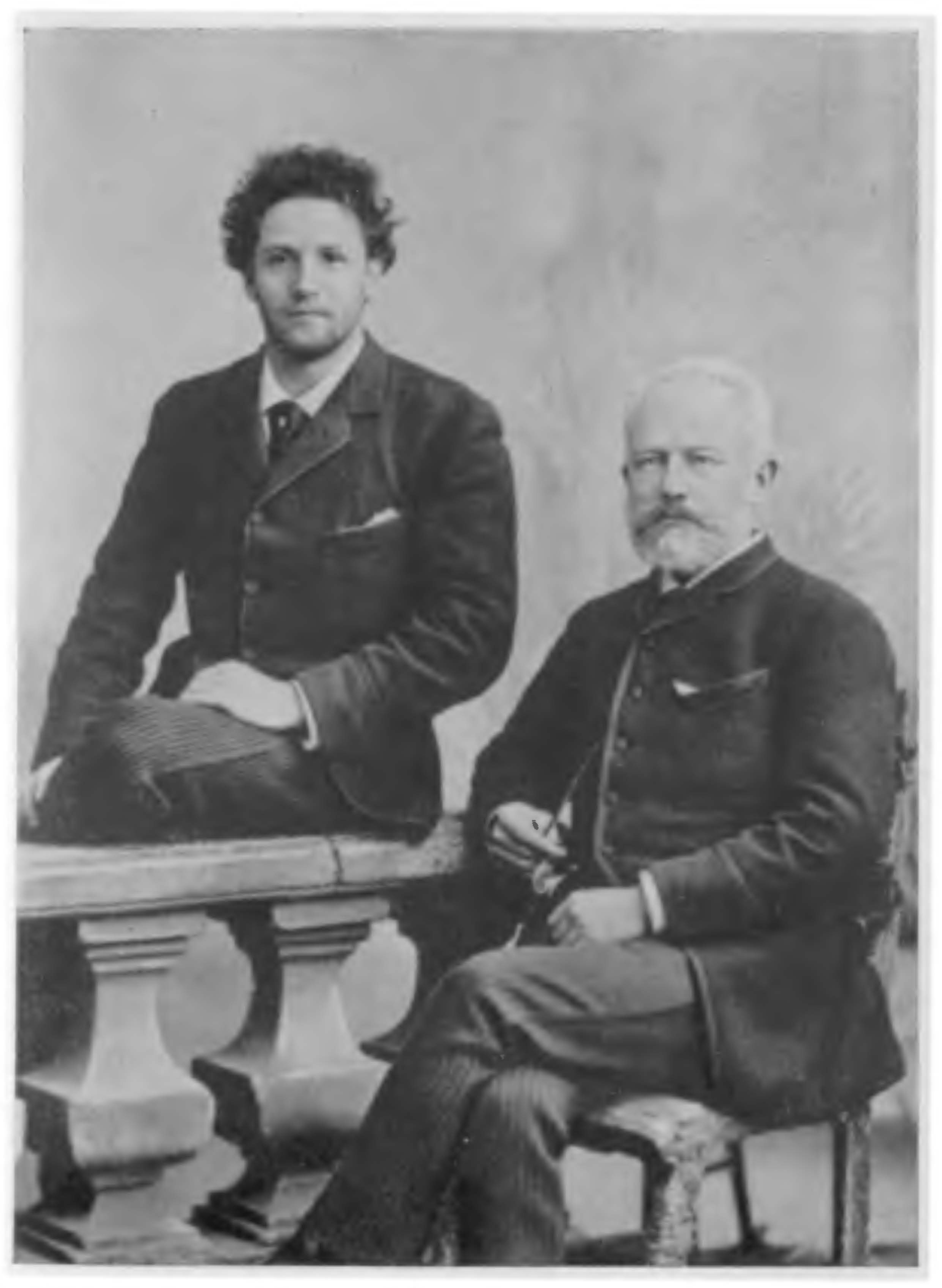
Tchaikovsky’s piece was written by the great composer specifically for Brandukov in 1887 during his stay in Aachen. In a letter to Brandukov, whom he had seen in Paris on August 4 of that year, Tchaikovsky informs him from Aachen on August 13/25, 1887: “I have written a small
[p. 369]
cello piece and want you to look through and refine the cello part.”¹ And further, teasing Brandukov in a friendly manner, he continues: “Of course, as a cellist you are very weak and bad—but what is to be done? There is no one else at hand!” On August 26, Tchaikovsky, who was extremely demanding of his own work, adds a postscript to a letter from Berlin (to the same addressee): “It seems the piece has turned out rather poorly.”²
The merits of this piece, distinguished by its expressive melody and graceful technique, as well as by the suitability of its means of expression to the content of the piece and to the very nature of the instrument, are attested by its performance by many concert cellists, beginning with Brandukov.
In 1891, at Siloti’s concert, A. A. Brandukov made a great impression on Moscow listeners with his incomparable performance with orchestra of Tchaikovsky’s Nocturne and Andante cantabile (P. I. Tchaikovsky conducted the orchestra).³
While still in Paris in the spring of 1881, P. I. Tchaikovsky presented A. A. Brandukov with an autograph of the theme of the Andante cantabile, bearing the following inscription: “To my dear friend Tolya Brandukov, as a keepsake. P. Tchaikovsky. Paris, April 1/March 20, 1881” (the autograph is preserved at the P. I. Tchaikovsky House-Museum). Brandukov’s repertoire also included other arrangements of Tchaikovsky’s compositions, particularly the Autumn Song and Barcarolle in his own transcriptions.
Tchaikovsky’s friendship with Brandukov continued until the end of the great composer’s life. Twenty days before P. I. Tchaikovsky’s death, Brandukov and Poplavsky visited him in Klin. They brought with them Saint-Saëns’s cello concerto, with which Pyotr Ilyich had expressed a desire to become acquainted; at that time, Brandukov was expected to perform this concerto in St. Petersburg under Tchaikovsky’s direction. (As is known, Tchaikovsky himself was planning to write a concerto for cello and orchestra.) In the evening, P. I. Tchaikovsky and the two cellists examined the concerto at the piano. Poplavsky, who played the piano part, recalls: “P. I. followed along and played the wind parts with his left hand, while A. A. sang the cello theme. This improvised trio with the participation of P. I. Tchaikovsky will remain in my memory forever.”⁴ This was October 6, 1893, the last evening of Tchaikovsky’s stay
[p. 370]
in Klin. Toward evening the following day, he left for Moscow with Brandukov and Poplavsky.
Brandukov repeatedly participated in chamber concerts of the Russian Musical Society. His participation in a quartet concert in St. Petersburg in 1887 has already been mentioned; he appeared at the Moscow quartet concert devoted to Tchaikovsky several days after the death of the great musician (November 1, 1893). At this concert, Brandukov, together with S. I. Taneyev and I. V. Grzhimali, performed the trio In Memory of a Great Artist and also participated in the sextet.
On December 8, 1895, A. A. Brandukov, together with Yu. E. Conus, V. R. Vilshau, and N. K. Avierino, participated in the first Moscow performance of one of A. K. Glazunov’s quartets.
Tchaikovsky’s trio was repeatedly performed with the participation of Taneyev and Brandukov; they played it with exceptional success together with the violinist Yu. E. Conus at his concert in Moscow on September 29, 1891. The reviewer of Moskovskiye vedomosti noted the performers’ “sensitivity,” “technical perfection,” and “deeply felt ensemble playing.”¹
At the rehearsal, the performers proposed certain changes in the manner of presenting the piano part in the fugue, concerning which Taneyev (probably the initiator of these changes) informed Tchaikovsky in a letter (September 22): “In the opinion of Conus and Brandukov and myself, with whom I rehearsed the Trio today, the aforementioned alterations make the fugue more accessible to listeners, and it gains in the effect it produces.”² Tchaikovsky, who attended the concert, approved these changes.
That same year, Brandukov gave his own concert in Moscow with the participation of a symphony orchestra, breaking with the established traditions of ordinary virtuoso concert artists, both with regard to the concert program and to its construction.
“January 27 will long remain in the memory of all those who truly love music”—thus begins one of the reviews of this concert.³ “Our excellent artist, the cellist Mr. Brandukov, was giving his own concert that evening. How are such concerts usually arranged? If the concert artist has great confidence in himself, he dispenses with any outside participation and plays several numbers in succession by himself. The less courageous invite someone else to provide greater variety in the program and to give themselves an opportunity to
[p. 371]
rest. In such concerts, if an orchestra participates at all, its participation is of the most miserable kind: some hackneyed overture—one of the ‘favorites’—at the beginning of the evening and of its second half, and that is the end of it; the rest of its work consists of accompanying various ‘solos.’ Mr. Brandukov rose immeasurably above this routine. His concert (a virtuoso’s concert) assumed the serious character of a symphonic concert with an exceptionally fine program.”
A symphony orchestra participated in the concert (the French conductor É. Colonne conducted), performing Beethoven’s Eighth Symphony, Tchaikovsky’s programmatic fantasia The Tempest, works by Berlioz, and others. The reviewer particularly noted that “in the entire program, even among the soloists (besides the concert artist, the pianist Mme. Mazurina performed), there was not a single composition of questionable taste or light content.”
With great expressiveness and elegance, Brandukov performed Saint-Saëns’s concerto, Bach’s Air, in which the performer combined “singing quality with austere grandeur,” and a movement (“Vision”) from a suite of his own composition.¹
“Mr. Brandukov,” we read in the same review, “has a most enchanting tone, impeccable taste, a marvelous broad bow, gifted phrasing, and captivating singing, somewhat leaving behind the strictly virtuoso aspect of cello technique, since Mr. Brandukov is not unconditionally good in passagework … Many thanks to Mr. Brandukov for such an evening. His concert turned out to be perhaps the most outstanding of the season.”
Anatoly Andreyevich also appeared with É. Colonne in other concerts; at the symphonic concerts in March 1895, he performed Popper’s suite In the Forest, Bruch’s Kol Nidrei, and Massenet’s Sous les tilleuls.
Mention must be made of Brandukov’s repeated appearances at Moscow symphonic concerts under the direction of the outstanding conductor A. Nikisch, with whom, in the 1890s, he performed Saint-Saëns’s concerto (1897), Godard’s On the Lake, and a mazurka of his own composition (1898).
In the spring of 1894, Anatoly Andreyevich successfully performed a concerto of his own composition with the accompaniment of a symphony orchestra (conducted by M. Erdmannsdörfer).
Brandukov was one of the first performers of Glazunov’s beautiful cello pieces. Appearing in 1891 at the aforementioned concert of A. I. Siloti, Brandukov played for the first time, with orchestral accompaniment under the direction of
[p. 372]
Tchaikovsky, Glazunov’s Spanish Serenade, repeating it twice at the audience’s request, and in 1904, together with Rachmaninov, this composer’s Melody.
Close friendly and artistic relations developed between Brandukov and S. V. Rachmaninov, and subsequently between Brandukov and S. I. Taneyev.
Brandukov participated in Rachmaninov’s first independent concert, which took place in Moscow on January 30, 1892. At this concert, one of Rachmaninov’s early chamber compositions was performed—the youthful Trio élégiaque in G minor (Rachmaninov, Krein, and Brandukov). One of Rachmaninov’s two marvelous cello pieces, written that year and dedicated to Brandukov, was heard for the first time—the Prelude in F major, Op. 2.¹ Brandukov also performed Davydov’s Farewell and At the Fountain, Tchaikovsky’s Nocturne, Saint-Saëns’s The Swan, Popper’s Gavotte and Reigen, as well as pieces of his own composition.
On January 31, 1894, Brandukov participated in the first performance of Rachmaninov’s Trio élégiaque in D minor (Op. 9), written on the death of P. I. Tchaikovsky; his partners in this performance were the composer and Yu. E. Conus.
At the same concert, whose program consisted entirely of works by Rachmaninov, Brandukov played warmly and expressively the Prelude dedicated to him and a youthful composition of the composer, the Serenade (Op. 3), in his own arrangement. Later, Brandukov repeatedly arranged Rachmaninov’s pieces for the cello. His arrangements of the Prelude (Op. 23) and Vocalise (Op. 34) enjoy wide popularity.²
The artistic style of Brandukov’s playing, the subtle musicality, profound expressiveness, and heartfelt quality of his performance apparently stimulated to no small degree the appearance of Rachmaninov’s remarkable sonata for cello and piano, one of his finest compositions. Rachmaninov dedicated the sonata, composed by him in 1901, to Brandukov, and on more than one occasion the two musicians performed this masterly work with inspiration, creating an inimitable ensemble. The first public performance took place before the publication of the sonata, on December 2, 1901, at a charitable concert in Moscow, and met with great success; the remarkable Andante was repeated. At the same concert, Rachmaninov, Ysaÿe, and Brandukov performed Tchaikovsky’s trio.
[p. 373]
In his review, N. D. Kashkin highly praised both the new composition of the young Rachmaninov and the excellent performance.¹ The talent and mastery, combined with profound expressiveness, characteristic of Brandukov’s performing style made him a worthy partner of Rachmaninov and an incomparable interpreter of this work.
Rachmaninov’s sonata became one of Brandukov’s favorite works, which he frequently performed in Russia and abroad. He repeatedly played it with the composer. S. N. Vasilenko had occasion to hear this work shortly after its composition, performed by Rachmaninov and Brandukov at Chaliapin’s home. In the same interpretation, Rachmaninov’s sonata was presented to Moscow listeners on January 16 and 18² and March 25, 1904, and on February 3, 1908. On January 7, 1909, Rachmaninov and Brandukov played the sonata at A. I. Siloti’s Third Chamber Concert in Moscow.³
Rachmaninov’s sonata was performed on more than one occasion by Brandukov in an ensemble with Siloti. Giving concerts not only in Moscow but also in other cities of the country,⁴ they performed it on October 7, 1902, in Vitebsk, and on October 13 of the same year in Kyiv. The Kyiv correspondents V. Chechott, B. Yanovsky, and others, noting the great artistic pleasure afforded to listeners by the concert artists, particularly emphasized the heartfelt quality of the performance, the nobility of Brandukov’s phrasing, and the singing quality of his tone.⁴
On December 9, 1902, Brandukov and Siloti opened their joint concert in Moscow with Rachmaninov’s sonata. Reviewing this concert, N. D. Kashkin wrote:⁵ “At the very beginning, the concert artists played S. V. Rachmaninov’s sonata for cello and piano, of whose outstanding merits we have already written. This remarkable work was likewise performed remarkably well; the elegant nobility of this music and the richness of its content were presented in their full light by the artists, who vied with one another in the vivid
[p. 374]
clarity of their rendering of all the movements of the sonata.” At this same concert, Brandukov gave the first public performance of two recently composed pieces by Arensky (Sad Song and Romance¹), as well as pieces by Schumann and Davydov. Brandukov’s performance was distinguished by expressiveness and mastery, and by the strength of his emotional impact on the audience. “Mr. Brandukov knows how to sing on the cello as few others do, and positively captivates his listeners,” wrote the same author.
Subsequently, Brandukov frequently played Rachmaninov’s sonata with many outstanding Russian and Soviet pianists. Mention may be made of his sonata partnerships with K. N. Igumnov, A. B. Goldenweiser, and also G. G. Neuhaus, with whom he gave his last concert in January 1930. Rachmaninov’s sonata, unsurpassed in its artistic significance, was the last work he performed publicly, the swan song of the remarkable cellist.²
* * *
Summing up the first period of Brandukov’s activities (1879–1905), we may note his constant artistic and friendly association with the foremost figures of Russian art; these connections grew and strengthened despite Brandukov’s sometimes lengthy stays far from his homeland. Repeated visits to Russia, participation in its artistic life, close association with Tchaikovsky, Rubinstein, Davydov, Arensky, Rachmaninov, Taneyev, Ippolitov-Ivanov, Verzhbilovich, Stanislavsky, Chaliapin,³ and many other representatives of Russian realistic art—all this influenced the development of Brandukov’s artistic gifts; his connection with his native
[p. 375]
culture helped him, during the difficult period of his life abroad, to preserve and strengthen in his performing style those progressive features characteristic of Russian classical art.
Particularly indicative of A. A. Brandukov’s musical and public activities during the 1880s and 1890s was his constant participation in charitable concerts during his frequent visits to his homeland. He repeatedly appeared in concerts “for the benefit of indigent students of Moscow University” and other educational institutions, “for the benefit of the fund for widows and orphans of artists,” and so forth. In 1897, Brandukov participated in a concert by K. N. Igumnov organized to establish a scholarship at the conservatory in the name of Professor P. A. Pabst.
In 1895, Anatoly Andreyevich participated in a concert by K. N. Igumnov; together with I. V. Grzhimali, they performed Beethoven’s E-flat-major Trio.
The desire to settle in his homeland never left Brandukov, but circumstances were unfavorable. As early as 1890, when the position of professor of cello at the Moscow Conservatory became vacant following Fitzenhagen’s death, P. I. Tchaikovsky put forward and warmly supported Brandukov’s candidacy. On March 19, 1890, the composer wrote to Jurgenson from Florence: “… the invitation of anyone other than Brandukov cannot take place as long as I am considered a director.”¹ Safonov, who was then director of the Moscow Conservatory, insisted upon inviting Davydov’s pupil A. E. von Glehn; Tchaikovsky was indignant at Safonov’s “incomprehensible obstinacy” in this matter and considered that “with regard to Brandukov, he is committing both an injustice and a stupidity.”²
It should be recalled that Tchaikovsky held the outstanding Russian cellist K. Yu. Davydov and the school he had created in very high esteem. In his time, Tchaikovsky had been an ardent supporter of inviting him to the Moscow Conservatory. And if he nevertheless considered Brandukov the most worthy representative of the Russian cello school, it was probably because, alongside his brilliant talent, he found in this cellist’s performing style features close to the Davydov school, and in his artistic orientation precisely those qualities that attracted him in Davydov’s work; Tchaikovsky saw in Brandukov a musician who
[p. 376]
was to continue developing the principles of the Davydov school.
The conflict with Safonov prompted Tchaikovsky’s resignation from the board of directors of the Russian Musical Society. Informing N. F. von Meck of this in a letter (March 27/April 8, 1890), Tchaikovsky explained his decision as follows: “The reason is as follows. Owing to Fitzenhagen’s death, the position of professor of cello became vacant. I expressed the wish that it should be filled by Brandukov, our pupil, an excellent cellist who, moreover, had long dreamed of securing a permanent position at the conservatory. The present director, Safonov, categorically refused to engage Brandukov (for reasons incomprehensible to me) and declared that nothing would induce him to agree to my proposal. After this, I had to choose one of two courses: either 1) go to Moscow, remove Safonov, and become director myself, since there is no one else at present to occupy this position, or 2) since I greatly value Safonov as a very energetic and intelligent director, resign from the board myself and give him complete freedom of action. I chose the latter … It is a great pity that Safonov proved so obstinate in his hostile attitude toward Brandukov. This is a great injustice.”
In a letter from Florence dated February 17/March 1, 1890, addressed to the board of directors of the Moscow branch of the Russian Musical Society, P. I. Tchaikovsky wrote: “… I am absolutely convinced that no one other than Brandukov can be invited … for Brandukov is an excellent cellist, a pupil of our Conservatory, an industrious man, a good musician, and above all someone who, despite his Parisian triumphs, has long dreamed of moving to Moscow and serving at the Conservatory. I even positively promised him this professorship in the event of Fitzenhagen’s departure, knowing that S. I. Taneyev was very sympathetic to this choice.”¹
After von Glehn had been invited, Tchaikovsky wrote to N. F. von Meck (June 2, 1890): “A certain Mr. von Glehn, whom I do not know at all, has been invited … Of one thing I am absolutely certain: he has infinitely less right than Brandukov to occupy Fitzenhagen’s position.”
Be that as it may, Brandukov did not succeed in obtaining a position at the Moscow Conservatory in 1890. Only in 1906 was he invited to Moscow as director and professor of the Music and Drama School of the Philharmonic Society. By that time, Brandukov already enjoyed worldwide renown. Nevertheless, at the first opportunity that presented itself to work in his homeland, he
[p. 377]
rejected the professorship at the Rome Conservatory offered to him at the same time and joyfully departed for Moscow. This joy was overshadowed by the difficult events through which the country was then passing.
It was the time of the onset of reaction following the defeat of the December uprising of 1905. Cruelly suppressing the continuing strike and peasant movements in the country, the tsarist government was passing from a policy of deceiving the people through the Duma to a policy of extreme reaction known as the “Stolypin” policy.
During this gloomy period, the progressive and independent activities of A. A. Brandukov as director of the School deserve particular mention. He frequently came into conflict with the board of directors and the merchants who patronized the Philharmonic Society, doing everything possible to restrict their attempts to interfere in the artistic and educational life of the School. Upon assuming the directorship, Brandukov did much to improve the teaching staff of the School. S. V. Rachmaninov and S. I. Taneyev¹ rendered him substantial assistance in selecting teachers. He invited the foremost performers to participate in the Philharmonic concerts.²
Brandukov devoted considerable energy to combating the official routine and bureaucracy flourishing at that time. Under his leadership, the curricula and programs of the School were revised and improved. Brandukov endeavored in every possible way to enliven the educational process and connect it organically with the students’ stage and concert experience.
The number of students doubled under Brandukov. “We pupils dearly loved our director, despite his somewhat uneven and at times irascible temperament,” recalls A. V. Sveshnikov, who was studying at the Philharmonic School at that time. “What attracted us to Brandukov was his enormous artistic authority, his exceptional sensitivity, and his complete absence of formalism in his dealings with us students.¹ He possessed an astonishing ability somehow to discern immediately the degree and character of a pupil’s musical gifts, which became particularly apparent during entrance examinations.”
Among the charitable concerts in which, as already noted, A. A. Brandukov regularly participated, many were organized for the benefit of students in need.
Anatoly Andreyevich Brandukov combined his directorship of the School
[p. 378]
with fruitful pedagogical activities. Under Brandukov, the cello class attained a high standard. Among his pupils, whose number at times reached twenty, may be named the cellists F. Banovich,¹ V. Kubatsky, P. Kutyin, S. Barbashev, L. Timoshenko, I. Potemkin, and many others. At student concerts, his pupils performed Tchaikovsky’s Variations on a Rococo Theme, concertos by Davydov and Haydn, and so forth. Cello unison ensembles were frequently organized to perform classical works.
A. A. Brandukov directed not only the cello class of the School but also the chamber and vocal ensemble classes, and the opera and orchestra classes. The attention of the Moscow musical community was attracted by the regular public student concerts and theatrical productions of the Philharmonic School, presented under the immediate direction of A. A. Brandukov.
Alongside his pedagogical activities, Brandukov also pursued an active performing career as a soloist and conductor of the symphonic concerts of the Philharmonic Society. In 1906, for example, he performed Haydn’s concerto (conducted by E. Młynarski). The reviewer (G. Chereshnev), while speaking reservedly of the performance of the concerto, particularly praised Brandukov’s interpretation of Fauré’s Elegy and Glazunov’s Melody, which were performed “with his customary elegance and musicality.”²
An excellent musician and sensitive accompanist, A. A. Brandukov repeatedly conducted the orchestra in appearances by such outstanding soloists as Rachmaninov, Nezhdanova, Casals, and others. Among Anatoly Andreyevich’s appearances as a conductor, let us mention the concert of February 2, 1908, when Rachmaninov’s Second Symphony was performed for the first time (under the composer’s direction), and A. A. Brandukov conducted the performance of an aria from Rimsky-Korsakov’s The Tsar’s Bride and Rachmaninov’s Second Concerto (the soloists were A. V. Nezhdanova and S. V. Rachmaninov).
Directing concerts by the students of the Philharmonic School, he conducted Beethoven’s Mass in C major, Saint-Saëns’s The Deluge, Taneyev’s cantata John of Damascus, and other large-scale works.
In his performing activities, Brandukov, as has already been stated, devoted enormous attention to chamber
[p. 379]
music, constantly participating in various instrumental ensembles.
His performances of sonatas by Beethoven, Mendelssohn, Saint-Saëns, Rubinstein, and particularly Rachmaninov—in an ensemble with the composer—afforded enormous pleasure.
A prominent place in Moscow’s musical life at that time was occupied by the quartet of the Philharmonic Society, whose members, in addition to A. A. Brandukov, were K. K. Grigorovich, Yu. E. Conus, and N. K. Avierino. Students were admitted to the rehearsals of this quartet, which was of considerable benefit to them. In the very first year of its existence (1906/07), the ensemble gave eight public concerts.
A. A. Brandukov readily participated in the numerous private musical evenings held at that time in the homes of professional and amateur musicians and in various artistic circles of Moscow. He also played at L. N. Tolstoy’s home.
Brandukov’s appearances at the Moscow Circle of Russian Music Lovers are known. On February 12, 1907, A. B. Goldenweiser, K. K. Grigorovich, and A. A. Brandukov performed Rachmaninov’s trio there. On November 8 of the same year, at one of the Circle’s concerts, S. I. Taneyev’s Piano Quartet (Op. 20) was performed for the first time. “Judging by the applause and the audience’s calls for the performers,” wrote N. Kashkin, “the quartet enjoyed very great success, attributable in equal measure to the work itself and to its performance …”¹ The performers were the composer, K. K. Grigorovich, N. K. Avierino, and A. A. Brandukov.
And here is what the painter M. F. Shemyakin wrote in his recollections: “In 1913, Repin was my guest at the apartment of my father-in-law, the conservatory professor Ivan Voitekhovich Grzhimali. Many of the Peredvizhniki [the Wanderers, members of the Association of Traveling Art Exhibitions.—Trans.] gathered at my home on that occasion: Dubovskoy, Volkov, Byalynitsky-Birulya, Bogdanov-Belsky, and others. Between tea and dinner, I treated my guests to music. Tchaikovsky’s trio was performed by I. V. Grzhimali, A. A. Brandukov, and A. N. Koreshchenko. Repin listened to the music with enormous attention, without moving, in a tense posture, with one hand tucked into his waistcoat and the other resting on his knee. The trio ended. Repin approached the musicians excitedly and said that he had never heard such a performance.”²
In 1915, M. F. Shemyakin successfully captured this ensemble in one of his finest paintings. The painting was
[p. 380]
soon acquired by the Literary and Artistic Circle¹ and hung in its concert hall alongside the portraits of the outstanding Russian actresses G. N. Fedotova and M. N. Yermolova (painted by V. A. Serov).²
The outbreak of the imperialist war [World War I.—Trans.] found Brandukov abroad, where he had gone for his summer vacation. The composer S. N. Vasilenko recalls an unexpected meeting with Brandukov, which delighted both of them, at a border crossing on their way to Russia in August 1914. “Anatoly Andreyevich,” says S. N. Vasilenko, “was among those Russian people who were striving to return home and were deeply concerned about the fate of their homeland in the ominous hour of war.”
Under the direction of A. A. Brandukov, a considerable number of concerts of the Music and Drama School took place during those years for the benefit of wounded and sick soldiers, medical detachments, and so forth. At one of these concerts (April 4, 1915), he himself played Tchaikovsky’s Andante cantabile and Nocturne with orchestra in an inspired manner and, together with L. V. Sobinov, sang on the cello Rachmaninov’s song The Night Is Mournful. At the same concert, A. A. Brandukov appeared as conductor of the orchestra and chorus of the Philharmonic School.
In December 1915, Anatoly Andreyevich participated in a concert by S. V. Rachmaninov, playing his cello sonata with him.
* * *
For all his subjective and not always consistent assessment of social phenomena (characteristic of many representatives of the intelligentsia of that time), A. A. Brandukov, as a progressive artist to whom the interests of his people were close and dear, could not fail to come to recognize the enormous significance of the Great October Socialist Revolution. As early as 1918, V. I. Lenin, noting that “the prejudices of the intelligentsia are still strong,”³ also pointed to the necessity of taking advantage of the change of attitude among the intelligentsia, which “now adopts a most neighborly position toward us.”⁴
Anatoly Andreyevich Brandukov was among those representatives of the Russian artistic intelligentsia who endeavored to place their knowledge and mastery at the service of the interests of the victorious people.
[p. 381]
A. A. Brandukov responded with exceptional readiness to various musical and public undertakings in Moscow during the 1920s. As early as 1919, Brandukov became a member of the board of directors of the Bolshoi Theatre, where he carried out extensive work in organizing symphonic and chamber concerts and provided advice on a number of artistic questions connected with the public musical life of the country in the first years after the Revolution. With his active participation, a chamber concert studio was opened, which organized concerts in the Beethoven Hall of the Bolshoi Theatre. At the same time, A. A. Brandukov regularly participated in concerts of the Stradivari Quartet.
V. A. Vlasov, who knew Anatoly Andreyevich well and repeatedly heard him play during the 1920s (particularly in ensembles with K. Igumnov, N. Orlov, and Yu. Isserlis), writes that Brandukov “was not only the ‘first violin’ of the ensemble, but also its soul, its commanding and temperamental conductor. One could not help admiring his enchanting tone and taking delight in the man himself …”¹
Among the many chamber music evenings held in Moscow during those years with Brandukov’s participation, let us mention at least the sonata evening he gave with Igumnov on October 23, 1919, when all three of Bach’s sonatas for cello and piano were performed.
The remarkable cellist’s appearances in the concert halls and clubs of the working-class districts of the capital invariably aroused great interest among broad circles of listeners, who warmly welcomed the venerable artist.
Among the numerous concerts organized for workers during the first years of the existence of the Soviet state, our attention is attracted in particular by the concert given in August 1919 on the open-air stage at Orekhovo-Zuyevo. The proceeds of the concert were to be used to organize a free dining hall for workers and their children. F. I. Chaliapin, A. A. Brandukov, and F. F. Keneman participated in the concert.
In 1920, Anatoly Andreyevich appeared at celebrations devoted to the 150th anniversary of Beethoven’s birth. In 1921, Muscovites heard Brandukov at concerts devoted to Rachmaninov and Grechaninov. That same year, he participated in a concert devoted to the 600th anniversary of the death of the poet Dante Alighieri. On February 28, 1923, A. A. Brandukov, together with K. N. Igumnov, performed Rachmaninov’s sonata at an evening commemorating L. N. Tolstoy. On June 2, 1925, he performed the same sonata with A. B. Goldenweiser at the celebration of the fiftieth anniversary of A. I. Hubert.
In February 1925, together with A. V. Nezhdanova, N. S. Golovanov, and others, Anatoly Andreyevich participated in a concert devoted to the thirtieth anniversary of the Tchaikovsky House-Museum
[p. 382]
in Klin.¹ On March 16, 1927, at a concert devoted to the sixtieth anniversary of the Moscow Conservatory, Brandukov played his favorite pieces—Tchaikovsky’s Nocturne and Andante cantabile—with inspiration. On March 11, 1929, he movingly performed Bach’s Air (accompanied by a string quintet) at an evening commemorating M. N. Yermolova at the State Academic Maly Theatre.
An enormous impression was made upon those attending the symphonic concert commemorating V. I. Lenin at the State Academic Bolshoi Theatre on February 10, 1924, by the performance of Bach’s Air by an ensemble of cellists led by A. A. Brandukov.
The final period of Anatoly Andreyevich Brandukov’s life was connected with the Moscow Conservatory, which had once educated him and at which he had aspired to work for many decades. In 1921, in connection with the transfer of the music classes of the Philharmonic School to the Moscow State Conservatory, he was invited to become professor of the cello class at this educational institution.
The Great October Socialist Revolution opened a new page in the life of the conservatory, creating the necessary prerequisites for the genuine democratization of musical education. Whereas previously the foremost figures in the sphere of string performance and pedagogy had been concentrated primarily at the St. Petersburg Conservatory, after the Revolution the center of the country’s string-playing culture shifted to Moscow. The cello classes of the Moscow Conservatory, directed from the beginning of the 1920s by Professors Brandukov and Kozolupov, became the most important center in the formation of the Soviet cello school.
During his comparatively brief career at the conservatory, Brandukov trained a considerable number of cellists. Among those who graduated from the Moscow Conservatory in his class were S. Shirinsky, A. Georgian, G. Nemerenetsky, A. Yegorov, A. Brown, A. Khramov, G. Veltman, Ya. Smolyansky, A. Klivansky, I. Gusev, and others.
Almost until his final days, although already seriously ill, Brandukov did not cease his activities: he gave concerts, taught, and contemplated a concert tour of the country.
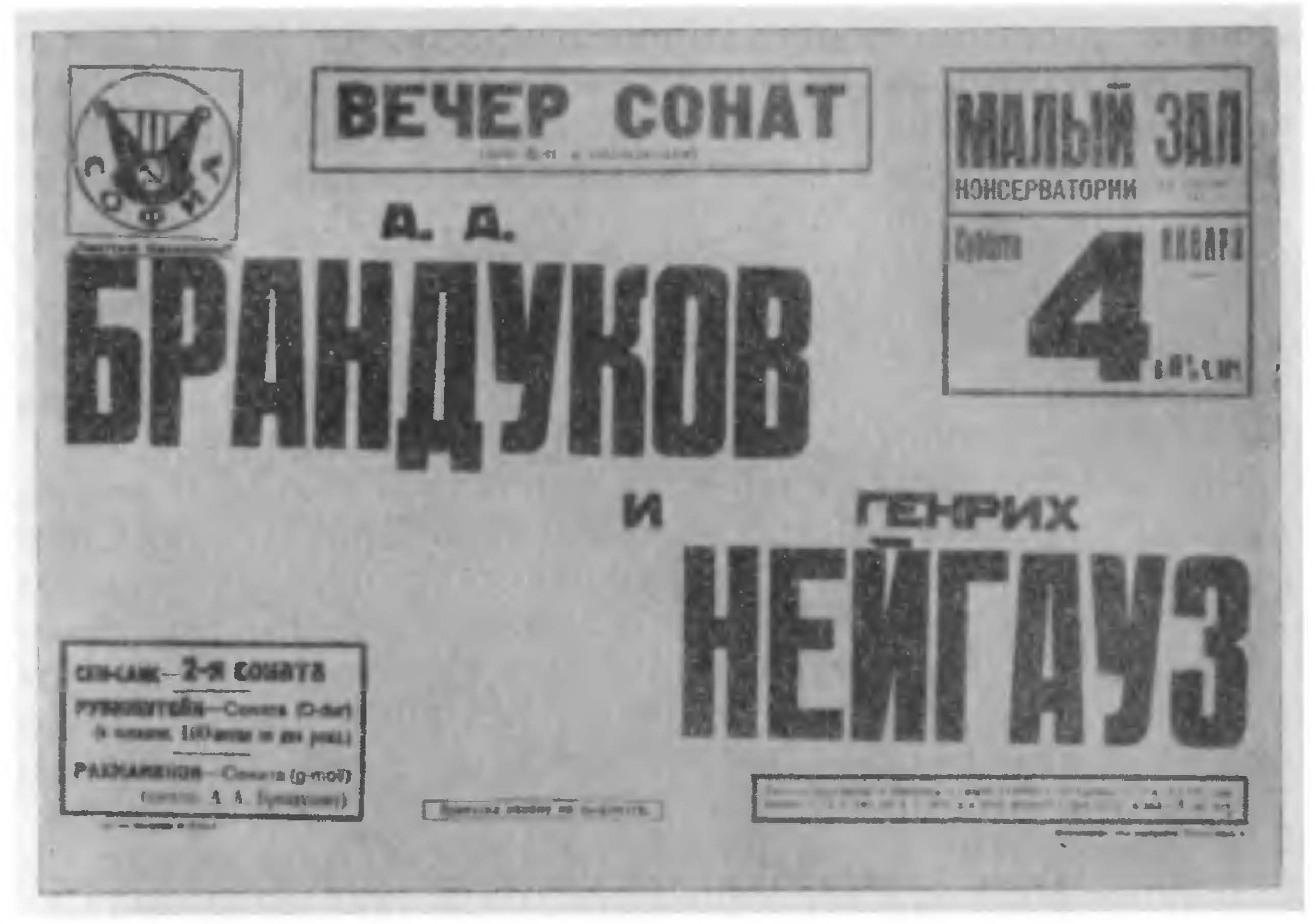
In the winter of 1929/30, A. A. Brandukov, together with G. G. Neuhaus, appeared at two sonata evenings, performing sonatas by Beethoven, Saint-Saëns, Rubinstein, and Rachmaninov with mastery and enormous inspiration.²
[p. 383]
[Insert illustration: Poster for A. A. Brandukov’s last concert (1930). Sonata evening with Heinrich Neuhaus, January 4, Small Hall of the Conservatory.]
All who heard this performance cannot forget the sincerity and heartfelt quality, the truthfulness and genuine artistry, the enthusiasm and youthful passion of the seventy-three-year-old musician and artist. This is how he has remained in our memory.
As late as January 4, 1930, the cello in Brandukov’s hands sounded expressively and movingly within the walls of the Small Hall of the Conservatory, and on February 16 of that year he was no more. A. A. Brandukov was buried in Moscow, at Vvedenskiye Gory [Vvedenskoye Cemetery.—Trans.], not far from the grave of K. Yu. Davydov.¹
* * *
A characteristic feature of Russian musical art is the close, organic connection between the culture of composition and that of performance. Many Russian musicians, for example Tchaikovsky, Balakirev, Rubinstein, Davydov, Rachmaninov, Glazunov, Taneyev, and also to some extent Brandukov, combined compositional and performing activities, appearing as soloists, conductors, and members of ensembles.
And Russian performers who did not compose (or composed little) were, for the most part, artistically connected with the foremost
[p. 384]
Russian classical composers, which enriched both the composers and the performers. Outstanding Russian performers have always endeavored to popularize the finest works of Russian classical composers.
As we have seen, A. A. Brandukov, who distinguished himself most brilliantly in the sphere of musical performance, was particularly close to the foremost representatives of Russian classical art—Tchaikovsky and Rachmaninov. It is difficult to overestimate the significance of these musicians in the formation of Brandukov’s artistic personality as a performer.
Tchaikovsky and Rachmaninov undoubtedly exerted a certain influence upon Brandukov’s compositional work as well. Among his compositions, which frequently reveal a certain mastery, good taste, and melodic merits, are six pieces for cello and piano (Spring Night, Nocturne, Romance Without Words, Romance, Mazurka, Gavotte), dedicated to Fitzenhagen and published by Jurgenson in Moscow. In addition, an Elegy, a Song, a Mazurka, and several other small compositions by Brandukov were published in Paris.
Several cello concertos by Brandukov, belonging to the early period of his compositional activities, have been preserved in manuscript at the P. I. Tchaikovsky House-Museum in Klin. The most complete is the E-minor Concerto. Its music is poetic and in places tinged with romantic colors. The concerto, in which cantilena is particularly extensively employed, contains elements of improvisatory writing and declamatory recitative. It consists of three movements concise in form (Allegro moderato, Andante sostenuto, and Allegro). The themes of the concerto are distinguished by expressiveness and beauty of melodic line. The romantically agitated principal theme of the first movement is preceded by a short cadenza for the solo cello:
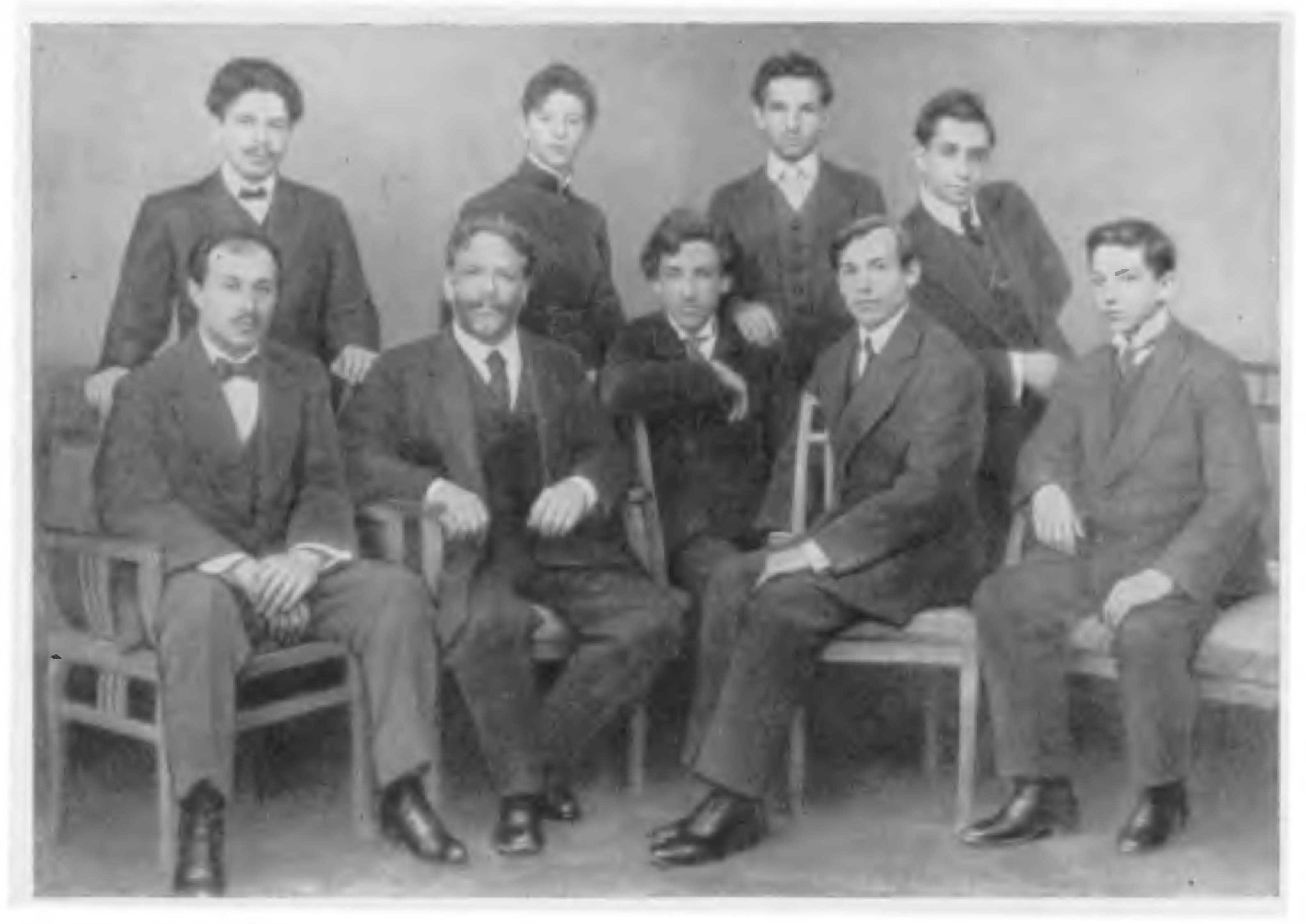
[A. A. Brandukov’s class at the Philharmonic School (1912).]
[p. 385]
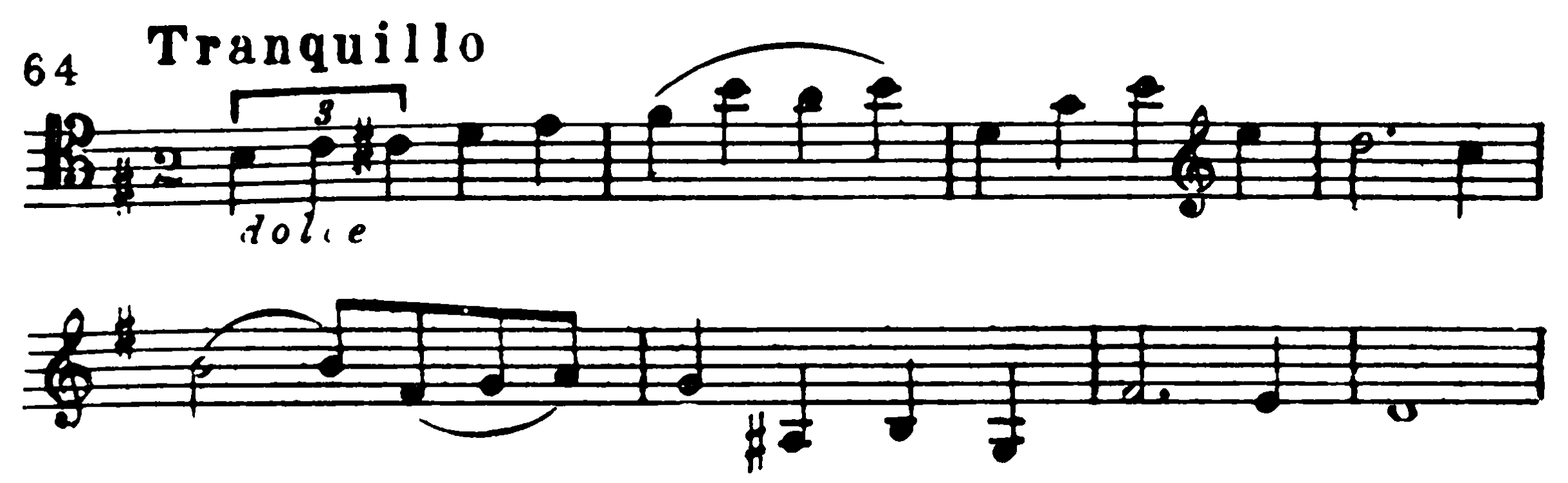
The secondary theme, written in the relative major, is of a brighter and more tranquil character:
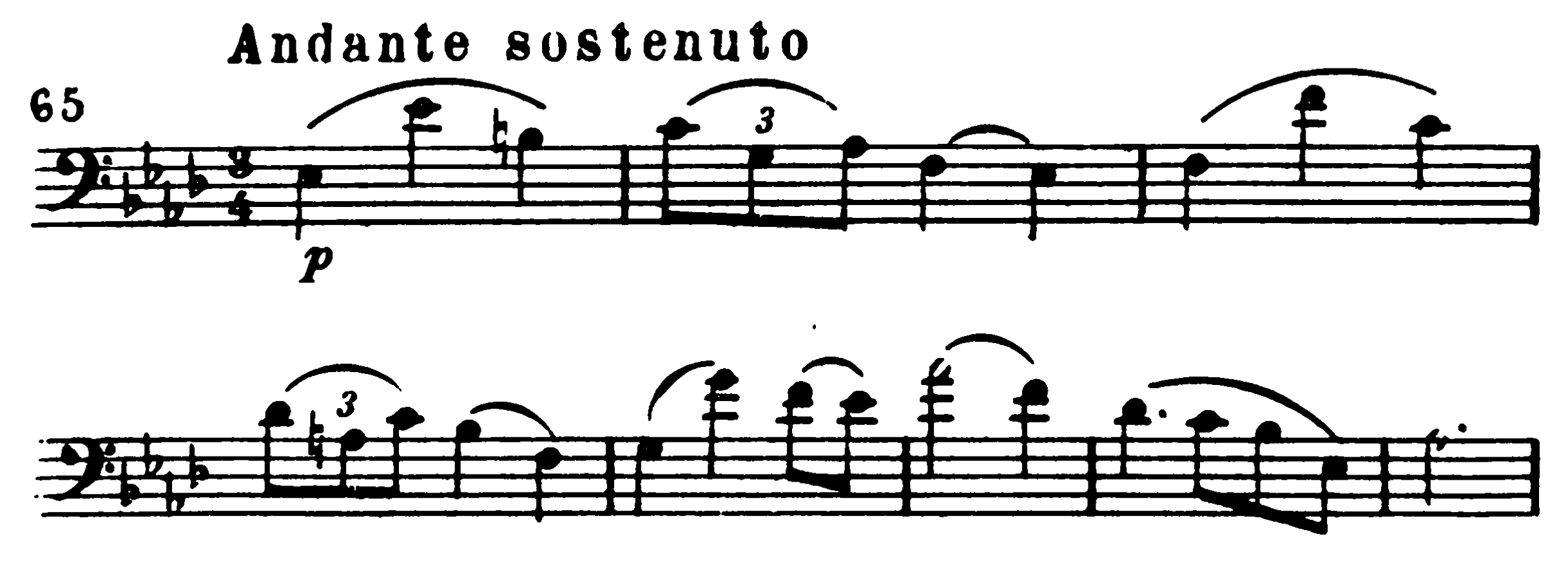
The middle movement, reminiscent of a lyrical romance, is contrasted by the impetuous and restless beginning of the Finale:
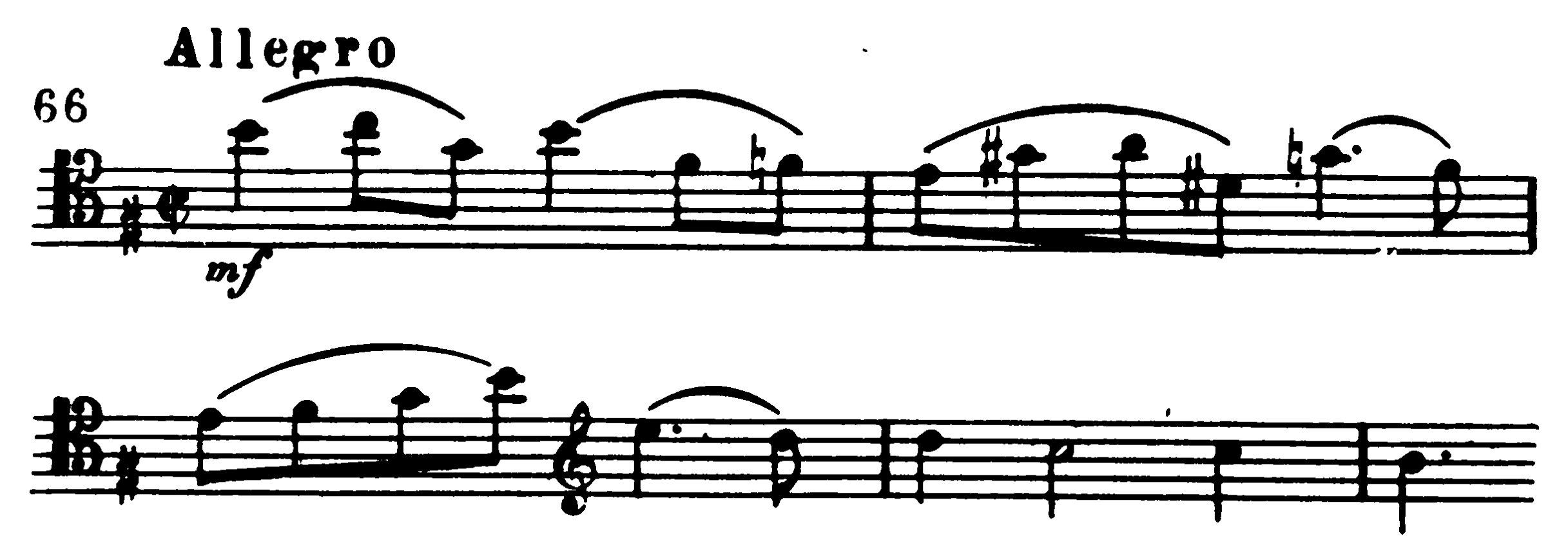
The orchestration of Brandukov’s concerto reveals a free command of the expressive resources of the orchestra.
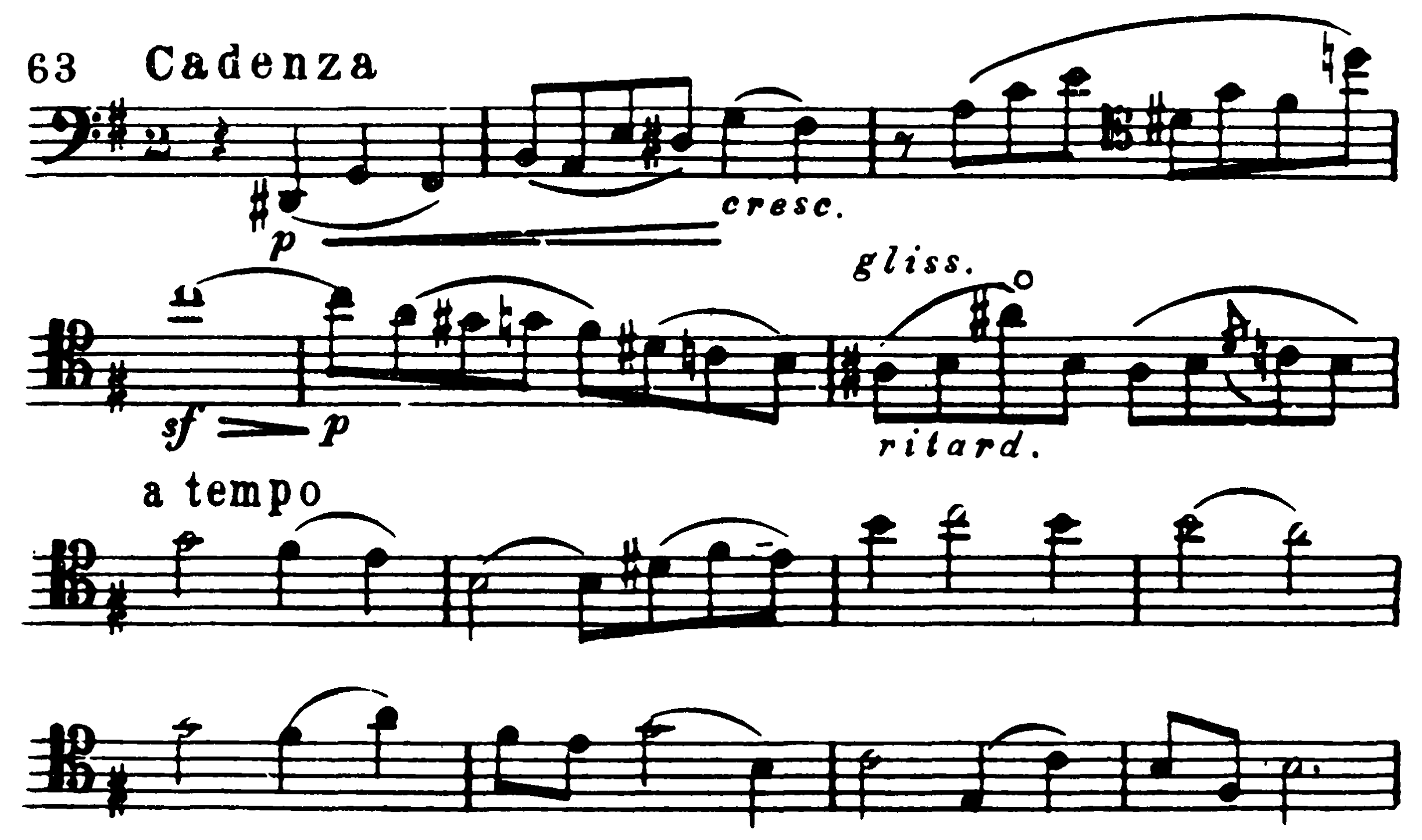
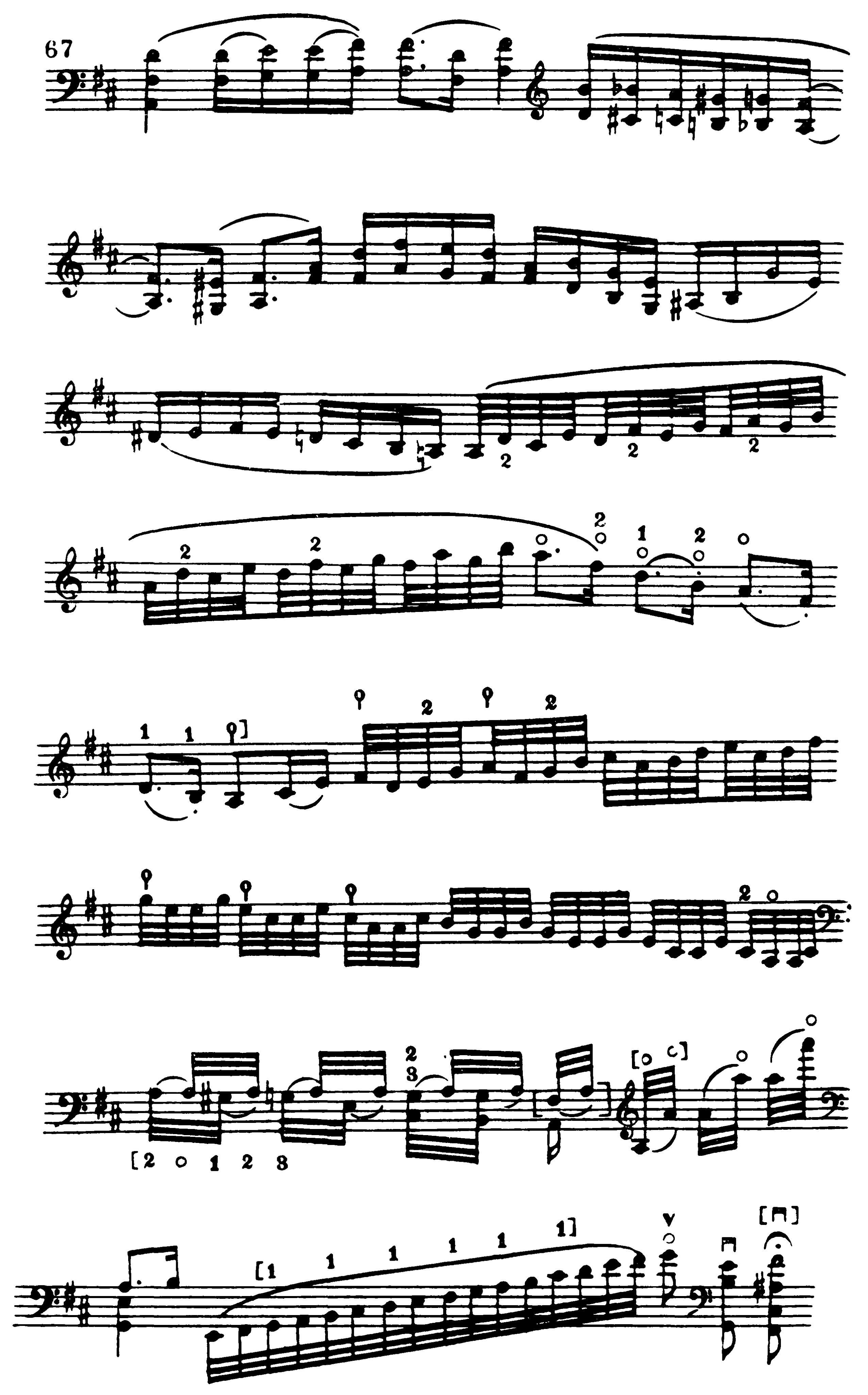
Brandukov’s other concertos (D minor, C minor, A minor, E-flat major, and F major) have been preserved in the form of variants and sketches. The various versions testify to the considerable work A. A. Brandukov devoted to his compositions and to the demands he placed upon himself.¹ The same is indicated by the variants of the cadenza he composed² for Haydn’s Cello Concerto in D
[p. 386]
major. In the cadenza (as in Brandukov’s concertos), virtuoso cello technique is employed masterfully:
[p. 387]
In addition, among Brandukov’s autographs preserved at the P. I. Tchaikovsky House-Museum are a cello suite, a Scherzo, a Waltz, a Romance dedicated to V. L. Kubatsky, and other works for cello, as well as for piano, violin, voice and piano, and quartet.
Brandukov was one of the most distinguished interpreters of the artistic cello literature in Russia, particularly of the works of Tchaikovsky and Rachmaninov, as well as those of Davydov, Arensky, Glazunov, Bach, Beethoven, Mendelssohn, Schumann, Saint-Saëns, Fauré, and other composers.
Mention must be made of the educational orientation of Brandukov’s many years of concert activity.
The educational tendencies of this musician manifested themselves particularly vividly during the Soviet period, when his cello began to sound in the workers’ clubs and concert halls of the capital, where a new, democratic audience had now appeared. Brandukov’s success among broad circles of Soviet listeners was facilitated by the exceptional accessibility of his performing art. Everything in his playing—its artistic truthfulness and simplicity, its profound emotionality, its broad melodiousness, and its brilliant artistry—contributed to genuine contact and mutual understanding between the performer and the audience.
Among the rich means of expression that Brandukov commanded masterfully and subordinated entirely to lofty artistic aims, particular emphasis should be placed on his expressive and heartfelt tone. This quality, which to a certain extent reflected the humanistic and democratic nature of the Russian performing school, was characteristic of its foremost representatives, particularly the cellists Davydov, Verzhbilovich, and Loganovsky. The deeply expressive sound of Brandukov’s cello, which so attracted the attention of Chaliapin and other outstanding singers, combined with poetic phrasing, imparted particular expressiveness to this cellist’s playing. Contemporaries frequently noted his “soft and at the same time rich, singing bow.”¹ A. V. Ossovsky, recalling with admiration the artistry and brilliance of Brandukov’s playing, characterized his tone as “beautiful and warm, full and soft.”
Fyodor Ivanovich Chaliapin, who loved the cello very much, held A. A. Brandukov’s playing in high esteem. Under the impression of Brandukov’s performance, he even acquired a cello and began studying the instrument with him. According to the recollections of the great artist’s daughter, I. F. Chaliapina, Fyodor Ivanovich repeatedly said: “One must sing as the
[p. 388]
cello sings.” In saying this, he naturally had in mind the cello in the hands of a performer capable of expressive “singing,” such as A. A. Brandukov.¹
Recalling Brandukov after Verzhbilovich and ranking both cellists among the “troubadour-singers,” A. A. Borisyak, who had heard them play, wrote: “The two figures of these remarkable contemporaries entered history as two pillars of a distinctive, inimitable school of free and commanding singers of the bow.”²
Like Davydov and Verzhbilovich, Brandukov repeatedly appeared in ensembles with vocalists, and the sounds of his instrument blended organically with the human voice. The joint appearances of A. A. Brandukov with F. I. Chaliapin, L. V. Sobinov, A. V. Nezhdanova, and other celebrated vocalists remained deeply impressed upon the memories of contemporaries.
Brandukov’s art was also highly esteemed by celebrated foreign singers. Captivated by the Russian cellist’s playing, the well-known Italian singer Angelo Masini (who gave concerts in Russia in the year of Brandukov’s graduation from the conservatory) presented him with an instrument by Ruggeri in 1890.³
As early as the 1880s, Russian critics emphasized the aforementioned qualities in the young cellist’s playing; the Moscow press of that time noted his impeccable taste, the nobility and musicality of his phrasing, his beautiful and heartfelt tone, and his ability “to sing excellently on the cello.” Subsequent reviews spoke of the same qualities: “The playing of this artist, distinguished by an excellent, beautiful tone, warmth, and artistic interpretation, has long won him the affection of the public.”⁴
Anatoly Andreyevich’s interpretation was distinguished by its exceptional persuasiveness. Experiencing the enormous impact of the artist’s talent, the listener believed him profoundly and accepted his interpretation of the music performed as that of the composer himself. “In his performance,” we read in one review, “there is an abundance of consummate artistry, musical understanding, and immersion in the work being interpreted, which involuntarily communicates itself to the listeners and establishes a close connection between the latter and the performer.”⁵
A. B. Goldenweiser, who gave concerts with A. A. Brandukov on more than one occasion, notes the captivating beauty of the artist’s tone and his warm, lively phrasing. “His vivid, emotional
[p. 389]
performance,” he recalls, “was entirely free of abstraction and intellectual calculation. Sometimes this artist’s emotionality even interfered with the unity of his interpretation. In general, much in Brandukov’s playing depended upon his mood. When creatively inspired and in the right frame of mind, he played very vividly, with genuine enthusiasm, finding an immediate response among the public …”
Until an advanced age, Brandukov retained the brilliance and temperament, inspiration and captivating quality of his performance, and the emotionality and expressiveness of his singing on the cello.
“The last time,” writes V. A. Vlasov, “I heard him in the Great Hall of the Conservatory at the ceremonial evening commemorating the sixtieth anniversary of the conservatory. When he played Tchaikovsky’s Nocturne with orchestra (specially orchestrated for him by Tchaikovsky in Paris), I glanced at the conductor, M. M. Ippolitov-Ivanov (also a friend of Tchaikovsky), and saw tears streaming down the face of the kindhearted Mikhail Mikhailovich. But he was not the only one weeping. And these were by no means tears of sentimental emotion or of farewell to the world’s oldest artist: A. Brandukov’s playing that day, his tone, the singing of his cello, were so unforgettable, so wonderfully beautiful, that one can only regret that it is impossible to describe them in words …”¹
G. G. Neuhaus, who participated in Brandukov’s final sonata evenings, recalls: “What was striking about Brandukov was his exceptional artistry, the captivating sincerity and artistic quality of his phrasing, his creative freedom and ardent emotionality, combined with a highly developed sense of style. Particularly attractive was his noble, powerful, and supremely expressive tone. Our rehearsals for the sonata evenings remain vividly in my memory. Passion and genuine creative ardor, a persistent search for truthfulness of expression, a restless and at times nervous state of mind, not a trace of mere craftsmanship or ‘academicism’—such was Brandukov in the process of working. He possessed to a considerable degree a ‘sense of the whole.’ In sonatas, he did not ‘play his part,’ but participated organically in the ensemble, vividly sensing the artistic work as a whole. The instances of rubato characteristic of Brandukov’s performing style, owing to their naturalness and sincerity, proved profoundly justified not only in Rachmaninov’s sonata but also in Beethoven’s sonata, to whose style they would probably not have corresponded in another performance.”²
The artistic interpretation characteristic of Brandukov—subtle, distinguished by depth and completeness, excellent
[p. 390]
taste, and an astonishing sense of style—was of considerable significance in the formation of Russian performing culture in our century.
During the years of reaction that were difficult for Russian art and followed the bourgeois revolution of 1905, when modernism and decadence launched an offensive against progressive Russian realistic art, the finest representatives of the older generation of Russian performing culture, among whom was Anatoly Andreyevich Brandukov, played a considerable role in preserving the finest classical traditions.¹ Their enormous merit lay in the transmission of these traditions to the young Soviet art.
The Soviet cello school had to wage a struggle against the survivals of negative phenomena in the sphere of musical performance, phenomena that led away from great art imbued with ideological purpose, relying in this struggle upon the constant and unremitting ideological and artistic growth of Soviet art as a whole. In this struggle for the realistic orientation of young Soviet cello art at the dawn of its development, Brandukov likewise played a considerable role as a living bearer of the finest classical traditions. Both as a performing artist and as a pedagogue, he resisted modernist and formalist influences and, to the extent of his abilities, protected Soviet youth from them, endeavoring to educate his pupils through classical works.
Brandukov’s pedagogical activities were inseparably connected with his performing art. The remarkable artist endeavored to develop in his pupils musicality of interpretation, a sense of style, and the ability to penetrate deeply into the composer’s artistic conception.
“Anatoly Andreyevich gave us, his pupils, a general direction, a feeling for style and form,” recalls V. L. Kubatsky. “He demanded a conscious attitude toward the work being performed and an inspired rendering of it. He said that without love and without enthusiasm nothing progresses in art, and that if you do not love what you are playing, no one will believe you.”
“Brandukov did not belong to the category of analytical pedagogues or pedagogical methodologists—technique did not occupy his special
[p. 391]
attention,” recalls another of his pupils, A. V. Brown. “Anatoly Andreyevich proceeded from the musical image. His penetration into the artistic essence of a work, into its character, style, and the particular features of its content and form, was astonishing. Such an interpretation of a work, always supremely clear and in its simplicity appearing to be the only correct and truthful one, frequently suggested to us the technical means that needed to be employed in one instance or another.”
Brandukov’s lessons with his pupils were of a lively, creative character. There was not a trace of dry dogmatism or pedantry in them, although he never compromised his fundamental requirements. He persuaded, but did not impose his ideas, allowing his pupils freedom for the manifestation of their creative individuality.
Of considerable interest are the recollections of Brandukov as a pedagogue recorded by K. G. Mostras, who had been his pupil in the quartet class and subsequently was closely associated with him through their joint pedagogical work at the Philharmonic School and at the conservatory. “Most characteristic of Anatoly Andreyevich Brandukov as a pedagogue,” writes K. G. Mostras, “was his intolerance of standardization in performance, which led to formulaic playing and the depersonalization of musical thought. The continual search for something new, more perfect, and more truthful, which at first glance appeared to be something unstable in A. A. Brandukov’s pedagogical system, in reality gave the pupil neither cause nor opportunity for complacency, awakened his initiative, and brought his thinking into a genuinely creative realm. But he was equally intolerant of departures from the spirit and meaning of a work, of the vulgarization of the composer’s thought, and of the substitution of the genuine style of the work by personal and unjustified aspirations for outward effect.”
The thought expressed by K. G. Mostras is also contained in the recollections of A. A. Brandukov’s conservatory pupil, A. N. Yegorov: “Anatoly Andreyevich’s extraordinary musical imagination sometimes caused him, without distorting the overall conception or idea of a work, to feel and interpret individual sections and phrases in a new way (always remarkably), which complicated the pupil’s already difficult task of satisfying his demanding teacher.”
Another of Anatoly Andreyevich’s pupils, A. Ya. Georgian, recalls essentially the same thing: “Treating the text with profound attention and avoiding departures from it, he was at the same time able to impart freedom and spontaneity to the interpretation of a work. Studying a composition with a student, he spoke not only of the work itself, but also of many circumstances associated with it and of the various
[p. 392]
interpretations he had heard, comparing them and drawing his own imaginative conclusion.”
Creative imagination, the absence of complacency, and the “continual search for something new, more perfect, and more truthful” in expression—all these features characteristic of A. A. Brandukov manifested themselves in the most positive manner in the course of his pedagogical activities, contributing to the cultivation of the pupils’ creative activity and the development of their artistic imagination.
As L. Ya. Edelman recalls, Anatoly Andreyevich rejected contrived and affected phrasing, but was prepared to agree with an interpretation proposed by a pupil if it corresponded to the content of the musical phrase: “If it comes from the heart and is appropriate, I shall always support it,” he said.
Everything false, superficial, and formal was equally foreign to Brandukov the pedagogue and Brandukov the artist. “Expression on a note is false expression,” he said. “One must play phrases, not notes.” Anatoly Andreyevich could not tolerate indifference or dispassion in art. Demanding inspired and emotional performance from his pupils, Brandukov himself set them an example of constant creative ardor and genuine enthusiasm. “His highly artistic demonstrations, whether on the cello or the piano, remained forever in one’s memory and were always convincing,” recalls K. G. Mostras. “… His playing was invariably inspired and therefore utterly convincing.”
An excellent pianist, Anatoly Andreyevich Brandukov usually conducted his lessons at the piano and himself accompanied his pupils at examinations and student concerts. “He did not accompany in the generally accepted sense of the word,” recalls A. V. Brown. “He guided us like a helmsman through the boundless element of music; he revealed to us such subtle emotional experiences and such astonishing colors, of which we ourselves had no conception and which, had it not been for him, would have remained unknown to us … It is impossible to remember him being indifferent at the piano. It was a kind of inexhaustible creative ardor, enthusiasm, intoxication with music.”
Endowed with a rich creative imagination, Brandukov knew how to reveal vividly to his pupils the content and mood of a particular work, for example, the first movement of Locatelli’s sonata or the secondary theme in the first movement of Lalo’s concerto.
His interpretation of Bach’s works, particularly the suites for solo cello, was interesting in its artistic orientation and individuality. “I was fortunate on several occasions (in class and at his home) to hear Anatoly Andreyevich performing movements from Bach’s suites,” relates A. N. Yegorov, “when he played with great enthusiasm, inspiration, and, as was evident, with great pleasure. The impression
[p. 393]
was inimitable and is difficult to convey. What was striking was the range of tonal colors, reminiscent of organ registers, the vividness of the voice-leading and nuances, the highlighting of modulations, and the originality of the cadences. Particularly impressive was his performance of the sarabandes.”
When working with pupils on Bach’s suites, Anatoly Andreyevich frequently made use of the piano. Skillfully revealing at the piano the concealed polyphony of the great composer’s remarkable suites, he helped the pupils understand these works, which are difficult to perform.
During the final years of his life, A. A. Brandukov worked on piano arrangements of Bach’s suites. As can be seen from his piano arrangement of the Prelude from the D-minor Suite, Anatoly Andreyevich possessed a profound understanding of the style and polyphonic texture of this music; he created an excellent piano transcription of the Prelude, which in this form deserves the attention of concert pianists (see photograph).¹
A. A. Brandukov continually recommended that his pupils play Bach’s Air, which he himself performed beautifully. This piece had become one of Anatoly Andreyevich’s favorite works in his repertoire ever since he had heard it in an excellent performance by K. Yu. Davydov.²
Being an excellent ensemble player, Brandukov instilled in his pupils a love and appreciation of chamber music and of the finest classical works of this genre.
“Lessons in Anatoly Andreyevich’s ensemble class were a festive occasion,” recalls his pupil at the Philharmonic School, I. V. Potemkin. “Working toward the realization of an artistic work, he inspired us and revealed a new world to us.”
As Brandukov’s conservatory pupil A. A. Klivansky relates, Anatoly Andreyevich severely condemned pupils who missed lessons in the chamber music class and said: “… such a pupil is not a musician at all.” Many of Brandukov’s pupils subsequently became members of well-known chamber ensembles in our country: V. L. Kubatsky—a member of the Stradivari Quartet; S. P. Shirinsky—of the Beethoven Quartet; A. V. Brown—of the Taneyev Quartet; P. N. Kutyin—of the Vuillaume Quartet; A. Ya. Georgian—of the trio of the All-Union Committee for Radio Information; and A. A. Klivansky—of the trio of the Moscow Regional Philharmonic Society.
[p. 394]
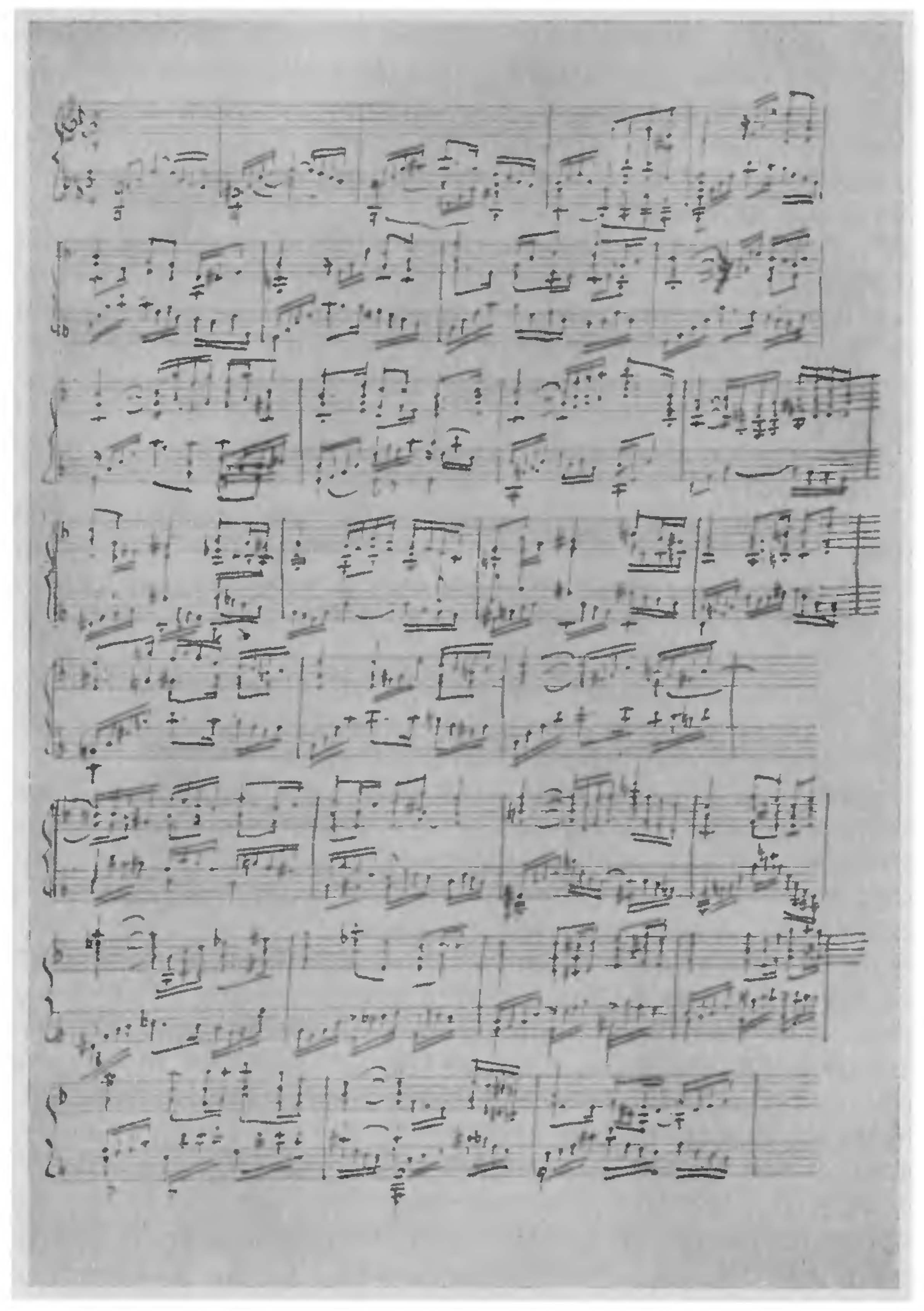
[Prelude in D minor by J. S. Bach in the piano arrangement of A. A. Brandukov (Tchaikovsky House-Museum).]
[p. 395]
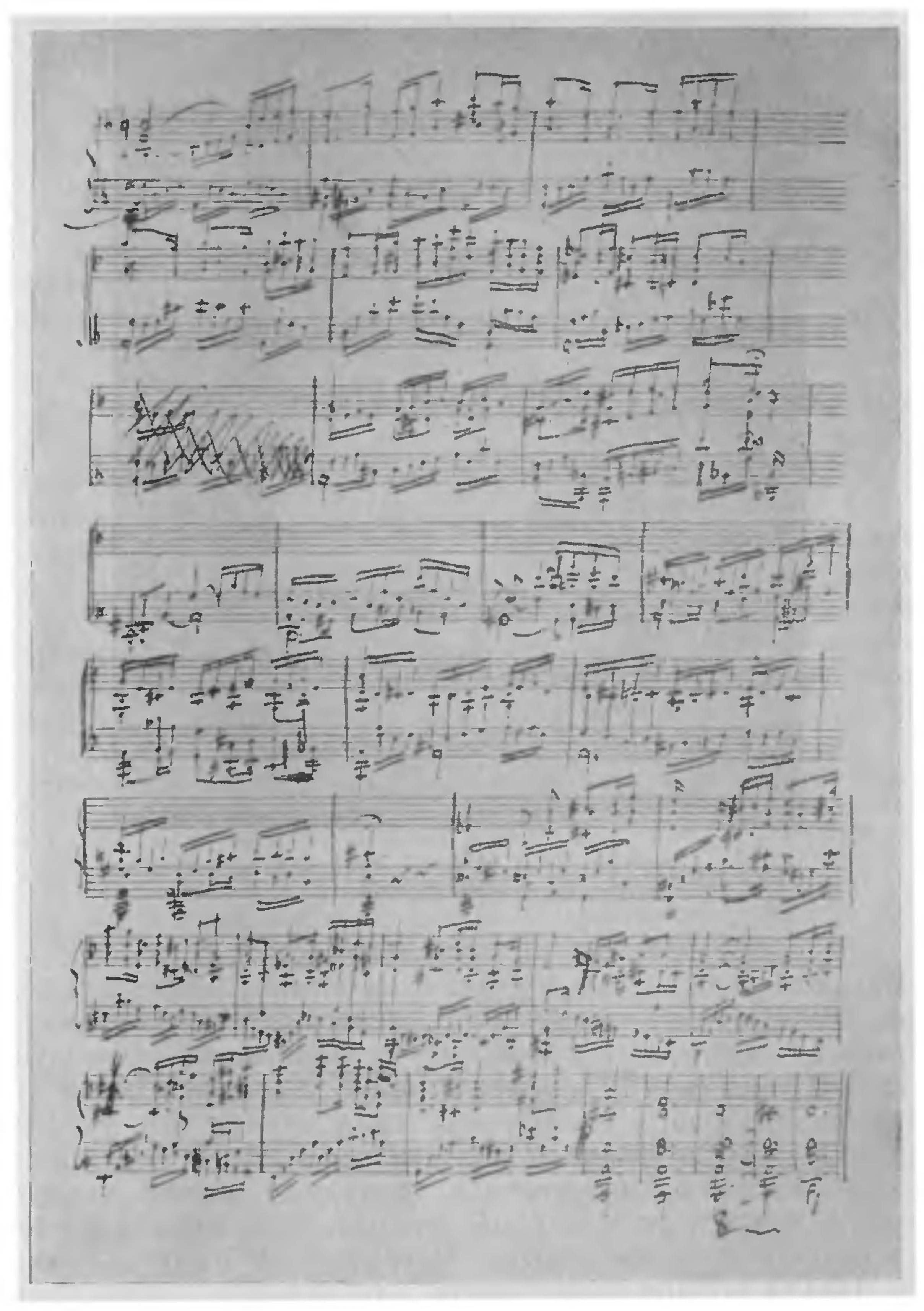
[Continuation of Brandukov’s piano arrangement of Bach’s Prelude in D minor.]
[p. 396]
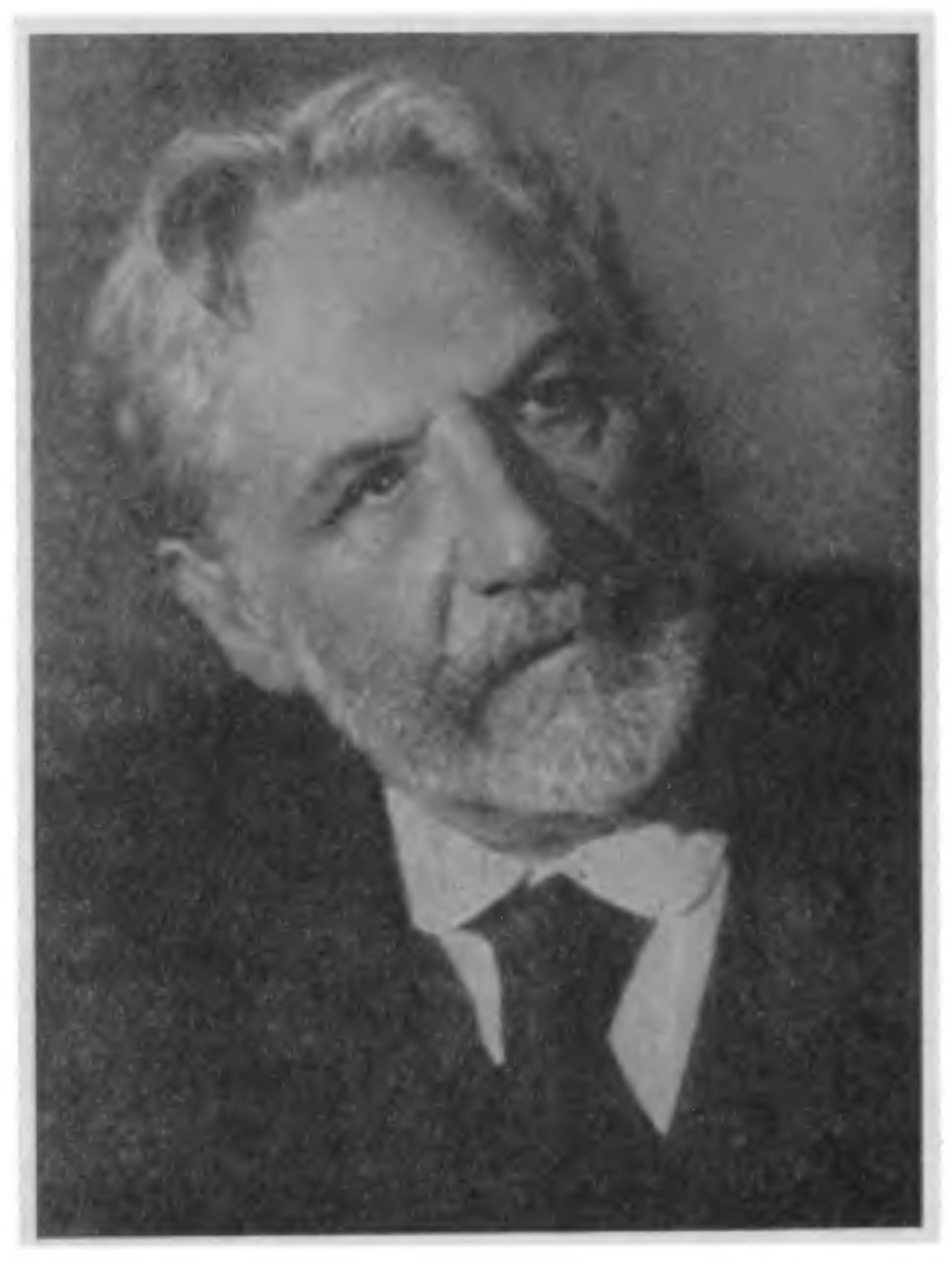
Of great educational significance were Brandukov’s frequent conversations with his pupils and his interesting recollections of artistic encounters with great artists. “Brandukov not only taught his pupils to play the cello, but also instilled in them a love of music,” wrote a group of his pupils on the occasion of the tenth anniversary of A. A. Brandukov’s death. “Anatoly Andreyevich’s conversations with his pupils assumed the character of lectures on the style of one composer or another, lectures on the analysis of forms and on the history of music. Brandukov’s extraordinary memory enabled him to tell his pupils a great deal.”¹ The latter listened with enormous interest to their teacher’s invariably instructive and, at the same time, masterful accounts of his encounters and joint appearances with Tchaikovsky,
[p. 397]
the Rubinstein brothers, Saint-Saëns, Liszt, Rachmaninov, Yesipova, Siloti, Chaliapin, Nikisch, and other outstanding musicians of his time.¹
These conversations undoubtedly played a positive role in the pedagogical process; they instilled in the pupils an appreciation of good music and an interest in the foremost representatives of the Russian classical school. Let us recall that this took place during the period of the dissemination of the erroneous doctrines of RAPM [the Russian Association of Proletarian Musicians.—Trans.], which to a considerable extent rejected the significance of the classical heritage and underestimated the problems of artistic mastery. The role that Brandukov played in educating young musicians in the spirit of respect for classical art therefore appears particularly significant.
* * *
Soviet musical art, developing on the basis of the progressive method of socialist realism and along the path of bringing art closer to life, achieved particularly significant successes in the subsequent decades.
In noting the outstanding achievements of the Soviet cello school, we preserve the memory of one of the foremost representatives of the older generation of Soviet performing culture, the remarkable cellist and artist Anatoly Andreyevich Brandukov, who made a significant contribution to the development of cello art in our country.
Original footnotes
p. 354
- This date, which differs from the dates given in encyclopedias and other sources and coincides with the date specified in Brandukov’s conservatory diploma, was established from an extract from the parish register (Central State Archive of the City of Moscow, fond 203, inventory 745, fols. 49 verso–50). According to the aforementioned document, A. A. Brandukov was the illegitimate son of Lyubov Ivanovna Brandukova, a woman of the Ryazan burgher class, and at his baptism received his patronymic from the name of his godfather, Arkady Alexeyevich Rozanov. In his diploma, he is likewise named Anatoly Arkadyevich Brandukov.
p. 355
- See Golos, 1876, No. 352.
- See Vechernyaya gazeta, 1877, No. 130.
- See Russkiye vedomosti, 1877, No. 54, as well as Moskovskiye vedomosti, 1877, No. 118.
- Brandukov studied piano with P. Shchurovsky, K. Vilshau, and A. Razmadze. His brilliant command of the piano proved extremely useful in his artistic and pedagogical activities.
p. 357
- According to the recollections of K. Yu. Davydov’s daughter, M. K. Kuprina-Iordanskaya, Brandukov studied with Davydov for some time; apparently, these were only occasional meetings, probably at a later period, after Brandukov had graduated from the conservatory.
- A. A. Brandukov was one of the first Russian performers and, in general, one of the finest interpreters of this concerto, written in 1872 and still occupying a prominent place in the repertoire of concert cellists.
- The musical salon of the celebrated singer Pauline Viardot (1821–1910) enjoyed wide renown during the 1870s and 1880s. Alongside the foremost musicians, prominent writers, painters, actors, and scholars visited it. I. S. Turgenev, who had become acquainted with this artist during her appearances in Russia in the 1840s, took an active part in P. Viardot’s musical evenings.
p. 358
- Romain Rolland, Musicians of Our Day. Moscow, 1938, pp. 252–253.
p. 359
- V. M. Lavrov (1852–1912) was the editor and publisher of the Moscow journal Russkaya mysl.
- The letter is preserved in the archive of A. A. Brandukov at TsGALI (fond 640).
- Russkoye slovo, 1910, No. 107.
p. 360
- Letter to Modest Ilyich Tchaikovsky dated April 18/30, 1883 (Days and Years of P. I. Tchaikovsky. Moscow–Leningrad, 1940, p. 291).
- Reviews from the Parisian press of the 1880s and 1890s; preserved at the P. I. Tchaikovsky House-Museum in Klin.
- Considerably later, while touring Moscow in 1906, the celebrated French conductor Ch. Lamoureux recalled Brandukov’s Paris appearances with admiration in a conversation with S. N. Vasilenko and Yu. S. Sakhnovsky.
p. 362
- M. L. Vasilenko, Recollections of I. S. Turgenev and P. Viardot. The manuscript, dating from 1947 and discovered in Perm by M. E. Goldstein, was made available by him to the author for use in the book A. A. Brandukov (Moscow, 1951); that same year, the manuscript was published in Sovetskaya muzyka, 1951, No. 7.
- In the archive of the Institute of Russian Literature of the Academy of Sciences of the USSR (Pushkin House), the program of one of the charitable musical evenings (probably at P. Viardot’s home), written in I. S. Turgenev’s own hand, has been preserved. At this evening, A. A. Brandukov performed Mendelssohn’s sonata, Davydov’s Fantasia on Russian Songs, and other works. I. S. Turgenev read poems by Pushkin and Lermontov and his own unpublished short story. M. L. Vasilenko also participated in the concert.
- Martin Pierre Joseph Marsick (1848–1924) was a well-known Belgian violinist and professor at the Paris Conservatory. He gave successful concerts in Moscow and St. Petersburg.
p. 363
- In subsequent years, Brandukov also participated in concerts devoted to the works of P. I. Tchaikovsky. Thus, for example, his appearance at a concert of works by the great Russian composer, held in Frankfurt am Main on February 8, 1903, is known. He repeatedly participated in performances of Tchaikovsky’s chamber works (quartets and trios) at concerts in Paris and elsewhere.
- Louis Diémer’s letter to A. A. Brandukov, written, as we have been able to establish, on March 2, 1888, is preserved at the Museum of Local History of the Moscow Region.
p. 364
- The letter is preserved at the P. I. Tchaikovsky House-Museum in Klin.
- P. I. Tchaikovsky, Correspondence with N. F. von Meck, Vol. III. Moscow–Leningrad, 1936, p. 421.
p. 365
- The letters are preserved at the P. I. Tchaikovsky House-Museum in Klin.
- Olga Ivanovna Chertkova was an acquaintance of A. A. Brandukov, to whom he dedicated his Elegy for cello and piano.
- The letter is preserved at the Museum of Local History of the Moscow Region.
- Brandukov’s mother, whom he loved dearly, was in Moscow.
p. 366
- See Muzykalny i teatralny vestnik, 1883, No. 45, p. 5.
- Peterburgskiye vedomosti, 1883, No. 316.
- The letter is preserved at the State Central Museum of Musical Culture (GTsMMK).
- When a concert commemorating P. A. Pabst took place in Moscow in 1897, his trio was performed by K. N. Igumnov, I. V. Grzhimali, and A. A. Brandukov.
- The letter is preserved at the P. I. Tchaikovsky House-Museum in Klin.
p. 367
- Muzykalnoye obozreniye, 1887, No. 30.
p. 368
- Moskovskiye vedomosti, 1889, No. 328.
- Russkiye vedomosti, 1889, No. 329.
p. 369
- The letter is preserved at the P. I. Tchaikovsky House-Museum in Klin.
- The letter is preserved at the P. I. Tchaikovsky House-Museum in Klin.
- Arranged for cello and piano by W. F. Fitzenhagen, they were orchestrated by the composer. At the same concert, Anatoly Andreyevich played Bach’s Air and Glazunov’s Spanish Serenade.
- Yu. Poplavsky, “Tchaikovsky’s Last Day in Klin.” Artist, 1894, No. 42, p. 118.
p. 370
- Moskovskiye vedomosti, 1891, No. 272.
- P. I. Tchaikovsky and S. I. Taneyev, Letters. Compiled and edited by V. A. Zhdanov. Moscow, 1951, p. 177.
- Artist, 1891, No. 13, p. 157 (the author of the review was S. Kruglikov).
p. 371
- Moskovskiye vedomosti (January 31, 1891) assessed Brandukov’s piece critically and wrote: “… Mr. Brandukov the composer harmed Mr. Brandukov the artist.”
p. 372
- The second piece of this opus by Rachmaninov is the Oriental Dance.
- From S. V. Rachmaninov’s letter to A. A. Brandukov, sent from Paris in 1907, it is evident that the composer approved Brandukov’s arrangements of his pieces and recommended them for publication. Besides the Serenade, Rachmaninov also mentions the Melody.
p. 373
- Moskovskiye vedomosti, 1901, No. 334.
- See Moskovsky listok, 1904, No. 20.
- S. V. Rachmaninov greatly valued Brandukov as an interpreter of his works. In a letter to M. S. Kerzina (December 7, 1906), Rachmaninov wrote: “If you decided to perform my trio, I would likewise be glad if the pianist were Goldenweiser, for example, with Brandukov and Grigorovich …” (the Kerzin archive in the Manuscript Department of the V. I. Lenin State Library).
- On October 3, 1902, Moskovskiye vedomosti reported the planned concerts of A. I. Siloti and A. A. Brandukov in Vitebsk, Smolensk, Minsk, Vilna, Kyiv, Kursk, Kharkiv, Sumy, Yekaterinodar, Novocherkassk, Taganrog, and Rostov-on-Don.
- See, for example, Kiyevskaya gazeta, 1902, No. 286. [The number 4 occurs twice in the printed original.—Trans.]
- Moskovskiye vedomosti, 1902, No. 341.
p. 374
- Brandukov performed these pieces in the presence of the composer also at a musical morning organized in honor of A. S. Arensky on March 3, 1902, at Goldenweiser’s apartment in Moscow. On that occasion, A. B. Goldenweiser, Yu. E. Conus, and A. A. Brandukov also performed Arensky’s trio.
- Many works by Russian composers are dedicated to A. A. Brandukov. In addition to the aforementioned compositions of P. Tchaikovsky and S. Rachmaninov, let us recall the pieces by A. Arensky (Op. 56), A. Koreshchenko (Op. 34), and other published cello compositions. The cello concerto of P. Krylov, written subsequently and also dedicated to Anatoly Andreyevich, remained in manuscript.
- The inscriptions on photographs presented to Brandukov and preserved at the P. I. Tchaikovsky House-Museum in Klin are of interest. “To my dear friend Anatoly Andreyevich Brandukov, from S. Rachmaninov, who sincerely loves him. April 6, 1906.” “To my dear friend and comrade Anatoly Brandukov, from A. Verzhbilovich, who loves him heartily. St. Petersburg, 1896.” “To my dear friend Anatoly Andreyevich Brandukov, as a token of love and in remembrance of our old friendship. Fyodor Chaliapin. December 23, 1911. Moscow.” “Dear Anatoly, know and believe that I love and respect you. To Brandukov, F. Chaliapin. December 1911. Moscow,” and so forth.
p. 375
- P. I. Tchaikovsky was at that time among the directors of the Russian Musical Society.
- Letters to Jurgenson dated March 19 and February 19, 1890 (P. I. Tchaikovsky, Correspondence with P. I. Jurgenson, Vol. 2. Moscow–Leningrad, 1952, pp. 148 and 141).
p. 376
- Muzyka i revolyutsiya, 1928, No. 11 (35), pp. 28–29.
p. 377
- See the letter from S. I. Taneyev to A. A. Brandukov dated March 18, 1914 (P. I. Tchaikovsky House-Museum).
- Brandukov initiated the invitation of such excellent musicians as Rachmaninov, Siloti, Safonov, Scriabin, Nikisch, Fauré, Weingartner, Mengelberg, Casals, Thibaud, Hofmann, Zimbalist, and others to participate in concerts of the Philharmonic Society.
p. 378
- At the P. I. Tchaikovsky House-Museum in Klin, a letter is preserved from one of Brandukov’s talented pupils, Frol Banovich, who was at that time serving as a private in Voronezh. In this letter, he touchingly thanks his teacher for the assistance he rendered him in circumstances that were difficult for him.
- Moskovskiye vedomosti, 1906, No. 288.
p. 379
- Russkoye slovo, 1907, No. 260.
- Khudozhestvennoye naslediye. “Repin.” Published by the Academy of Sciences of the USSR. Moscow–Leningrad, Vol. II, 1949, p. 259. In the collection of V. L. Kubatsky there is a sketch of a portrait of A. A. Brandukov attributed to I. Ye. Repin.
p. 380
- The Moscow Literary and Artistic Circle, which existed from 1898 to 1920, played a notable role in the life of the Russian artistic intelligentsia at the beginning of our century. From 1908, the Circle was headed by V. Ya. Bryusov.
- This painting is at the P. I. Tchaikovsky House-Museum in Klin.
- V. I. Lenin, Works, 4th ed., Vol. 27, p. 478.
- Ibid., Vol. 28, p. 194.
p. 381
- Sovetskaya muzyka, 1962, No. 7, p. 79.
p. 382
- See Iskusstvo trudyashchimsya, 1925, No. 9. According to N. S. Golovanov, A. A. Brandukov repeatedly played Rachmaninov’s Lilacs with A. V. Nezhdanova and, together with S. I. Taneyev and I. V. Grzhimali, accompanied her in Beethoven’s Scottish Songs.
- Rachmaninov’s sonata was included in the programs of both evenings: December 18, 1929, and January 4, 1930.
- The gramophone recording of Brandukov’s performances of Saint-Saëns’s Romance and Arensky’s Barcarolle (Muztrest, E 622 and 623) dates from approximately the end of January 1930. [This footnote continues on p. 383.—Trans.]
p. 383
- In the autumn of 1949, the monument to A. A. Brandukov, erected with funds collected by Moscow cellists, was unveiled. The Moscow State Conservatory devoted special concerts to the memory of A. A. Brandukov in 1951 (on the twentieth anniversary of his death) and in 1959 (on the hundredth anniversary of his birth).
p. 385
- It is interesting to note the use of musical material from Brandukov’s E-minor Concerto in his C-minor Concerto (intonations and themes; the slow movements of the concertos almost coincide).
- The complete cadenza was published in the appendix to L. Ginzburg’s booklet A. A. Brandukov. Moscow, 1951.
p. 387
- Moskovsky vestnik, 1897, No. 313.
p. 388
- See I. Chaliapina, Recollections of My Father (Fyodor Ivanovich Chaliapin, Literary Legacy. Edited and compiled by E. A. Grosheva. Vol. I. Moscow, 1957, p. 655 ff.).
- A. Borisyak, My Musical Impressions. Manuscript, 1952. (A copy was kindly made available to us by Yevgeniya Alexandrovna Borisyak.)
- See Moskovskiye vedomosti, 1890, No. 81.
- See ibid., 1897, No. 31.
- Novosti dnya, 1894, No. 3868.
p. 389
- Sovetskaya muzyka, 1962, No. 7, pp. 79–80.
- A. A. Brandukov truly loved Beethoven; according to the accounts of his pupils, the score of Beethoven’s violin concerto was Anatoly Andreyevich’s constant companion, with which he did not part until the final days of his life.
p. 390
- This circumstance is rightly noted by T. N. Livanova in her article “On the Controversies Concerning the Musical Heritage” (Sovetskaya muzyka, 1950, No. 10): “As is known, Nezhdanova, Sobinov, Yershov, Igumnov, Goldenweiser, Nikolayev, Brandukov, Blumenfeld, Suk, and many other excellent performers formed the oldest generation of Soviet artists. It must not be forgotten that all of them were formed and were active earlier. It was they, these remarkable Russian musicians, who to a considerable extent protected Russian realistic art, its classical traditions, and its performing culture from the pernicious influences of modernism.”
p. 393
- The original is preserved at the P. I. Tchaikovsky House-Museum.
- The great contemporary of both cellists, L. N. Tolstoy, being under the powerful impression of an expressive performance of this piece, wrote: “Bach’s Air: what words can compete with it while it is being performed?” (Diary of Lev Nikolayevich Tolstoy. Edition under the editorship of V. G. Chertkov, Vol. I, 1895–1899. Moscow, 1916, p. 66.)
p. 396
- Sovetsky muzykant (newspaper of the Moscow State Conservatory), 1940, No. 15.
p. 397
- Recalling Brandukov’s fascinating accounts of Turgenev, Tchaikovsky, the Rubinstein brothers, Liszt, Saint-Saëns, and Rachmaninov, V. A. Vlasov writes: “This was a living connection with the previous century, with the great men of the nineteenth century” (Sovetskaya muzyka, 1962, No. 7, p. 79).