(Excerpted from Lev Ginzburg’s History of the Art of the Violoncello, Vol. 3, The Russian Classical Cello School (1860–1917), Moscow, 1965, pp. 561–564, translated by Yuriy Leonovich.)
[p. 561]
The Concerto elegiaco for cello and orchestra (Op. 11, B minor) by A. A. Jurjāns, which appeared in 1889, is, as already noted, one of the very few cello concertos written by composers of our country during the period under consideration. The work is, in all probability, the first example of the concerto genre in Latvian music.
This work reflects both the composer’s love of his native Latvian folklore and the classical traditions of the Russian school, which he absorbed during his studies with N. A. Rimsky-Korsakov at the St. Petersburg Conservatory (from which he graduated in composition in 1881).
In 1882, A. A. Jurjāns settled in Kharkiv, where he taught for many years at the Music College of the Russian Musical Society (RMS). The composer dedicated his concerto to Davydov’s pupil A. E. von Glehn (the concerto was published by Jurgenson in 1912 with this dedication), who had also been working at the Kharkiv Music College since 1884. In 1889, that is, in the year of the concerto’s composition, von Glehn gave its first performance in Kharkiv.
The contemporary Latvian musicologist O. Grāvītis ranks Jurjāns’s Concerto elegiaco among the composer’s finest works, based upon “intonations and melodic turns of folk songs, and sometimes entire folk melodies.”¹
The very title—Concerto elegiaco—defines the prevailing range of moods in this poetic work, written with an excellent understanding of the emotional possibilities of the cello.
In the exposition and recapitulation of the first movement of the concerto, the keys of the themes conform to the classical style (E minor–G major and E minor–E major). The originality of the form lies in the development of each of the themes (particularly the first) immediately following its presentation.
The majestic and concise introduction is followed by an expressive cello recitative leading to the first movement proper:
[p. 562]
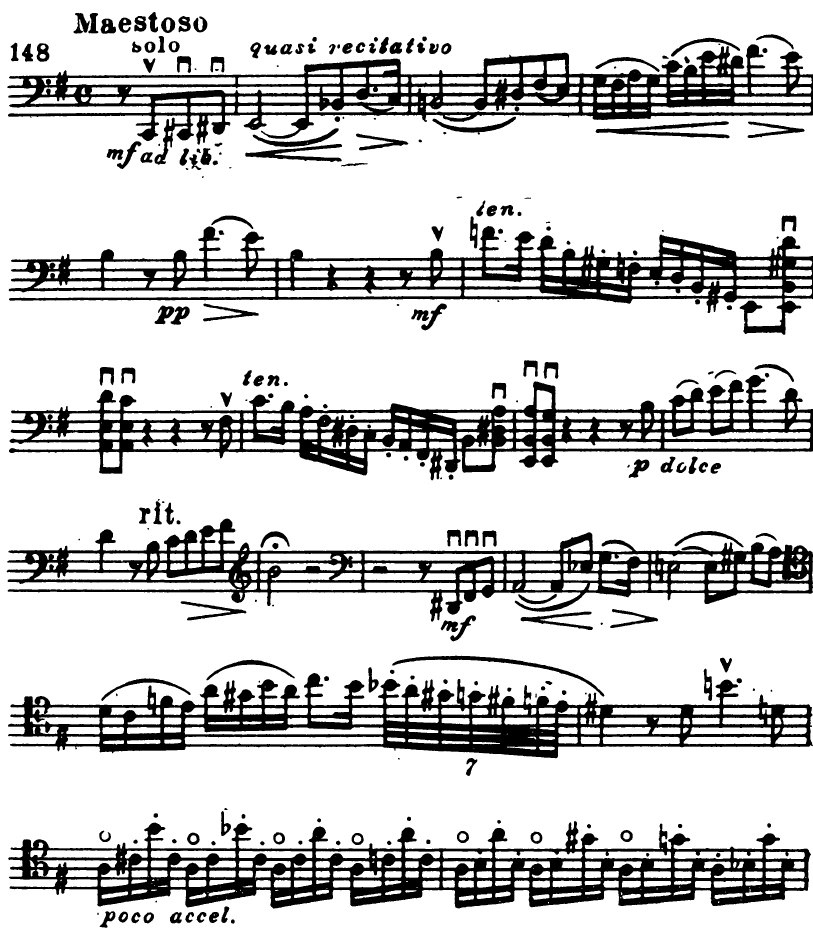
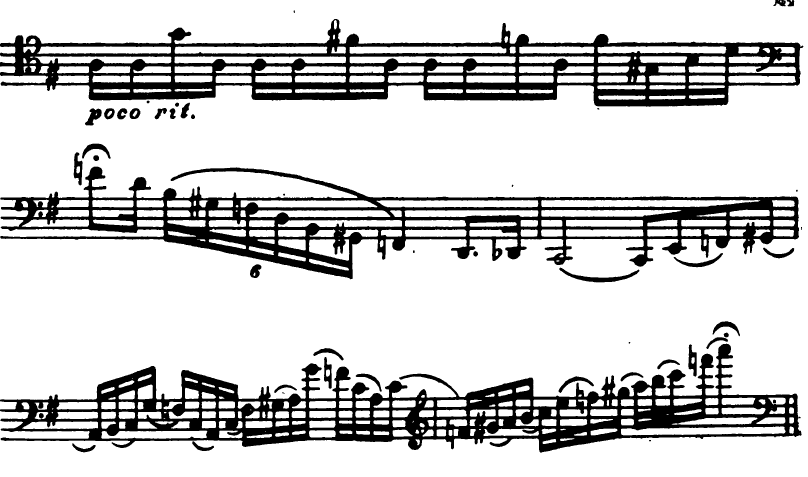
[p. 563]
Both its themes are melodious and contrast primarily in mode and mood:
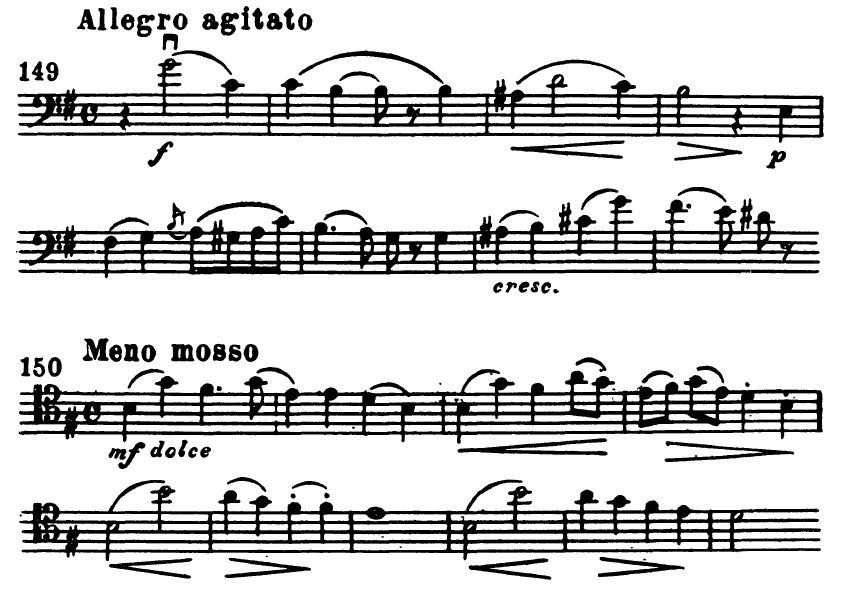
The distinctive mode of the lyrical and more tranquil secondary theme emphasizes its folk character; this theme is the Latvian folk song “Ko tu raudi, kas ten kait” (“Why are you crying? What is the matter with you?”).
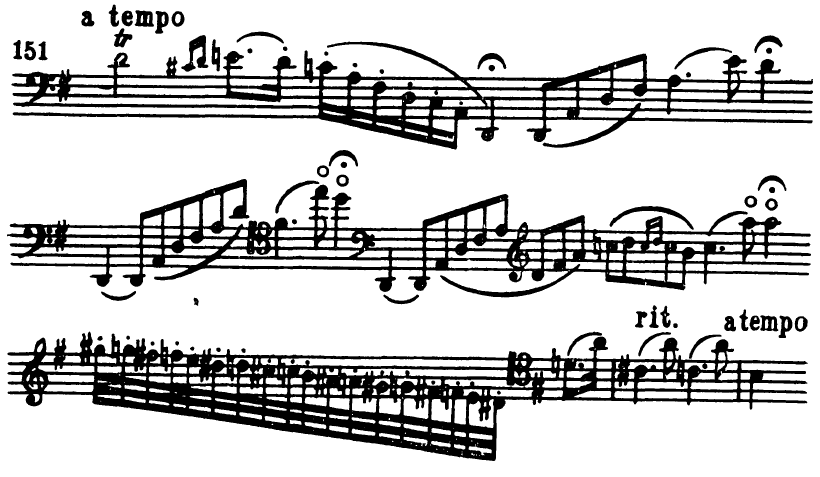
Another cello recitative is interpolated into the presentation of the secondary theme:
The middle movement of the concerto—an Andante in F major in 9/8 (into which the first movement leads directly and without a pause)—sounds in the rhythm of a flowing waltz:
[p. 564]

In the recapitulation, as was customary in the old classical concertos, there is a pause on a fermata for the soloist’s cadenza. This cadenza is not provided in the edition; presumably, the performer was expected to compose it (hardly to improvise it).
In the recitatives and developmental episodes, the virtuoso resources of the cello are employed in interesting ways: chords, arpeggios, staccato passages, bariolage in passages across three strings, and double stops.
Such merits of the concerto as its melodic expressiveness and originality of form, and the fairly varied and rewarding use of the solo instrument’s technique, make it possible to employ the work in contemporary pedagogical and even performing practice.
Original footnotes
p. 561
- Olgerts Grāvītis, Brief Biographies of Latvian Composers. Translated by P. Pechersky. Riga, 1955, p. 27.