(This biography was excerpted from Lev Ginsburg's Volume 3 of "The Art of the Violoncello" pp. 456–465, translated by Yuriy Leonovich).
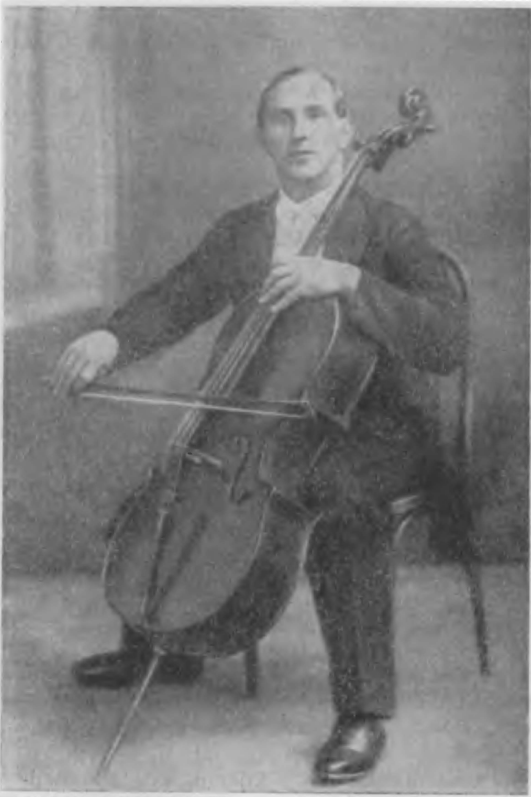
Leopold Rostropovich, a student of A. V. Verzhbilovich, was distinguished by his remarkable artistic talent. He was born on February 26, 1892, in Voronezh into a family of musicians. His father, who was also his first teacher, began teaching him piano as a young boy. Leopold also started learning the cello at an early age under the guidance of Alexander Lukinich (1875–1942), a Czech cellist living in Voronezh. Leopold progressed rapidly and began performing in concerts by the age of 12, showcasing his exceptional musical talent and outstanding performance skills.
In 1905, Rostropovich enrolled in the St. Petersburg Conservatory, studying cello under A. V. Verzhbilovich. He briefly took piano lessons from Anna Yesipova during this time. On November 15, 1905, the young cellist participated in a concert in St. Petersburg. A reviewer, impressed by his performance, advised him to focus on rigorous practice to further develop his undeniable abilities rather than frequent public performances.
During the following academic year, Rostropovich performed Saint-Saëns’ Cello Sonata and Glazunov’s Chant du ménestrel. His time in Verzhbilovich’s class greatly enhanced his artistry, particularly in expressive and heartfelt performances. Despite Verzhbilovich’s frequent illnesses, which limited instruction, Leopold’s natural talent and independent work drove his development. While still a conservatory student, he began teaching cello at N. M. Bystrov Music School (1907–1910), displaying early signs of independence in his pedagogical endeavors.
However, by his third year at the conservatory, Rostropovich’s attendance became irregular, a fact recalled vividly by fellow student A. A. Borisyak. He described Leopold as bursting into the classroom with vibrant enthusiasm only a few times per semester, often showcasing newly learned pieces or accompanying other students on piano, a skill he taught himself.
Despite his sporadic attendance, his talent was undeniable. In 1909, Verzhbilovich noted, “Talented, but unfortunately does not attend class and does nothing,” while A. K. Glazunov praised his “beautiful tone, talented phrasing, and excellent technical potential.” The following year, Rostropovich graduated with high honors, earning a gold medal and glowing evaluations from Glazunov, who described him as “a great virtuoso and a highly gifted musician.”
On May 9, 1910, Rostropovich performed Davidov’s Cello Concerto No. 3 at the conservatory’s final concert, impressing critics with his noble tone, flawless intonation, and elegant phrasing. A reviewer predicted that he would bring widespread recognition to his teacher’s legacy.
After graduating, Rostropovich gave several successful performances, including one in Moscow on October 10, 1910, and another in Warsaw on November 20, where he played works like Boëllmann’s Symphonic Variations. Critics highlighted his “full, noble tone,” “passionate temperament,” and “outstanding technical skill.” These performances solidified his reputation as a rising star in the cello world.
In early 1911, Rostropovich traveled to Paris to study with Pablo Casals. Fifty years later, Casals fondly remembered his Russian pupil in conversations with the author of this biography. During a January 1911 concert in Paris, Rostropovich performed works by Bach, Arensky, and Glazunov, captivating audiences and critics alike with his artistry. French, American, and British newspapers praised his impeccable technique, expressive phrasing, and youthful energy.
Rostropovich continued his successful concert career with notable performances in Warsaw and Łódź in March 1911, where he played Tchaikovsky’s Piano Trio with Barcewicz and Urstein and several solo pieces. Critics lauded his lyrical depth, virtuosic technique, and expressive playing.
On August 15, 1911, he returned to his hometown of Voronezh, where he gave a triumphant performance. Local newspapers proudly reported on the artistry of their native son. Rostropovich continued to perform in Voronezh in subsequent years, including a charity concert on November 14, 1912, which left audiences deeply moved.
After his concert on November 14, 1912, given “for the benefit of underprivileged students of the Real School,” a newspaper remarked on the “boundless artistic pleasure” provided by his performance. “The enchanting sounds of Mr. Rostropovich’s deeply expressive cello will long resonate in the memories of those who heard this talented artist yesterday,” concluded the review of that concert.
This concert was preceded by highly successful performances during the summer and autumn concert season in Yalta, where he frequently played with orchestral accompaniment. In August, he was the soloist in a concert conducted by A.K. Glazunov. Among the pieces Rostropovich performed were Davidov’s First Concerto, works by Bach, Tchaikovsky, Glazunov, Popper, and other composers. Contemporary critics expressed admiration for his musical phrasing, artistic taste, beautiful and powerful tone, and technical mastery.
At that time, L.V. Rostropovich’s repertoire included numerous classical works and many pieces by Russian composers. During the mentioned cello competition, he played Bach’s Second Suite, Romberg’s Fourth Concerto, Saint-Saëns’ Cello Concerto, Chopin-Glazunov’s Étude, and Davidov’s “At the Fountain.” Even critics who favored other contestants could not deny “the technical excellence and broad expressive range of a true stage artist,” acknowledging the 19-year-old’s accomplishments and placing him alongside the competition laureates.
The gifted cellist was warmly remembered by S.N. Vasilyenko, who conducted concerts in which Rostropovich was a soloist. Their joint performances took place in Rostov, Kazan, and other cities. Vasilyenko spoke of Rostropovich’s exceptional artistry, emotional depth, and expressive phrasing. Around that time, he also performed with Arthur Kapp in Astrakhan.
In 1913, Leopold Vitoldovich moved to St. Petersburg and began working in the orchestra of the Mariinsky Theater, occasionally appearing as a soloist. During the summer seasons, he frequently toured southern cities, where his concerts were highly successful. For instance, in 1916, he performed in Tiflis. P. Bebutov’s correspondence noted: “Cellist Leopold Rostropovich (a laureate of the St. Petersburg Conservatory) is performing in Tiflis for the first time. The young artist is a prominent figure due to his outstanding musical talent. I had the pleasure of hearing him perform Saint-Saëns’ concerto and a number of smaller works by Glazunov, Tchaikovsky, Popper, and Massenet. The artist demonstrated exceptional technique, a rich and singing tone, refined phrasing, and thoughtful interpretation. The young artist has already won the audience’s enthusiastic admiration.”
In 1915, Leopold Vitoldovich performed in Baku, playing Tchaikovsky’s “Pezzo Capriccioso” and other works. He also participated in a quartet with Piastro, Tesler, and Magaziner.
Rostropovich’s concert and pedagogical activities expanded significantly after the October Revolution of 1917. From 1918 to 1919 and again from 1923 to 1925, he worked in Saratov as a professor at the conservatory. In the early 1920s, he toured Voronezh, Penza, Orenburg, and other cities. In Orenburg, he married pianist S.N. Fedotova (a graduate of the Moscow Conservatory under K.N. Igumnov), who often accompanied him at the piano.
Rostropovich’s concerts were consistently successful, noted not only for their artistic execution but also for their thoughtfully curated programs. For example, at one concert in Voronezh, the first half featured Chopin’s works, while the second focused on Russian composers such as Tchaikovsky, Rachmaninoff, Glazunov, and Rebikov. Contemporaries recalled the elegance, nobility, and lyricism of his interpretations, a deep, velvety tone, and impeccable technique.
From 1925 to 1931, Rostropovich served as a professor at the Azerbaijan Conservatory, where one of his students was I.M. Turich. During this time, he frequently performed both as a soloist and as part of the Azerbaijan Conservatory Quartet. The quartet’s repertoire included classical masterpieces as well as new Soviet chamber music.
Rostropovich’s long musical career in Voronezh, Orenburg, Saratov, and Baku played an important educational role during the early development of Soviet musical culture. It is worth noting that in the 1930s, he worked as a concertmaster and soloist for symphony concerts in Slavyansk, Zaporizhia, and other cities.
In 1931, Rostropovich settled in Moscow, teaching cello at the Gnesin School and district music schools. Among his students was his son Slava (Mstislav), who studied with him from the age of eight until entering the conservatory.
In 1935, Leopold Vitoldovich was awarded the title of Honored Artist of the RSFSR for his exceptional artistry and contributions to Soviet musical culture. He occasionally performed as a chamber musician and soloist. In the 1930s, he gave a recital in the Small Hall of the Moscow Conservatory with K.N. Igumnov. Their poetic and kindred interpretations brought out the beauty of sonatas by Chopin and Grieg.
Rostropovich was particularly renowned for his interpretation of Chopin’s Sonata. In a letter from Paris in the 1930s, A.K. Glazunov praised Rostropovich’s performance of this sonata.
In the same concert, Rostropovich played works by Schumann, Fauré, Caplet, Cassadó, and others with pianist G.I. Romanovsky. During this period, he also performed at a concert in Moscow dedicated to Tchaikovsky, where he excelled in the “Variations on a Rococo Theme” and joined M. Meychik and B. Sibor in Tchaikovsky’s trio “In Memory of a Great Artist.”
Rostropovich also performed his own compositions, demonstrating his remarkable talent as a musician. For example, in 1933, he performed his classical suite for solo cello, including a Prelude, Courante, and Sarabande, alongside works by Tchaikovsky, Rachmaninoff, Scriabin, and others.
In 1941, on the eve of his 50th birthday and the 30th anniversary of his artistic and pedagogical career, prominent Soviet musicians praised his contributions to Soviet musical culture. However, the outbreak of war and his untimely death cut short the celebrations.
Evacuated to Orenburg during the war, Leopold Vitoldovich, though unwell, continued teaching and occasionally performed in concerts, including for wounded soldiers. In April 1942, he played the first movement of his son’s cello concerto, accompanied by Slava on piano. On July 31 of that year, Leopold Vitoldovich passed away.
In the obituary by M.I. Chulaki, B.E. Khaykin, and R.V. Glazer, other musicians who knew Rostropovich well wrote about him as "one of the most outstanding representatives of the Russian cello school," "a highly gifted performer, composer, and teacher, a compassionate person, and a wonderful friend."
Among Leopold Vitoldovich's manuscripts are four cello concertos, one piano concerto, a piano trio, a suite for solo cello, pieces for cello and piano, romances, and other works. Some of these undoubtedly deserve publication in our time.
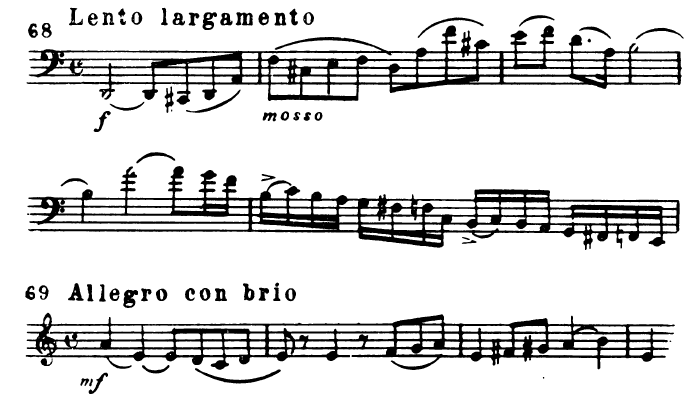
The romantic intensity of his First Concerto is evident in both the introductory recitative, which has a passionate character, and the main theme of the Allegro con brio:
Additionally, L.V. Rostropovich created a number of cello arrangements, including transcriptions of some Chopin études for solo cello and Prokofiev's Gavotte for cello and piano.