I. Introduction
- Contrary to the popular belief that the major mode originated from the Ionian mode and the minor mode from the Aeolian mode, both modes have roots in the Dorian mode, arguably the most commonly used mode in the Renaissance and early Baroque eras.
II. The Role of the Dorian Mode
- Dorian Dominance: The Dorian mode was highly influential and frequently employed in sacred and secular music.
-
Importance of Accidentals:
- F# (Picardy Third): The sharp on F, leading to the major third in cadences, was commonly used in Dorian music.
- B-flat: Flattening the B smoothed the voice leading down to A.
- F# (Picardy Third): The sharp on F, leading to the major third in cadences, was commonly used in Dorian music.
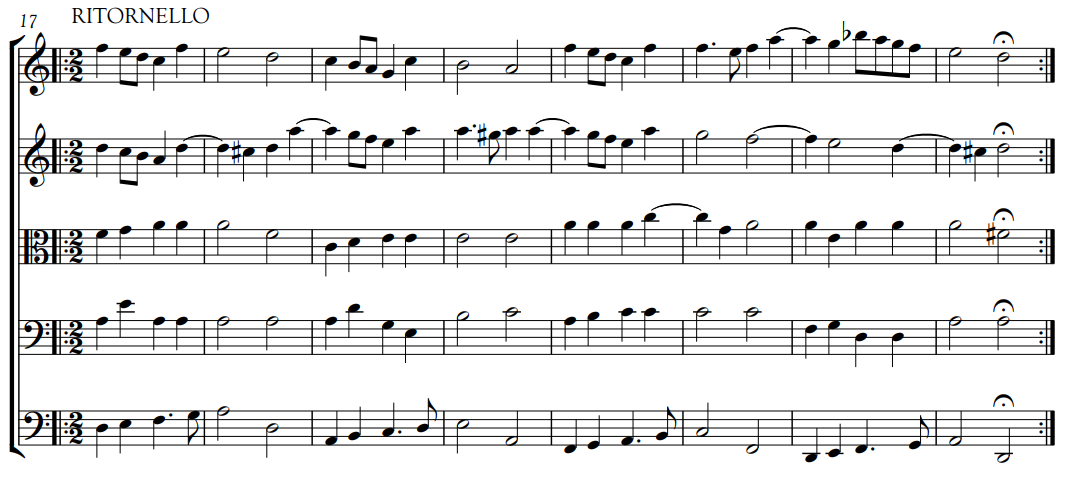
Monteverdi, L'Orfeo
III. Influence on Major and Minor Modes
-
Major Mode Development:
- The introduction of F# in Dorian music (on D) led to the eventual adoption of this accidental in key signatures, contributing to the development of the major mode.
- Key signatures often appear to be "missing" one sharp in earlier music (e.g., A major with two sharps, E major with three sharps) due to this historical transition.
- The introduction of F# in Dorian music (on D) led to the eventual adoption of this accidental in key signatures, contributing to the development of the major mode.
-
Minor Mode Development:
- The flattening of B led to the early forms of the minor mode.
- In early music, key signatures often lacked this accidental, resulting in pieces where D minor had no key signature, G minor had one flat, and so on.
- The flattening of B led to the early forms of the minor mode.
IV. Language and Notation
-
Evolution of Accidentals:
- The flat symbol's resemblance to a lowercase "B" is not an accident. The term "bemolle" (soft B) contrasts with "duro" (hard), reflecting this development.
- German terminology still reflects this historical practice with "Dur" (major) and "Moll" (minor) in mode naming conventions.
- The flat symbol's resemblance to a lowercase "B" is not an accident. The term "bemolle" (soft B) contrasts with "duro" (hard), reflecting this development.
V. Historical Examples
-
Early editions of Bach, Corelli, and Vivaldi’s works demonstrate this transition, with key signatures that appear incomplete by modern standards but reflect Dorian influences.
- For example, A major written with two sharps and E major with three sharps, with the seventh scale degree altered by an accidental rather than the key signature. Same with minor keys lacking one flat.
- For example, A major written with two sharps and E major with three sharps, with the seventh scale degree altered by an accidental rather than the key signature. Same with minor keys lacking one flat.
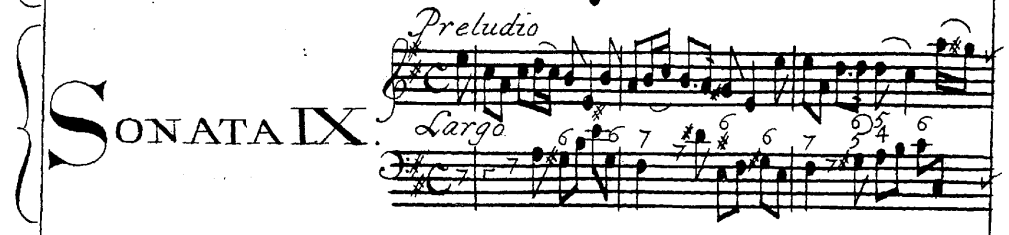
Corelli, Violin Sonata in A major, Op. 5, No. 9

Bach, Violin Sonata in G minor, BWV 1001